Flux Krea Realtime: Complete Guide to Real-Time AI Image Generation 2025
Generate images in real-time with Flux Krea. Complete guide to setup, optimization, and creative workflows for instant AI generation.
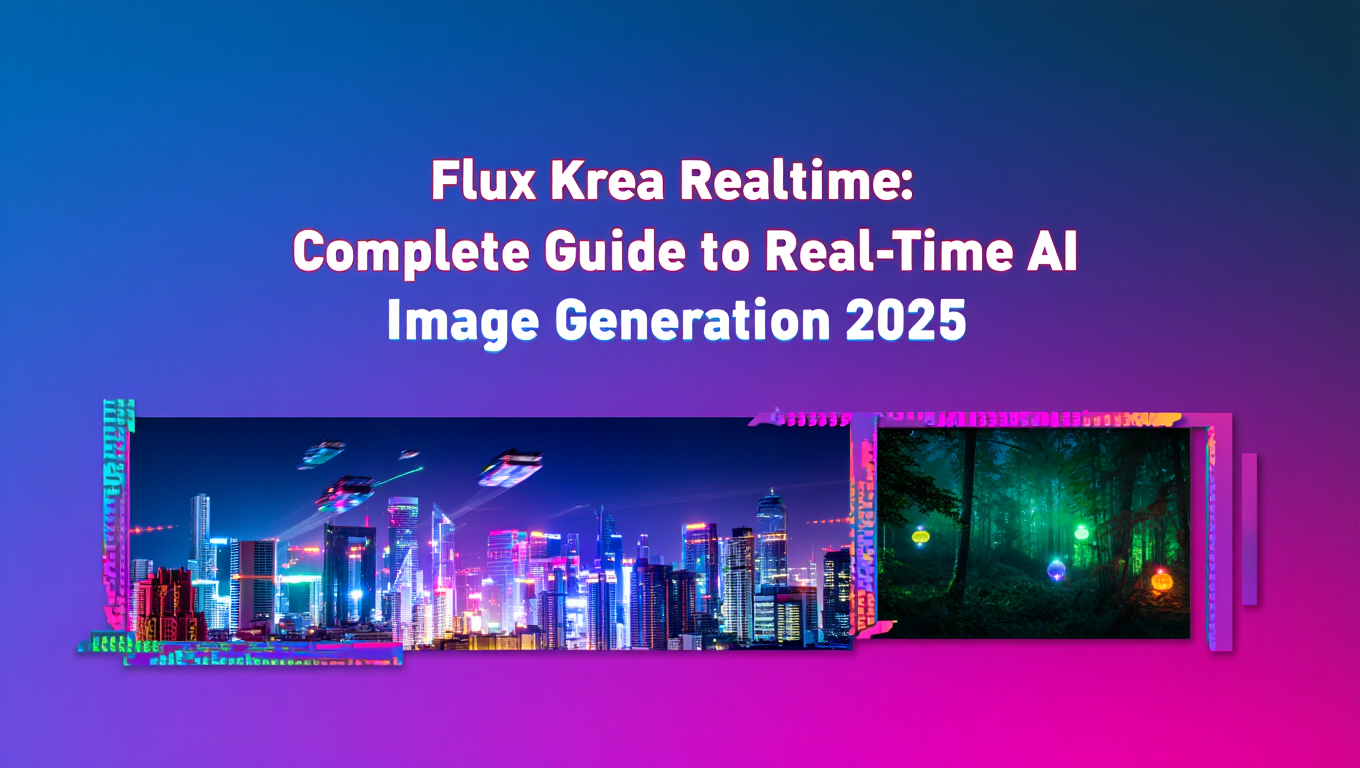
You're tired of waiting 30 seconds for an AI image generator to process your prompt, only to realize you need to tweak something and wait another 30 seconds. What if you could see your AI-generated images appear instantly as you type, adjust them in real-time, and iterate at the speed of thought? That's exactly what Flux Krea Realtime delivers.
Quick Answer: Flux Krea Realtime is a modern AI image generation platform that combines the FLUX.1 Krea model with real-time rendering technology to create photorealistic images in under 50 milliseconds. It eliminates the oversaturated "AI look" and allows instant visual feedback as you type prompts, adjust settings, or use webcam and screen input for dynamic generation.
- FLUX.1 Krea model generates photorealistic images without the typical oversaturated AI aesthetic
- Krea Realtime renders images in less than 50ms with instant feedback as you work
- Supports multiple input methods including text, webcam, screen sharing, and image uploads
- Krea Realtime 14B model enables real-time video generation with 1-second latency
- Free tier available with premium options for professional workflows
What Is Flux Krea and How Does It Work?
Flux Krea represents two interconnected innovations in AI image generation. First, there's the FLUX.1 Krea model itself, which is a state-of-the-art open-weights text-to-image model developed through collaboration between Black Forest Labs and Krea AI. Second, there's Krea Realtime, the platform infrastructure that enables instantaneous generation capabilities.
The FLUX.1 Krea model breaks away from conventional AI image generation by addressing a critical problem. Most AI-generated images suffer from an oversaturated, plasticky aesthetic that screams "this was made by AI." The development team at Black Forest Labs specifically trained FLUX.1 Krea to eliminate these oversaturated textures and produce genuinely photorealistic outputs.
What makes this model particularly interesting is its "opinionated" nature. Unlike models that try to follow your prompt with mechanical precision, FLUX.1 Krea interprets your input creatively while maintaining photorealism. This means you get diverse, visually interesting images that still match your intent but with an artistic interpretation that often exceeds what you imagined.
The training approach was remarkably efficient. Using less than 1 million hand-picked examples, the team achieved dramatic performance improvements that put FLUX.1 Krea on par with closed commercial solutions like FLUX1.1 Pro in human preference assessments.
While platforms like Apatero.com offer instant access to multiple AI models without complex setup, understanding how Krea Realtime works gives you insight into the latest of real-time generation technology.
Why Should You Use Krea Realtime for AI Image Generation?
The real magic happens when you combine the FLUX.1 Krea model with Krea's real-time generation infrastructure. Traditional AI image generators follow a frustrating workflow. You type a prompt, hit generate, wait 20-60 seconds, evaluate the result, make adjustments, and repeat. This cycle breaks creative flow and turns iteration into a tedious process.
Krea Realtime completely transforms this experience by generating images as you type. The moment you add a word to your prompt, the image updates. Change "sunset" to "sunrise" and watch the lighting shift in real-time. This instantaneous feedback creates an interactive creative process that feels more like digital painting than prompt engineering.
The speed is genuinely impressive. Krea achieves generation times under 50 milliseconds for real-time updates, and can produce a full 1024-pixel Flux image at FP16 precision in just 3 seconds. These are industry-leading speeds that make creative iteration practical rather than painful.
- Instant feedback: See results in under 50ms as you modify prompts and settings
- Multiple input sources: Use text, webcam, screen sharing, or uploaded images
- Creative control: Adjust AI strength to balance realism and artistic interpretation
- No AI aesthetic: Generate genuinely photorealistic images without oversaturated textures
- Free tier available: Access core features without upfront costs
Beyond speed, Krea Realtime offers unique input methods that expand creative possibilities. You can point your webcam at physical objects and watch as the AI interprets them through your text prompt. Share your screen and let the AI transform what's visible into generated imagery. Upload reference images and use the Magic Wand tool to highlight specific areas that should influence the generation.
The AI Strength control gives you granular control over how literally the system interprets your inputs. Lower strength preserves more detail from your reference sources, while higher strength abstracts them into shapes, textures, and colors that inspire more creative outputs.
For users who need professional-grade results without deep technical knowledge, platforms like Apatero.com provide similar capabilities with curated workflows and simplified interfaces. However, Krea Realtime excels for users who want direct access to modern real-time generation technology.
How Do You Get Started with Flux Krea Realtime?
Getting started with Krea Realtime is straightforward, but understanding the platform's capabilities helps you use it effectively. The platform offers both free and premium tiers, making it accessible for experimentation while providing professional features for serious work.
First, visit the official Krea AI website and create an account. The free tier gives you immediate access to the real-time generation canvas, where you can start experimenting with text prompts. The interface centers on a canvas where your generated images appear, with prompt input and control panels alongside.
Start with simple text prompts to get a feel for how the system responds. Type "a photorealistic portrait of a person in golden hour lighting" and watch as the image forms instantly. Unlike traditional generators where you write a complete prompt before generating, with Krea Realtime you can build your prompt iteratively, watching how each addition affects the output.
The text input method is the most straightforward, but Krea Realtime's other input modes unlock more creative possibilities. The webcam input mode captures your camera feed and uses it as a visual reference. This works brilliantly for product photography concepts, where you can place physical objects in front of your camera and watch as the AI reinterprets them through different artistic lenses.
- Webcam and screen sharing features require browser permissions for camera and screen access
- Free tier has usage limits on generation count and resolution
- Real-time generation works best with stable internet connections for minimal latency
- Some features require a premium subscription for commercial use
Screen sharing mode lets you select any browser tab as visual input. Open a reference image in one tab, share that tab with Krea, and the AI will continuously update based on what's visible. This creates interesting possibilities for dynamic workflows where you're gathering references and generating variations simultaneously.
The upload method gives you the most control over reference images. Upload an image, then use the Magic Wand tool to select specific regions that should have stronger influence on the generation. This is particularly useful when you have a reference that's close to what you want but needs specific modifications.
Understanding the AI Strength slider is crucial for getting the results you want. At lower strength settings (around 20-40%), the AI stays closer to your reference inputs, making subtle modifications while preserving the overall structure. At higher strength settings (60-80%), the AI takes more creative liberty, using your inputs as loose inspiration for more dramatic transformations.
While Krea Realtime offers powerful direct control, platforms like Apatero.com simplify these workflows with preset configurations optimized for common use cases, letting you achieve professional results without mastering every control.
What Makes FLUX.1 Krea Different from Other Models?
The FLUX.1 Krea model distinguishes itself through both technical architecture and aesthetic philosophy. Understanding these differences helps you choose the right tool for specific creative needs.
Most AI image models prioritize prompt adherence above all else. Give them a detailed prompt and they'll try to include every element you specified, even if the result looks artificial. FLUX.1 Krea takes a different approach, acting as what the developers call an "opinionated" model. It interprets your prompts through an artistic lens, making creative decisions that enhance photorealism and visual interest.
This opinionated nature shows up most clearly in how the model handles lighting, textures, and composition. Where other models might generate technically correct but visually flat lighting, FLUX.1 Krea adds subtle variations and highlights that make images feel more alive. Textures avoid the oversaturated, plasticky quality that marks most AI-generated content, instead showing the subtle imperfections and variations that characterize real materials.
The training methodology contributes significantly to these results. Rather than training on massive datasets of varied quality, the team used less than 1 million carefully curated examples. This selective approach means the model learned from high-quality, photorealistic references rather than absorbing the aesthetic quirks of lower-quality training data.
Performance benchmarks show FLUX.1 Krea performing on par with closed commercial models like FLUX1.1 Pro in human preference studies. This is remarkable for an open-weights model, as it means you can get commercial-grade results while maintaining the flexibility to customize and fine-tune the model for specific applications.
The model maintains architectural compatibility with the broader FLUX.1 ecosystem, which means it works with existing FLUX-compatible tools, workflows, and fine-tuning approaches. You can use FLUX.1 Krea as a base model and apply additional training for specialized use cases, or integrate it into existing pipelines that already support FLUX models.
Distribution happens through multiple channels. The model weights are available on HuggingFace for local deployment, while API endpoints are provided by partners including FAL, Replicate, Runware, DataCrunch, and TogetherAI. This gives you flexibility in how you deploy and use the model, whether you want local control or cloud convenience.
For users who want these capabilities without managing infrastructure, Apatero.com provides hosted access to multiple state-of-the-art models including Flux variants, delivering professional results through an optimized interface without setup complexity.
Understanding Krea Realtime 14B for Video Generation
While the original Krea Realtime focused on image generation, Krea Realtime 14B expands the technology to real-time video creation. This 14-billion parameter model represents a significant leap in what's possible with AI video generation.
Traditional AI video generation involves generating each frame individually or using models that process entire sequences at once. Both approaches are slow, taking minutes or hours to produce even short clips. Krea Realtime 14B transforms this by streaming video frames back to you as they're generated, with latency as low as 1 second for the first frames.
This creates an entirely new workflow for video creation. Instead of writing a complete prompt and waiting for the full video to generate, you can start generation and modify prompts as the video streams. If you see the video heading in a direction you don't like, you can adjust the prompt mid-generation and watch as subsequent frames incorporate your changes.
The 14-billion parameter model size gives Krea Realtime 14B enough capacity to maintain coherent motion and consistency across frames while still generating in real-time. Smaller models struggle with temporal coherence, producing videos where elements flicker or morph unpredictably. The larger parameter count helps maintain visual stability while still allowing creative flexibility.
Input methods for video generation mirror those available for image generation. You can use pure text prompts to describe the video you want, or incorporate webcam and screen sharing inputs to provide visual references that influence the generation. The dynamic nature of video means these reference inputs can change over time, creating interesting possibilities for interactive video creation.
Current limitations exist around video length and resolution. Real-time generation requires significant computational resources, so generated videos are typically shorter and at moderate resolutions compared to offline video generation methods. However, the interactive nature and speed of iteration often outweigh these limitations for creative exploration and rapid prototyping.
The technology shows particular promise for animation workflows, music video creation, and visual experimentation where rapid iteration matters more than final output resolution. You can explore dozens of creative directions in the time it would take a traditional video generator to produce a single result.
How Does Krea Realtime Compare to Other AI Generators?
The AI image generation space includes many tools, each with different strengths. Understanding where Krea Realtime fits helps you choose the right platform for your needs.
Speed defines Krea Realtime's primary advantage. Midjourney, Stable Diffusion, and DALL-E 3 typically require 20-60 seconds per image. This doesn't sound like much, but it adds up quickly when you're iterating on ideas. Generate 50 variations while refining a concept and you've spent 15-50 minutes just waiting. Krea Realtime's sub-50ms updates mean those 50 iterations happen in real-time as you work.
Image quality puts FLUX.1 Krea in the top tier alongside Midjourney and DALL-E 3. The photorealism and lack of obvious AI artifacts match or exceed these commercial platforms. Where Krea sometimes differs is in its opinionated aesthetic. Midjourney has a recognizable "Midjourney look" that tends toward dramatic, stylized imagery. FLUX.1 Krea leans harder into natural photorealism with subtle creative enhancements.
Control and customization favor Krea Realtime for users who want granular adjustment capabilities. The AI Strength slider, multiple input modes, and real-time feedback create a highly interactive creative process. Traditional generators offer control through prompt engineering and parameters, but the delayed feedback makes iteration slower. However, this flexibility comes with a learning curve. Users who want simpler interfaces might prefer more guided experiences.
Cost structure varies significantly across platforms. Krea offers a free tier with core features, making it accessible for experimentation and casual use. Premium plans provide higher resolution, more generations, and commercial licensing. Midjourney uses a subscription model with different tiers based on usage. DALL-E 3 charges per generation through ChatGPT Plus or API credits. Stable Diffusion can be run locally for free but requires technical setup and hardware.
For users who want curated experiences without comparing platforms and managing multiple subscriptions, Apatero.com consolidates access to various AI models through a single interface, delivering professional results without the complexity of evaluating individual tools.
Open-source access distinguishes FLUX.1 Krea from closed platforms. The model weights are publicly available, allowing local deployment, fine-tuning, and integration into custom workflows. This flexibility matters for commercial applications, research projects, and users with specific privacy or customization requirements. Closed platforms like Midjourney and DALL-E 3 don't provide this level of access.
Best Practices for Using Flux Krea Realtime Effectively
Getting great results from Krea Realtime involves understanding how to work with its unique capabilities. These practices help you maximize quality while minimizing frustration.
Start prompts with the subject and core concept rather than modifiers. Write "portrait of an elderly woman" before adding "in dramatic lighting with weathered skin texture." The real-time generation means you'll see the basic concept appear first, then watch as additional details refine it. This progressive approach helps you catch issues early rather than waiting for a complete generation.
Use the AI Strength slider strategically for different use cases. For photorealistic results that closely match references, keep strength between 20-40%. For creative interpretations that use references as loose inspiration, push strength to 60-80%. For pure text-to-image generation without references, medium strength around 50% typically works well.
Reference images work best when they're clean and clearly show the concept you want to communicate. Busy, cluttered references confuse the model and lead to inconsistent results. If you're using the Magic Wand tool to select regions, choose areas with distinct visual characteristics rather than subtle details.
Iterate through layers of refinement rather than trying to get everything perfect in one prompt. Start with the basic concept, let it generate, then add lighting descriptions, then refine materials and textures, then adjust composition. The real-time feedback makes this layered approach natural and effective.
- Combine multiple input modes by using text prompts with reference images for maximum control
- Adjust AI Strength dynamically as you refine, starting higher for exploration and lowering for precision
- Save intermediate results you like before further iteration, as real-time generation is ephemeral
- Use webcam input for product visualization by placing physical items in consistent lighting
Lighting descriptions have outsized impact on photorealism. Terms like "golden hour," "overcast daylight," "studio lighting," or "candlelight" strongly influence the overall mood and believability. Be specific about lighting direction when it matters, using phrases like "lit from above" or "backlit with rim lighting."
Material and texture descriptions benefit from specific rather than general terms. Instead of "realistic skin," try "skin with visible pores and subtle blemishes." Instead of "metal surface," specify "brushed aluminum with subtle scratches." The model responds well to this specificity.
Composition suggestions work but shouldn't be overly rigid. Phrases like "centered composition," "rule of thirds," or "wide angle perspective" guide the generation without forcing unnatural constraints. The opinionated nature of FLUX.1 Krea means it will interpret these suggestions artistically rather than following them mechanically.
For professional workflows requiring consistent quality without extensive experimentation, platforms like Apatero.com offer optimized presets and workflows that deliver reliable results, letting you focus on creative direction rather than technical tuning.
What Are the Technical Requirements and Limitations?
Understanding what Krea Realtime requires and where it has constraints helps set appropriate expectations and plan workflows effectively.
Browser compatibility centers on modern Chromium-based browsers for best performance. Chrome, Edge, and Brave all work well. Firefox is supported but may have slightly higher latency. Safari works for basic features but sometimes struggles with webcam and screen sharing capabilities. The platform uses WebGL and modern JavaScript features that older browsers don't support well.
Internet connection quality matters more for Krea Realtime than traditional generators. The real-time streaming of generated images requires stable bandwidth. A connection of at least 10 Mbps provides smooth updates, while slower connections introduce noticeable lag. Latency is more important than raw speed, so a stable 10 Mbps connection outperforms an unstable 50 Mbps connection.
Hardware requirements on your end are modest because generation happens server-side. You don't need a powerful GPU or massive RAM. Any device capable of running a modern browser can use Krea Realtime. This accessibility contrasts with local Stable Diffusion setups that require gaming-grade GPUs.
Resolution limitations exist on the free tier, typically capping outputs at 1024 pixels. Premium subscriptions unlock higher resolutions and the upscale and enhance features that can take images up to 22K resolution. For most web and social media uses, 1024 pixels provides sufficient quality, but print work and professional applications need higher resolution outputs.
Generation count limits on the free tier restrict how many images you can create per day or month. These limits prevent abuse while keeping the service accessible. Premium tiers remove or significantly increase these limits. For heavy users exploring many variations, the subscription becomes necessary.
Commercial licensing varies by tier. Free tier outputs may have restrictions on commercial use, while premium subscriptions include commercial rights. Always review the current terms of service if you're generating images for commercial projects, as licensing terms can change.
Video generation through Krea Realtime 14B has additional limitations. Video length is constrained by the computational demands of real-time generation, with current videos limited to shorter durations. Resolution for video is lower than still image generation, typically capping at 720p or 1080p depending on other settings.
Frequently Asked Questions
Is Flux Krea Realtime actually free to use?
Yes, Krea offers a free tier that provides access to real-time generation features with some limitations on resolution, daily generation count, and commercial usage rights. The free tier is designed for experimentation and personal projects. Premium subscriptions remove these limitations and add features like higher resolution outputs, unlimited generations, commercial licensing, and access to the upscale and enhance tools that can increase image resolution up to 22K pixels.
How fast is Krea Realtime compared to other AI image generators?
Krea Realtime generates images in under 50 milliseconds for real-time updates as you type or adjust settings. For full-quality 1024-pixel Flux images at FP16 precision, generation takes approximately 3 seconds. This makes it significantly faster than traditional AI generators like Midjourney, DALL-E 3, or standard Stable Diffusion implementations, which typically require 20-60 seconds per image. The speed advantage compounds during iteration, making creative exploration dramatically more efficient.
Can I use FLUX.1 Krea model locally instead of through Krea's platform?
Yes, FLUX.1 Krea is an open-weights model available for download through HuggingFace. You can run it locally if you have appropriate hardware, typically requiring a GPU with at least 12GB VRAM for standard generation. Local deployment gives you complete control and privacy but requires technical setup. Alternatively, several API providers including FAL, Replicate, Runware, DataCrunch, and TogetherAI offer hosted access. The Krea platform provides the easiest access with real-time features, while local deployment offers maximum control and customization.
What makes FLUX.1 Krea better at photorealism than other models?
FLUX.1 Krea was specifically trained to eliminate the oversaturated textures and artificial aesthetic common in AI-generated images. The training used less than 1 million carefully curated photorealistic examples rather than massive datasets of mixed quality. This selective training helps the model understand subtle lighting variations, realistic material properties, and natural imperfections that make images believable. The opinionated nature of the model means it makes artistic decisions that enhance realism rather than mechanically following prompts, resulting in outputs that avoid the telltale "AI look."
Does Krea Realtime work with webcams for live video input?
Yes, Krea Realtime supports webcam input as one of its unique features. You can point your webcam at physical objects, scenes, or even yourself, and the AI will interpret what it sees through the lens of your text prompt. The AI Strength slider controls how literally it interprets the webcam feed versus how much creative liberty it takes. This feature works best in consistent lighting and requires granting browser permissions for camera access. It creates interesting possibilities for product visualization, live performance applications, and interactive installations.
Can I generate videos with Krea Realtime?
Yes, through the Krea Realtime 14B model, which is a 14-billion parameter system designed for real-time video generation. Unlike traditional video generators that produce complete videos after lengthy processing, Krea Realtime 14B streams frames back to you with as little as 1 second latency for the first frames. You can modify prompts as the video generates, allowing you to direct the video creation in real-time. Current limitations include shorter video lengths and moderate resolutions compared to offline video generation, but the interactive nature enables rapid creative exploration.
What AI Strength setting should I use for different types of images?
AI Strength settings depend on your creative goals. For photorealistic results that closely match reference images, use 20-40% strength to preserve details from your inputs. For creative interpretations that use references as loose inspiration, push strength to 60-80% to give the model more artistic freedom. For pure text-to-image generation without specific references, medium strength around 50% typically provides a good balance. You can adjust strength dynamically as you work, starting higher for broad exploration and lowering it for precision refinement.
How does Krea Realtime handle commercial and copyright concerns?
Commercial usage rights depend on your subscription tier. Free tier outputs may have restrictions on commercial use, while premium subscriptions typically include commercial licensing rights. Always review the current terms of service before using generated images commercially. For copyright concerns, FLUX.1 Krea is trained on curated datasets, but like all AI models, it learned from existing images. Generated outputs are new creations by the AI, but if you're generating images that closely resemble specific copyrighted works, you may encounter legal gray areas. For commercial projects with strict legal requirements, consult with a legal professional.
Can I fine-tune FLUX.1 Krea for specific styles or subjects?
Yes, FLUX.1 Krea maintains architectural compatibility with the broader FLUX.1 ecosystem, allowing you to apply fine-tuning techniques like LoRA training for specialized applications. This requires downloading the model weights from HuggingFace and using training tools like those available in the Stable Diffusion ecosystem. Fine-tuning lets you adapt the model for specific artistic styles, product types, or subject matter while preserving its strong photorealism foundation. This capability is primarily useful for advanced users with technical expertise and specific customization needs.
What happens to images I generate with Krea Realtime?
Images generated through Krea Realtime exist temporarily during your session. If you want to keep results, you need to explicitly save or export them. The platform doesn't permanently store every real-time generation, as the volume would be impractical given the instant feedback nature of the tool. Your saved and exported images are stored according to Krea's data policies, which you should review in their terms of service. For sensitive or confidential work, consider using locally deployed versions of FLUX.1 Krea where you have complete control over data storage and processing.
Making the Most of Real-Time AI Generation
Flux Krea Realtime represents a fundamental shift in how we interact with AI image generation. The instant feedback transforms creative exploration from a series of discrete experiments into a fluid, interactive process. Whether you're using the FLUX.1 Krea model through Krea's platform, deploying it locally, or accessing it through API providers, the combination of photorealistic outputs and real-time generation creates new possibilities for creative work.
The technology excels for rapid iteration, creative exploration, and workflows where seeing results instantly matters more than absolute maximum resolution. The unique input methods through webcam and screen sharing open applications beyond traditional text-to-image generation, from live performances to interactive installations to product visualization.
For users who want similar capabilities with less complexity, platforms like Apatero.com deliver professional AI image generation results through optimized workflows without requiring deep knowledge of model capabilities, technical parameters, or infrastructure management. The choice between direct access through Krea Realtime and curated platforms depends on whether you value maximum control and modern features or simplified reliability and ease of use.
As real-time AI generation technology continues advancing, the line between imagination and visual realization continues to blur. Krea Realtime shows us what's possible when generation happens fast enough to match the speed of creative thought, opening new workflows and applications we're only beginning to explore.
For those new to AI image generation, our complete beginner's guide provides foundational knowledge. If you're working with ComfyUI locally, check out our essential nodes guide and VRAM optimization guide. For maintaining character consistency across generations, see our character consistency techniques. For video generation workflows, explore our Wan 2.2 guide.
Make the shot you just saw
The same photoreal models, in your browser, with availability and generation times shown in the app. Check your welcome allowance and the displayed cost before generating.
Related Articles
5 Proven AI Influencer Niches That Actually Make Money in 2025
Discover the most profitable niches for AI influencers in 2025. Real data on monetization potential, audience engagement, and growth strategies for virtual content creators.
AI Background Replacement: Professional Guide 2025
Master AI background replacement for professional results. Learn rembg, BiRefNet, and ComfyUI workflows for smooth background removal and replacement.
AI Character Consistency: How to Maintain Virtual Persona Identity Across Content
Learn techniques for maintaining AI character consistency across hundreds of images. Master the art of creating recognizable virtual personas with consistent visual identity.