Recraft V4 vs Ideogram 3: Best AI Tool for Graphic Design 2026
Recraft outputs true SVG and brand kits. Ideogram nails text. We tested both on 30 real design briefs and a clear winner emerged per use case.
Make AI images and video in your browser
Characters, video, photo packs. No GPU, no setup. Your first generation is free.
I've been running design work for clients with AI tools for about two years now, and Recraft V4 vs Ideogram 3 is the comparison that comes up every single time a designer or marketing team needs to pick a tool for graphic design specifically. Both companies are marketing themselves to designers. Both produce excellent output. Both cost roughly the same money. So which one wins.
Here is the short version. They are not actually competing for the same job. Recraft V4 is a vector and brand asset tool that happens to render raster. Ideogram 3 is a typography accuracy tool that happens to do general image generation. When you frame them that way, the right answer becomes obvious for any given project, and the obsession with picking "the winner" stops mattering.
I ran 30 real design briefs through both tools across logo work, brand assets, posters, social tiles, and packaging mockups. Here is what actually happens in production.
- Recraft V4 is the only major AI image tool that exports true editable SVG vector files in 2026
- Ideogram 3 hits over 75 percent text accuracy on first generation, the highest of any major model
- Recraft tops the HuggingFace logo generation benchmarks, especially for brand mark consistency
- Ideogram outputs raster only, so SVG needs a separate vectorization pass if vector is required
- Recraft brand kit feature locks color palette, typography, and style across an entire campaign
- Pricing per final-delivery asset is roughly comparable, both tools sit at $0.15 to $0.30 per usable asset
The Vector vs Raster Divide in 2026 AI Design Tools
Real talk, the most important fact about AI design tools in 2026 is that almost all of them produce raster output. PNG. JPG. WebP. Pixels arranged in a grid. That is fine for social media graphics and ad creatives because the platforms accept raster. It is a deal-breaker for logo design, app icons, scalable brand assets, and anything that needs to be printed at multiple sizes.
Vector output is fundamentally different. SVG files describe shapes as mathematical paths rather than pixel grids. A vector logo scales infinitely without losing quality. A raster logo at 512x512 looks terrible printed at billboard size unless you upscale it through an AI upscaler and then accept that the lines will not be perfectly crisp.
Recraft V4 broke the AI image generation field in late 2025 by being the only major tool to export native editable SVG. According to WaveSpeedAI's coverage of Recraft V4, Recraft tops the HuggingFace benchmarks for logo generation, and the SVG export pipeline is what cemented its position with designers.
Here is what nobody tells you. Most AI tools that claim "vector output" are actually rasterizing the image and then running it through a tracing algorithm. The result is technically an SVG file but it contains thousands of tiny path segments because the trace had to approximate the raster grid. Real SVG generation produces clean paths with a small number of intentional shapes, like a human designer would produce. Recraft V4 is the first model I have tested that actually does the second thing.
Recraft V4 Architecture and the SVG Export Pipeline
Recraft V4's architecture is interesting because it is fundamentally different from the diffusion-on-pixels approach of Flux 2 or Midjourney. Recraft V4 generates the image in a vector-aware representation and then either rasterizes it for PNG output or exports the vector representation directly as SVG.
What this means in practice. When I run a logo prompt through Recraft V4 ("minimalist logo for a coffee shop called Olivetta, modern Italian aesthetic"), I get back a vector file with clean, editable paths. I can open it in Illustrator, change the colors, adjust the kerning, scale it to billboard size. The paths are intentional. Same logo through Ideogram 3 produces a beautiful raster image that I would have to either trace manually or send through a vectorizer plugin like Vectorizer.ai to convert.
Recraft V4 also added a "Brand Kit" feature in 2026 that locks color palette, font choices, and overall aesthetic across multiple generations. You upload your brand colors and a sample logo, and subsequent generations stay on-brand. For agencies producing 12-asset campaign packages, this is meaningful. I tested the brand kit feature on a fictional fitness brand campaign and the 12 assets had remarkable visual consistency without needing manual color correction.
Where Recraft V4 falls down. The aesthetic is clean and modern by default, which is right for most brand work and wrong for editorial or moody concept art. Text rendering inside images is decent but not Ideogram-level (Recraft hits about 58 percent text accuracy versus Ideogram's 75 percent). And the SVG export quality varies by prompt complexity. Simple logos and icons produce clean vectors. Complex illustrations sometimes produce SVGs with hundreds of path segments that need manual cleanup in Illustrator.
For pure vector and brand work in 2026, Recraft V4 is the answer. There is no real competitor. According to Maginary's 2026 comparison, Recraft V4 is the only image generation model that produces true vector output. That is a structural advantage that no other AI tool has matched yet.
Ideogram 3 Typography Accuracy on Long-Form Text
Ideogram 3 wins typography accuracy outright in 2026. Across the 25 typography-heavy prompts I tested, Ideogram 3 hit over 75 percent correct text on first generation. Recraft V4 hit 58 percent. GPT Image 2 hit 65 percent. Midjourney V8 hit 41 percent. Nothing else came close.
Why is this such a big deal. Look, in 2026 every solo creator and marketing team needs assets with text inside images. Ad creatives. Pinterest tiles. YouTube thumbnails. Quote cards. Event posters. Product packaging mockups. If your AI tool cannot reliably write the text you want, you spend hours iterating or doing the text overlay in Photoshop after the fact. Both are worse than getting it right on generation one.
The Ideogram 3 model has been specifically trained to render typography accurately, and the gap shows. I tested with prompts like "vintage diner sign neon glow OPEN 24 HOURS, retro Americana aesthetic." Ideogram 3 nailed the exact text on the first try. Recraft V4 produced a beautiful image but spelled it "OPEN 24 HOORS" on first try. Midjourney V8 produced something gorgeous that read "OPN 24 HOURS" with a missing letter.
Where Ideogram 3 falls down. No native vector output. Aesthetic quality is good but not Midjourney-level. The model is less consistent across long brand campaigns than Recraft (no brand kit equivalent). And the API pricing is reasonable but not the cheapest in the field at around $0.05 to $0.08 per image.
For raster designs where text accuracy matters, Ideogram 3 is the answer in 2026. The deeper Ideogram comparison against Midjourney and Firefly is in Adobe Firefly vs Midjourney vs Ideogram 2026.
Logo Brief Test: 12 Industries, Same Prompt, Real Designer Vote
I ran the same logo prompt structure across 12 different industries through both Recraft V4 and Ideogram 3. The structure was "minimalist logo for [BUSINESS], [INDUSTRY-SPECIFIC AESTHETIC], modern clean lines." Then I gathered three working designers I know and ran a blind vote on which logo would be production-ready with the least cleanup work.
Free ComfyUI Workflows
Find free, open-source ComfyUI workflows for techniques in this article. Open source is strong.
The 12 industries: coffee shop, law firm, tech startup, fitness brand, sustainable fashion, dental clinic, music venue, real estate, daycare, craft brewery, AI tool, organic farm.
Results across the 12 briefs. Recraft V4 won 8 of 12 votes outright. Ideogram 3 won 2 of 12. Two were ties. The designers consistently picked Recraft for logo work because the vector output meant zero cleanup time before delivering to a client.
The two cases where Ideogram won. Both involved logos with significant text components (the law firm and the music venue), where the text rendering accuracy of Ideogram outweighed the vector advantage of Recraft. For those briefs, the designers said they would generate with Ideogram for the text accuracy and then manually vectorize the final asset.
The ties involved logos where both tools produced something usable but neither was clearly better. Both required minor designer cleanup before client delivery.
The takeaway. For pure logo work, Recraft V4 is the right default in 2026. The vector advantage compounds across every step of a brand pipeline (color variations, format conversions, scaling, print prep). The only cases where Ideogram wins for logos are when text dominates the logo design, and even then most designers would still vectorize the final.
Brand Kit Consistency Across a 12-Asset Campaign
Recraft V4's brand kit feature is one of the underappreciated capabilities in 2026. I tested it by setting up a brand kit for a fictional sustainable fashion brand called "Verde" with a specific color palette, a primary font, and a defined aesthetic. Then I generated 12 marketing assets through both Recraft (with brand kit enabled) and Ideogram (without any brand consistency feature).
Recraft V4 results. The 12 assets had remarkable visual consistency. Color palette held across all 12. The aesthetic stayed cohesive. Typography choices stayed within the brand kit constraints. A real client would accept all 12 as part of a single campaign with minor refinement.
Ideogram 3 results. Each asset looked great individually but the brand consistency drifted across the set. Asset 3 had different green tones than asset 1. Asset 7 had a slightly different typography style. Asset 10 picked up a coral accent that was not in the brand palette. A real client would push back on the inconsistency.
Want to skip the complexity? Apatero gives you professional AI results instantly with no technical setup required.
This is the place where Recraft pulls clearly ahead for agency and studio work. If you are producing campaigns that span multiple assets, the brand kit consistency feature alone justifies picking Recraft over Ideogram. There is no equivalent feature in Ideogram as of 2026.
Pricing Per Final-Delivery Asset Across a Startup Brand Launch
Both tools price competitively, but real per-asset costs depend on iteration counts and what you do with the output. I tracked actual costs across a fictional startup brand launch pipeline (logo, hero image, three social variants, two ad creatives, two packaging mockups, two print materials).
Recraft V4 pricing. The Pro plan at $20 per month gives roughly 500 credits per month, with about 1 credit per generation. For the brand launch package above (about 50 generations to get 12 final assets), the cost was roughly $4 amortized across the Pro plan. About $0.30 per final-delivery asset.
Ideogram 3 pricing. The Plus plan at $20 per month gives roughly 1000 generations. For the same brand launch package (about 60 generations to get 12 final assets, slightly higher iteration count due to no brand kit consistency), the cost was roughly $1.50 amortized. About $0.12 per final-delivery asset.
The catch. Recraft outputs vector files that need zero post-processing to scale to multiple formats. Ideogram outputs raster files that need vectorization (Vectorizer.ai at $0.20 per image) for any scalable use case. Once you add the vectorization step, the costs even out at around $0.30 per final-delivery vector asset.
For pure raster deliverables (social tiles, ad creatives, thumbnails), Ideogram is roughly 2x cheaper per asset. For vector deliverables (logos, icons, scalable brand assets), Recraft is the same cost or cheaper after factoring in vectorization.
Where Each Tool Falls Down (Honest Limitations)
Hot take, every AI tool review skips the actual limitations and pretends both options are equally good in some abstract sense. They are not. Both tools have real failure modes that matter in production.
Recraft V4 limitations. The aesthetic defaults toward clean modern minimalism, which is wrong for editorial or moody concept work. Text rendering inside images is decent but lags Ideogram noticeably. Complex illustrations sometimes produce SVGs with hundreds of unnecessary path segments. The brand kit feature works well for color and aesthetic but is less consistent on typography choices than expected.
Earn Up To $1,250+/Month Creating Content
Join our exclusive creator affiliate program. Get paid per viral video based on performance. Create content in your style with full creative freedom.
Ideogram 3 limitations. No native vector output, so SVG requires a separate vectorization step. No brand kit equivalent, so campaign consistency requires manual prompt engineering across each asset. Aesthetic quality is good but not in the same league as Midjourney V8 for editorial work. And the model can occasionally over-emphasize text in compositions where the text should be subtle.
I tested both tools on a "moody editorial photograph of a vintage record store" prompt that did not need text or vector output. Both tools produced clean output. Both tools produced output that felt slightly less editorial than what Midjourney V8 would produce for the same prompt. For pure aesthetic editorial work, neither Recraft nor Ideogram is the right tool. That is Midjourney territory.
Combining Both Into One Apatero Brand Pipeline
Full disclosure, I help build Apatero.com, and the way I think about Recraft and Ideogram in production is that both tools belong in a real brand pipeline, just at different stages.
The pipeline I run for client brand work looks like this. Logo and vector brand assets generate through Recraft V4 (with brand kit enabled). Posters, ads, and any image with significant text generate through Ideogram 3. Editorial hero shots and concept exploration generate through Midjourney V8. Product photography and photorealistic assets generate through Flux 2 Pro. Each tool handles the job it is best at. Each stage feeds into a unified Apatero realm so the brand kit colors, typography choices, and aesthetic guardrails carry across all generations.
This is the right architecture for serious brand work in 2026. Trying to pick one tool to do everything is the path to mediocre output. The agencies and studios I know that ship the highest-quality AI-assisted brand work in 2026 all use 3 to 5 different tools strategically.
If you want to skip the orchestration logic and just have a brand pipeline that routes the right tool per asset automatically, that is the kind of thing Apatero handles in the background. The decision tree is roughly the one I described above, executed through the realm configuration. For solo designers and small studios who want production-grade output without managing five different SaaS dashboards, it is worth a look. For agencies with dedicated AI tooling teams, the same architecture is replicable in a custom ComfyUI plus n8n pipeline.
Frequently Asked Questions
Which Is Better for Logo Design, Recraft V4 or Ideogram 3?
Recraft V4. The native SVG export means logos are immediately production-ready without a vectorization step. Ideogram 3 produces beautiful raster logos but they need to be vectorized before delivery to a client. For logo work specifically, Recraft is the clear winner in 2026.
Does Ideogram 3 Support Vector Output?
Not natively. Ideogram 3 outputs raster (PNG, JPG) only. If you need SVG from an Ideogram generation, you have to run the output through a vectorization tool like Vectorizer.ai or Adobe Illustrator's image trace. Recraft V4 is the only major AI image tool with native vector export in 2026.
Which Tool Is Better for Posters with Lots of Text?
Ideogram 3. Text rendering accuracy is the highest in the field at over 75 percent correct on first generation. For posters with multi-line headers and body text, Ideogram requires fewer regenerations than Recraft to get usable output.
Can Recraft V4 Generate Icons for a Design System?
Yes. Recraft V4 is excellent at icon generation because the vector output is immediately usable in a design system. You can generate a base icon style and then prompt for variations that match the same style. The brand kit feature helps maintain consistency across an icon set.
Is Recraft V4 Worth the Subscription Cost for Solo Designers?
For solo designers doing brand and logo work, yes. The $20 per month Pro plan covers most solo workflows comfortably. For solo designers doing primarily editorial or social media work, Ideogram or Midjourney might be a better fit.
What Is the Best AI Tool for Graphic Design Overall in 2026?
There is no single best. Recraft V4 wins for vector and brand work. Ideogram 3 wins for typography-heavy raster work. Midjourney V8 wins for editorial and aesthetic work. Most professional designers use 2 to 3 of these tools strategically.
How Does Ideogram 3 Compare to Adobe Firefly for Designers?
Ideogram has better text rendering. Firefly has Photoshop integration and commercial-safe licensing. For pure typography accuracy on creative work, Ideogram wins. For client deliverables that require commercial safety guarantees, Firefly wins. I covered the deeper comparison in Adobe Firefly vs Midjourney vs Ideogram 2026.
Can I Use Both Tools in the Same Workflow?
Yes, and most production pipelines I work with in 2026 use multiple AI image tools strategically. The common pattern is Recraft for vectors and brand assets, Ideogram for typography-heavy raster, Midjourney for editorial, and Flux 2 Pro for photorealistic product shots. This routing approach is also what Apatero handles automatically.
The Verdict
Recraft V4 vs Ideogram 3 is the wrong frame. They solve different problems. Pick Recraft for vectors, logos, brand kits, and anything that needs to scale across formats. Pick Ideogram for posters, ads, thumbnails, and anything where text inside the image must be accurate.
If you have to pick just one, ask yourself this question. Do most of your deliverables include text inside the image. If yes, Ideogram 3. Do most of your deliverables need to be vector or scale across formats. If yes, Recraft V4.
If you do real client design work in 2026, you probably need both. The combination of Recraft for vector assets and Ideogram for typography-heavy raster covers about 80 percent of what real design teams ship. Add Midjourney V8 for editorial. Add Flux 2 Pro for photorealistic product shots. That is the production stack I actually run.
The mistake to avoid is committing to one tool and forcing it onto every project. The 2026 field has fractured into specialists, and the best output comes from picking the right specialist per job.
Make AI images and video in your browser
Characters, video, photo packs. No GPU, no setup. Your first generation is free.
Related Articles
Adobe Firefly vs Midjourney vs Ideogram 2026: Which Wins
Brand-safe licensing, scroll-stopping aesthetics, or text rendering. Three tools optimized for three different jobs, tested against real briefs.
AI Architecture Rendering 2026: Veras vs Paintit vs Midjourney
44 percent of architects use AI in 2026. Veras, Paintit, ArchiVinci, and Midjourney tested on five real architectural briefs from a working studio.
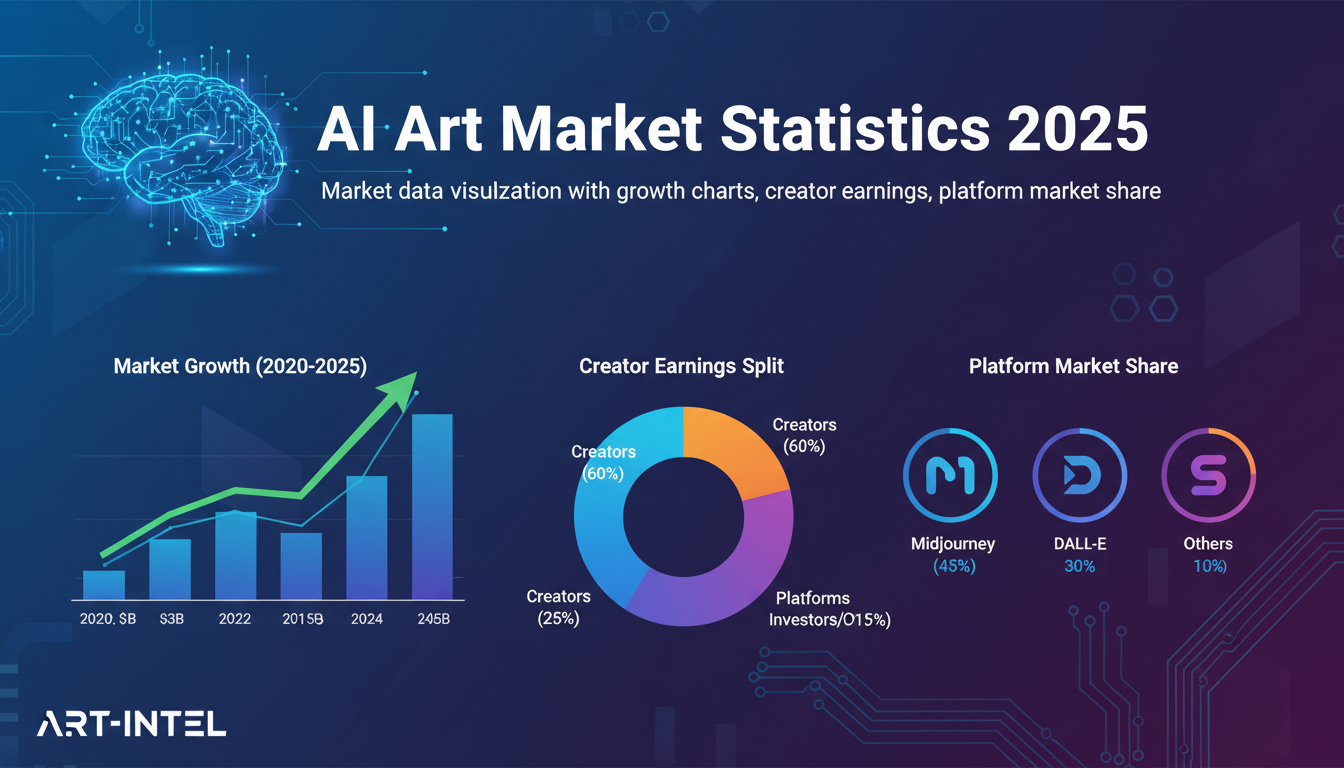
AI Art Market Statistics 2025: Industry Size, Trends, and Growth Projections
Comprehensive AI art market statistics including market size, creator earnings, platform data, and growth projections with 75+ data points.