Best AI Models for Realistic Backgrounds - Complete Guide 2025
Discover the best AI models for generating realistic backgrounds, architecture, and environments. Complete comparison of Flux, MiniMax, Leonardo, and specialized models.
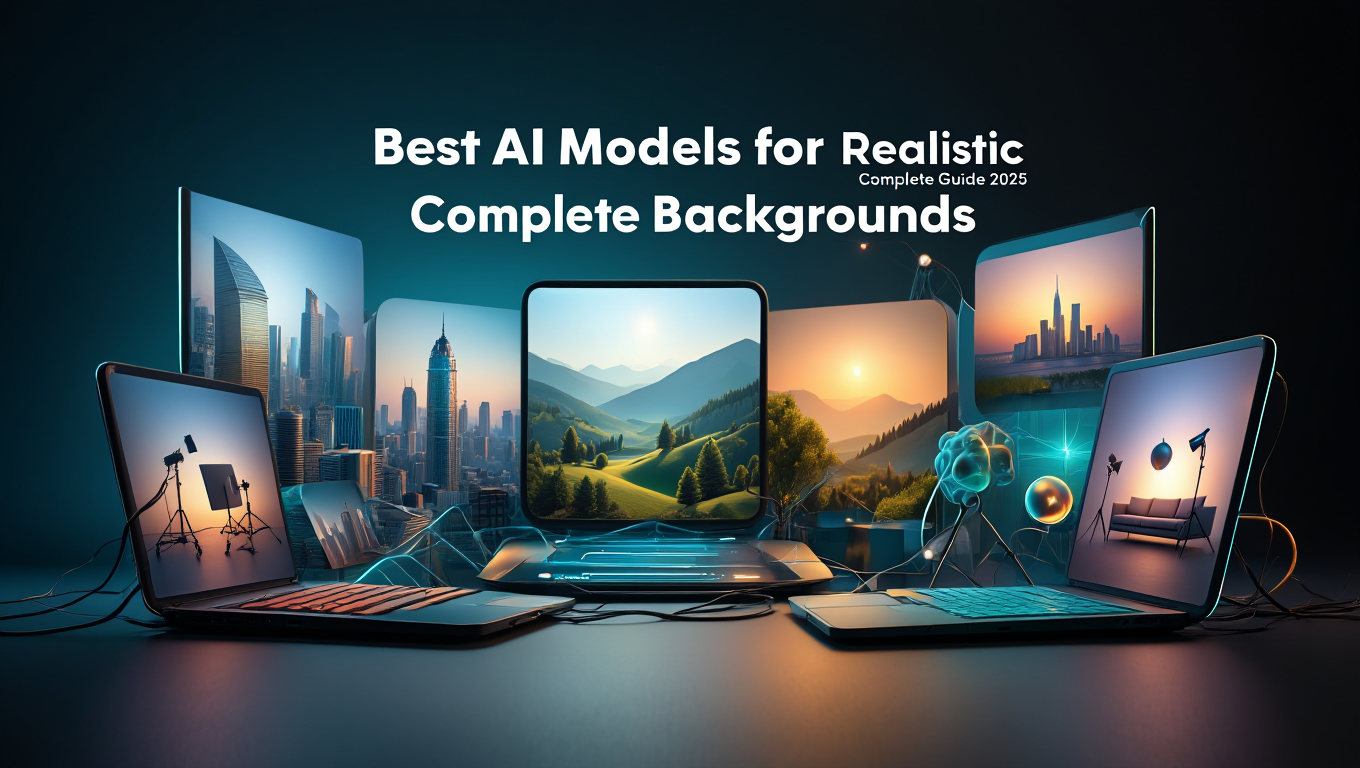
You need convincing backgrounds for your AI-generated subjects, but standard models produce environments that scream "AI generated." The wrong lighting, impossible architecture, and inconsistent physics break immersion instantly. Choosing the right model for backgrounds makes the difference between amateur composites and professional-quality imagery.
Quick Answer: For realistic backgrounds, MiniMax Image excels at structural renders and architectural visuals with photographic quality. Flux 1.1 Ultra produces highly detailed environments with superior lighting. Leonardo AI's PhotoReal models handle textures exceptionally. For architecture specifically, ArchitectureRealMix and dvArch deliver professional-grade results.
- MiniMax Image leads for photorealistic structural and architectural backgrounds
- Flux 1.1 Ultra excels at detailed environments with accurate lighting
- Leonardo PhotoReal handles fabric, wood grain, and material textures best
- Specialized architecture models outperform general models for buildings
- Nano Banana Pro handles complex lighting and background coherence accurately
What Makes Background Generation Challenging?
Backgrounds present unique challenges that reveal AI model weaknesses.
Lighting Consistency:
Backgrounds must have coherent light sources with appropriate shadows. Many models produce lighting that contradicts itself across the image.
Architectural Accuracy:
Buildings need proper perspective, realistic construction, and physically possible structures. AI often generates architecturally impossible elements.
Environmental Physics:
Water, clouds, vegetation, and terrain follow natural patterns. Poor models produce uncanny versions that feel wrong without obvious errors.
Depth and Scale:
Backgrounds must establish proper depth relationships. Incorrect scale between elements breaks the sense of space.
- Top models for different background types
- Specialized architecture models
- Best approaches for specific environments
- Prompt strategies for realistic backgrounds
- Combining models for optimal results
What Are the Best General-Purpose Models for Backgrounds?
These models handle diverse background types well.
MiniMax Image:
MiniMax Image is the go-to AI image generator for realistic and photographic image generation. Its focus on realism makes it best fit for structural renders and architectural visuals.
| Strength | Rating |
|---|---|
| Architectural accuracy | Excellent |
| Lighting coherence | Excellent |
| Material rendering | Very Good |
| Environmental depth | Very Good |
Flux 1.1 Ultra:
Flux 1.1 Ultra is a powerhouse for generating highly detailed, realistic imagery with superior attention to lighting, textures, and environmental details. Images feel like they belong in a high-budget movie.
| Strength | Rating |
|---|---|
| Environmental detail | Excellent |
| Lighting complexity | Excellent |
| Atmospheric effects | Excellent |
| Large-scale scenes | Very Good |
Leonardo AI PhotoReal:
Leonardo AI's photorealistic models contain rich and accurate textures. Fine-tuned models like PhotoReal excel at fabric weave, metal gloss, wood grain, and architectural detail.
| Strength | Rating |
|---|---|
| Material textures | Excellent |
| Surface detail | Excellent |
| Interior spaces | Very Good |
| Natural materials | Very Good |
Nano Banana Pro:
Nano Banana Pro (Google Gemini) raises the bar for realism and handles complex lighting, clean subject separation, and background coherence more accurately than many alternatives.
| Strength | Rating |
|---|---|
| Lighting accuracy | Excellent |
| Background coherence | Excellent |
| Real-world knowledge | Excellent |
| Architectural detail | Very Good |
What Specialized Architecture Models Exist?
For architecture-specific work, specialized models outperform general ones.
ArchitectureRealMix:
ArchitectureRealMix is the overall best architecture Stable Diffusion model. It produces accurate architectural proportions and realistic building materials.
InteriorDesignSuperMix:
Best for interior design, this model excels at generating highly detailed, aesthetically pleasing, and realistic interior spaces while maintaining spatial coherence. Styles range from minimalistic Scandinavian to lavish baroque interiors.
LandscapeSuperMix:
This model excels in producing intricate cityscapes, futuristic skylines, and natural environments with advanced fine-tuning ensuring structural accuracy and crisp detailing.
dvArch:
For professional-grade architectural visualization, dvArch delivers superior accuracy and control. It's designed specifically for architectural rendering workflows.
Imagine (Exterior Design):
Best for exterior design work, providing accurate building facades and outdoor architectural elements.
How Do You Choose the Right Model?
Match models to your specific background needs.
For Urban Environments:
Use Flux 1.1 Ultra for complex cityscapes with multiple buildings. LandscapeSuperMix for skylines and urban landscapes. MiniMax for street-level urban scenes.
For Interior Spaces:
InteriorDesignSuperMix for residential and commercial interiors. Leonardo PhotoReal for texture-rich interiors. ArchitectureRealMix for architectural interior accuracy.
For Natural Environments:
Flux 1.1 Ultra for landscapes with atmospheric effects. LandscapeSuperMix for natural terrain. Leonardo for detailed vegetation and natural textures.
For Product/Studio Backgrounds:
MiniMax Image for clean studio setups. Leonardo PhotoReal for textured backdrops. Nano Banana Pro for accurate lighting scenarios.
For users wanting professional backgrounds without model experimentation, Apatero.com provides access to optimized generation with strong background capabilities.
What Prompt Strategies Improve Background Realism?
How you prompt affects background quality significantly.
Lighting Specification:
Always specify lighting conditions. "Golden hour sunlight from the left," "overcast diffused lighting," "studio lighting with soft shadows." This forces coherent light throughout the scene.
Architectural Style:
Name specific architectural styles or periods. "Modern minimalist architecture," "Victorian Gothic building," "Brutalist concrete structure." Specific terms produce more accurate results.
Material Callouts:
Specify key materials. "Polished marble floors," "exposed brick walls," "weathered wooden beams." Material specificity improves texture accuracy.
Atmosphere and Mood:
Describe atmospheric conditions. "Hazy afternoon atmosphere," "crisp morning light," "moody overcast sky." This affects how the entire background renders.
Camera Terms:
Include photography terms. "Wide-angle architectural photography," "medium format film quality," "professional real estate photography." These guide the model toward photorealistic outputs.
How Do Professional Tools Compare?
Some professional tools integrate AI for architectural visualization.
Graphisoft AI Visualizer:
Integrates into Archicad, bridging raw BIM geometry and presentation-ready images. Describes atmosphere, materials, and lighting through prompts.
Veras:
Plugin for Revit, SketchUp, Rhino, Vectorworks, and Archicad. Works with existing project files and has a web-based version for sketches.
Google Veo 3.1 (Video):
For animated architectural visualization, Veo 3.1 is rated as the gold standard with superior reference image support for materials, lighting, and spatial relationships.
Midjourney:
Popular for conceptual architectural visuals and mood images, though less precise for technical accuracy.
What Common Background Problems Occur?
Understanding issues helps you avoid or fix them.
Problem: Impossible Architecture
Buildings with impossible physics, floating elements, or contradictory construction.
Solution: Use architecture-specific models. Include terms like "structurally accurate," "realistic architecture," "proper perspective."
Problem: Inconsistent Lighting
Light sources that contradict each other, shadows in wrong directions.
Solution: Explicitly describe single light source. Use models known for lighting accuracy (Flux, Nano Banana Pro).
Problem: Flat Depth
Backgrounds that lack proper depth, feeling like painted backdrops.
Solution: Include foreground, midground, and background elements in prompts. Specify atmospheric depth. Use wider aspect ratios.
Problem: Uncanny Textures
Materials that don't look quite right, especially on close examination.
Solution: Use Leonardo PhotoReal for texture-critical backgrounds. Specify exact materials. Generate at higher resolutions.
Frequently Asked Questions
Which model is best for photo composites?
MiniMax Image or Flux 1.1 Ultra for matching photorealistic subjects. Lighting coherence is critical for composites.
Can I use different models for subject and background?
Yes, this is common practice. Generate backgrounds separately, then composite subjects. Matching lighting is the main challenge.
What resolution should backgrounds be?
Generate at highest practical resolution. Backgrounds often need to be larger than subjects for proper composition and cropping flexibility.
How do I match AI backgrounds to real photos?
Study the lighting in your real photo. Prompt for matching light direction, quality, and color temperature. Post-processing may be needed.
Are specialized architecture models worth it?
For professional architectural visualization, absolutely. For casual use, general models may suffice.
Which model handles outdoor environments best?
Flux 1.1 Ultra excels at outdoor environments with complex atmospheric effects. LandscapeSuperMix for terrain-focused scenes.
How do I avoid repetitive AI patterns in backgrounds?
Use higher temperatures/randomness settings. Include varied elements in prompts. Generate multiple versions and select best.
Can AI backgrounds be used commercially?
Check specific model licenses. Most major models allow commercial use, but terms vary.
Conclusion
The best AI model for realistic backgrounds depends on your specific needs. MiniMax Image and Flux 1.1 Ultra lead for general photorealistic backgrounds. Specialized architecture models outperform general ones for buildings. Leonardo excels at material textures.
Quick Recommendations:
Urban/architectural backgrounds - MiniMax Image, ArchitectureRealMix. Natural environments - Flux 1.1 Ultra, LandscapeSuperMix. Interior spaces - InteriorDesignSuperMix, Leonardo PhotoReal. Complex lighting - Nano Banana Pro, Flux 1.1 Ultra.
Key Success Factors:
Choose models matching your background type. Use specific prompts for lighting, materials, and style. Generate at high resolution. Consider specialized models for professional work.
For users wanting professional backgrounds without extensive model testing, Apatero.com provides optimized generation pipelines delivering consistent background quality through intuitive interfaces.
The gap between AI-generated and real backgrounds continues to narrow. With the right model and prompting approach, AI backgrounds can be indistinguishable from professional photography.
Render the video you just read about
Kling, Veo, Seedance and more, in your browser, no queue to build. Check your welcome allowance and the displayed cost before generating.
Related Articles
5 Proven AI Influencer Niches That Actually Make Money in 2025
Discover the most profitable niches for AI influencers in 2025. Real data on monetization potential, audience engagement, and growth strategies for virtual content creators.
AI Background Replacement: Professional Guide 2025
Master AI background replacement for professional results. Learn rembg, BiRefNet, and ComfyUI workflows for smooth background removal and replacement.

AI Character Consistency: How to Maintain Virtual Persona Identity Across Content
Learn techniques for maintaining AI character consistency across hundreds of images. Master the art of creating recognizable virtual personas with consistent visual identity.