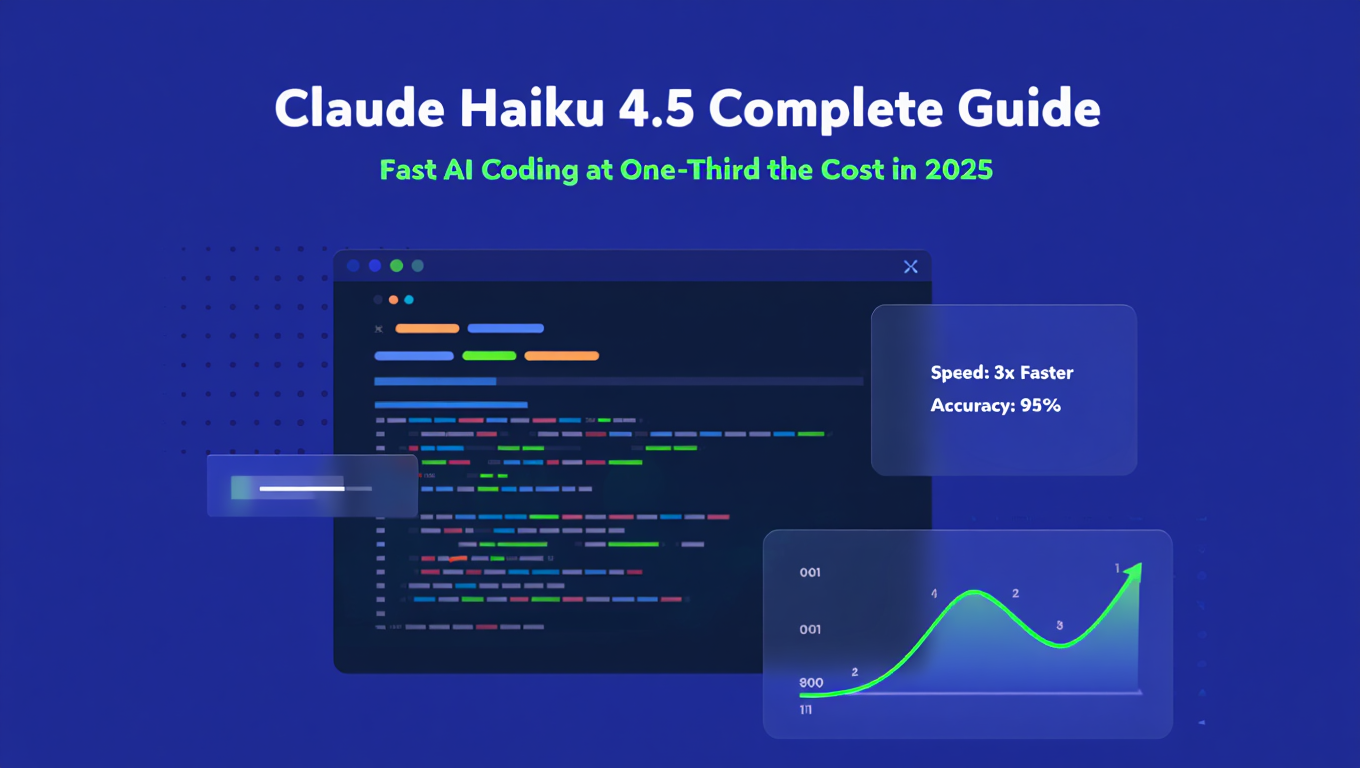
Claude Haiku 4.5 Complete Guide: Fast AI at Low Cost
Master Claude Haiku 4.5 for fast, cost-effective AI coding assistance. Performance benchmarks, use cases, and optimization strategies for developers.
:::tip[Key Takeaways]
- Follow the step-by-step process for best results with claude haiku 4.5 complete guide: fast ai at low cost
- Start with the basics before attempting advanced techniques
- Common mistakes are easy to avoid with proper setup
- Practice improves results significantly over time :::
Quick Answer: What Is Claude Haiku 4.5?
Claude Haiku 4.5 is Anthropic's fastest AI model that delivers Sonnet 4-level coding performance at one-third the cost ($1/$5 per million tokens vs $3/$15). It's 4-5x faster than Sonnet while scoring 73.3% on SWE-bench Verified and 50.7% on OSWorld for computer use. The model includes extended thinking capabilities, 64K token output, and excels at coding, agentic workflows, and terminal automation. Best for developers needing professional-grade AI at budget-friendly prices.
You need AI assistance for rapid coding, customer support, or real-time workflows, but frontier models like Claude Sonnet or GPT-5 drain your budget and introduce latency. Smaller models are cheap and fast, but performance suffers. This forced compromise between capability and cost has plagued AI development since the beginning.
Claude Haiku 4.5 eliminates this tradeoff. Anthropic's latest model delivers Sonnet 4-level coding performance at one-third the cost and 4-5 times the speed.
Even more impressive, it surpasses Sonnet 4 on computer use tasks while being the first Haiku model to support extended thinking and reasoning capabilities.
This guide breaks down everything developers and businesses need to know about Claude Haiku 4.5, from benchmark performance through practical implementation strategies for coding, agentic workflows, and production deployments. For deploying AI workflows to production, see our ComfyUI workflow to production API guide.
- Pricing: $1 input / $5 output per million tokens (vs Sonnet 4 at $3/$15)
- Performance: 73.3% SWE-bench score, 50.7% OSWorld score (beats Sonnet 4 at computer use)
- Speed: 4-5x faster than Sonnet 4.5 with comparable quality
- Output: 64K max tokens (8x larger than Haiku 3.5)
- New Features: Extended thinking mode, computer use capabilities, agentic coding
- Best For: High-volume coding, customer support, multi-agent systems, terminal automation
- Optimization: Use prompt caching (90% savings) and Message Batches API (50% off)
What Is Claude Haiku 4.5 and Why Does It Matter for Developers?
Anthropic released Claude Haiku 4.5 on October 15, 2025, as a smaller, faster alternative to flagship models while maintaining near-frontier performance.
The model achieves similar levels of coding performance to Claude Sonnet 4 at one-third the cost and more than twice the speed - a fundamental shift in the cost-performance equation for AI applications.
| Model | Release | Context Window | Output Tokens | Key Innovation |
|---|---|---|---|---|
| Claude 3 Haiku | March 2024 | 200K | 4K | Fastest model, 21K tokens/sec |
| Claude 3.5 Haiku | October 2024 | 200K | 8K | Improved reasoning |
| Claude Haiku 4.5 | October 2025 | 200K | 64K | Extended thinking + computer use |
The technical specifications tell the story. Haiku 4.5 includes a 200,000 token context window for handling extensive documents and conversations, 64,000 maximum output tokens (up from just 8,192 for Haiku 3.5), reliable knowledge cutoff of February 2025 for current information, and native support for extended thinking and reasoning. It's the first Haiku model to support extended thinking mode for complex problem-solving, computer use capabilities for direct interface interaction, and context-aware responses for sophisticated applications.
This matters for developers because it eliminates the previous forced choice between expensive frontier models with excellent performance or cheap models with mediocre results. Haiku 4.5 provides a third option - professional-grade performance at budget-friendly pricing. A development team running 1 million API calls per day can switch from Sonnet 4 to Haiku 4.5 and save approximately 66% on costs while actually gaining speed improvements. This makes previously cost-prohibitive AI-powered development workflows suddenly viable.
How Does Claude Haiku 4.5 Perform on Real Coding Benchmarks?
Claude Haiku 4.5 delivers impressive results across industry-standard benchmarks, competing directly with much larger models.
The most striking result is its 73.3% score on SWE-bench Verified, which tests models on actual GitHub issues from real open-source projects.
This isn't some synthetic benchmark - it's real code problems that actual developers encounter. A 73.3% success rate means Haiku 4.5 resolves nearly three-quarters of real-world coding issues, placing it among the world's elite coding models.
| Benchmark | Haiku 4.5 Score | Comparison | Significance |
|---|---|---|---|
| SWE-bench Verified | 73.3% | One of world's best coding models | Real GitHub issue resolution |
| Terminal-Bench | 41.0% | Strong command-line performance | Agentic terminal workflows |
| Augment Agentic Coding | 90% of Sonnet 4.5 | Matches much larger models | Multi-file refactoring capability |
The computer use capabilities are even more surprising. Claude Haiku 4.5 achieved 50.7% on the OSWorld benchmark compared to Sonnet 4's 42.2%. OSWorld measures how well AI can actually use software applications by clicking buttons, filling forms, and navigating interfaces. The smaller, cheaper Haiku model beats its more expensive sibling at computer interaction tasks. This has massive implications for automation workflows where you need AI to work with existing applications that don't have APIs.
Speed is where Haiku really shines. It runs 4-5 times faster than Sonnet 4.5 while maintaining comparable quality. The previous Haiku 3 already processed 21,000 tokens per second for prompts and generated 123 tokens per second for output. Haiku 4.5 builds on this speed advantage with better capabilities across the board.
For multi-agent systems, Haiku 4.5 changes the economics entirely. You can use Sonnet 4.5 as an orchestrator to break down complex problems, then deploy multiple Haiku 4.5 instances as workers executing subtasks in parallel. The cost difference is dramatic - instead of paying Sonnet prices for every agent, you only pay premium rates for the orchestrator while workers run at one-third the cost. This pattern is similar to converting workflows into production APIs where orchestration layers manage multiple processing nodes.
What Is Extended Thinking and When Should You Use It?
Claude Haiku 4.5 is the first Haiku model to support extended thinking, bringing advanced reasoning capabilities to the budget-friendly Haiku family.
Extended thinking mode allows the model to explicitly reason through problems step-by-step before providing answers, similar to how humans tackle difficult tasks.
The model generates intermediate reasoning tokens that help it avoid common pitfalls and produce more accurate results.
The feature is disabled by default to prioritize speed, but you should enable it for complex problem-solving, multi-step coding tasks, and strategic planning. For debugging complex code, extended thinking helps Haiku trace through logic systematically rather than jumping to conclusions. For architectural decisions, it considers multiple approaches and their tradeoffs before recommending solutions. For test generation, it identifies edge cases that simple pattern matching would miss. This systematic approach addresses many of the challenges senior developers face with AI coding tools.
| Task Type | Extended Thinking | Reasoning |
|---|---|---|
| Simple queries | Disabled | Fast, direct answers |
| Complex problem-solving | Enabled | Better quality, takes longer |
| Multi-step coding | Enabled | Thorough implementation |
| Real-time chat | Disabled | Prioritize speed |
| Strategic planning | Enabled | Comprehensive analysis |
The tradeoff is real. Extended thinking increases token usage by 20-50% because the model generates reasoning tokens in addition to the final response. Latency also increases as the model works through its reasoning process. But for non-real-time applications, the quality improvement justifies the cost. You're often better off paying 30% more tokens for one high-quality response than making three cheaper attempts that don't solve the problem.
You can combine extended thinking with Haiku's other capabilities for powerful workflows. Enable it alongside computer use for thoughtful interaction with applications, or use it in multi-agent orchestration where worker agents need to reason through complex subtasks independently.
How Does Claude Haiku 4.5 Handle Computer Use and Automation?
Claude Haiku 4.5 brings computer use capabilities to the Haiku family, enabling direct interaction with software interfaces and powerful agentic workflows.
Computer use means Claude can actually click buttons, navigate menus, fill forms, read screen contents, execute commands, and verify results visually.
It's not limited to API calls - it can work with any software application.
The surprising part is that Haiku 4.5 actually beats Sonnet 4 at computer use tasks. The 50.7% OSWorld score versus Sonnet 4's 42.2% shows the smaller, cheaper model handles computer interaction better than its expensive sibling. This matters enormously for automating legacy applications without APIs, testing UI applications automatically, and creating comprehensive workflow automation that spans multiple tools.
For agentic coding, Haiku 4.5 represents a major leap forward in sub-agent orchestration. The model handles complex workflows reliably, self-corrects in real-time without manual intervention, and maintains momentum without the latency overhead that makes larger models impractical for agent swarms. A powerful pattern is emerging where Sonnet 4.5 acts as orchestrator breaking down complex problems, while multiple Haiku 4.5 instances execute subtasks in parallel. The cost savings are massive compared to using Sonnet for all work.
Terminal automation is another sweet spot. Haiku 4.5 scored 41% on Terminal-Bench, making it excellent for Git workflow management, build and deployment automation, and system administration tasks. It shines for frequent small fixes, test stub generation, docstring creation, and light refactors where speed matters more than deep architectural thinking. For production deployments, this makes it ideal for turning workflows into scalable APIs.
The best workflow pairs Claude Code with Haiku 4.5 as the default fast path, escalating to Sonnet 4.5 only when tasks demand deeper reasoning or complex multi-file refactors. Claude's checkpoint features add a safety net by enabling instant rollback after AI edits, letting you automate aggressively while maintaining control.
In Anthropic's internal testing, Haiku 4.5 demonstrated reliable execution of multi-step terminal workflows, effective error recovery and self-correction, and consistent quality across diverse tasks. These aren't just benchmark numbers - the model is production-ready for real agentic applications.
How Much Does Claude Haiku 4.5 Cost and Is It Worth It?
Claude Haiku 4.5 pricing represents a strategic shift from previous Haiku models, balancing capability improvements with cost efficiency.
At $1 per million input tokens and $5 per million output tokens, it costs 4x more than Haiku 3.5.
But the performance improvements justify the increase - you get extended thinking capabilities, computer use functionality, an 8x larger output window (64K vs 8K tokens), and Sonnet 4-level coding performance for one-third the price of Sonnet.
| Model | Input (per 1M tokens) | Output (per 1M tokens) | Use Case |
|---|---|---|---|
| Claude Haiku 4.5 | $1.00 | $5.00 | High-performance tasks |
| Claude 3.5 Haiku | $0.25 | $1.25 | Budget applications |
| Claude Sonnet 4 | $3.00 | $15.00 | Frontier performance |
| Claude Sonnet 4.5 | $3.00 | $15.00 | Maximum capability |
The real savings come from optimization features. Prompt caching provides up to 90% cost savings for repeated API calls by storing common context server-side. When making multiple calls with similar context (like stable system prompts or reference documents), subsequent requests only pay for new tokens, not cached content. For a chatbot with a 2K token system prompt making 10K calls daily, caching saves approximately $100 per day.
The Message Batches API offers 50% cost reduction for non-real-time workloads by processing requests asynchronously. This works excellently for batch processing documents, analyzing large datasets, generating reports overnight, and other non-interactive workflows where you don't need immediate responses. This asynchronous pattern is essential for building production API systems at scale.
Real-world cost scenarios demonstrate the savings. A customer support chatbot handling 1M requests monthly costs approximately $200 with Haiku 4.5 and prompt caching (assuming 1K cached context, 500 input tokens, 300 output tokens per request) compared to $900 with Sonnet 4. That's 78% cost savings while maintaining quality. A code review agent processing 100K reviews monthly costs roughly $600 with Haiku 4.5 versus $3,000 with Sonnet 4.5, representing 80% savings with comparable coding performance.
Applications requiring thousands to millions of API calls benefit most from Haiku 4.5's pricing structure. The cost difference compounds dramatically at scale. Complex reasoning tasks requiring maximum capability, critical applications where quality trumps cost, and creative work requiring subtle understanding may still justify Sonnet pricing - but many developers overestimate how often they truly need frontier models.
Compared to competitors, GPT-4o Mini costs $0.15 input and $0.60 output per million tokens (significantly cheaper) and Gemini 1.5 Flash costs $0.075 input and $0.30 output (cheapest option). Claude Haiku 4.5 at $1/$5 is more expensive than both, but offers superior coding and agentic performance that justifies the premium for development workloads.
Comparison with Competing Models
Claude Haiku 4.5 competes in a crowded small model market with GPT-4o Mini and Gemini Flash. The pricing tells an interesting story - at $1/$5 per million tokens, Haiku 4.5 costs significantly more than GPT-4o Mini ($0.15/$0.60) and Gemini 1.5 Flash ($0.075/$0.30). But the performance justifies the premium for development workloads.
| Model | Pricing (Input/Output) | Context Window | Key Strength |
|---|---|---|---|
| Claude Haiku 4.5 | $1/$5 per 1M tokens | 200K | Coding & computer use |
| GPT-4o Mini | $0.15/$0.60 per 1M tokens | 128K | General performance |
| Gemini 1.5 Flash | $0.075/$0.30 per 1M tokens | 1M | Massive context |
| Claude 3.5 Haiku | $0.25/$1.25 per 1M tokens | 200K | Budget option |
On coding benchmarks, GPT-4o Mini scored 87.2% on HumanEval, ahead of Claude 3 Haiku at 75.9% and Gemini Flash at 71.5%. But Haiku 4.5 scores 73.3% on the more challenging SWE-bench Verified, which tests real-world GitHub issues rather than isolated coding problems. The benchmark choice matters - synthetic tests versus actual production scenarios produce different winners.
For reasoning, Claude 3.5 Haiku scored 41.6% on GPQA benchmark, outperforming GPT-4o Mini's 40.2%. Haiku 4.5 builds on this advantage with extended thinking capabilities unavailable in competing models. Speed is another differentiator - Claude 3 Haiku leads with 165 tokens per second throughput, while Gemini 1.5 Flash has incredible time-to-first-token under 0.2 seconds. Haiku 4.5 continues the family speed tradition with 4-5x faster generation than Sonnet models.
Context windows reveal different design priorities. Gemini 1.5 Flash stands out with an enormous 1,000,000-token window, unmatched by GPT-4o Mini's 128,000 tokens and Haiku 4.5's 200,000 tokens. For analyzing entire codebases or processing books, Gemini offers unique advantages. But Haiku 4.5 counters with unique capabilities no other small model offers - computer use for direct UI interaction, extended thinking mode for complex reasoning, and a 64,000 token output window (versus 4K-16K for competitors).
Model selection depends on your specific needs. Choose Haiku 4.5 for coding and software development tasks, agentic workflows and multi-agent systems, computer use and terminal automation, tasks requiring extended thinking, and long-form content generation. Choose GPT-4o Mini for budget-conscious general applications, real-time customer interactions, balanced performance across domains, and OpenAI ecosystem integration. Choose Gemini Flash for analyzing entire codebases or documents, ultra-low latency requirements, absolute minimum cost priority, and tasks requiring 200K+ context. Choose Claude 3.5 Haiku for maximum budget constraint and simple tasks not requiring advanced features.
The true competitor to Haiku 4.5 isn't other small models but rather larger models like Sonnet 4 and GPT-5. Haiku 4.5 challenges the assumption that you need expensive frontier models for professional work, proving that a well-designed efficient model can match frontier performance for most tasks. This shifts the AI programming space significantly toward cost-efficient yet powerful options.
Practical Use Cases and Applications
Claude Haiku 4.5's combination of performance, speed, and cost efficiency enables diverse applications across industries. Here are the areas where it delivers the most value.
Software Development
Code review automation is a perfect fit. Haiku 4.5 analyzes pull requests for bugs, style issues, and potential improvements, with its 73.3% SWE-bench score proving it can identify real problems in production code. Pair programming integration into IDEs or Claude Code provides rapid coding assistance - extended thinking mode handles architectural decisions while default mode cranks through quick completions and refactoring. Understanding how different experience levels work with AI tools helps optimize this workflow.
Test generation is another strong application. The model automatically generates unit tests, integration tests, and edge case coverage, with its reasoning capabilities identifying corner cases developers frequently miss. Documentation creation benefits from the 64,000 token output window, allowing comprehensive README files and technical docs in single requests rather than piecing together multiple outputs.
Customer Support and Operations
Chatbot backends powered by Haiku 4.5 deliver intelligent responses at manageable cost. Prompt caching dramatically reduces expenses for common knowledge base content that appears in most conversations. Email response automation handles high-volume support efficiently, with the speed and quality balance making it practical for real customer-facing applications.
Ticket categorization and routing based on content analysis benefits from fast inference that enables real-time processing. No waiting for slow model responses while customers sit in queue.
Multi-Agent Systems
Complex refactoring projects showcase the orchestration model - Sonnet 4.5 handles overall strategy while multiple Haiku 4.5 instances modify individual files in parallel. This dramatically speeds large-scale code changes that would take hours with sequential processing. The same principles apply to building scalable workflow systems across different domains.
Data processing pipelines deploy multiple Haiku 4.5 agents for parallel work on analysis and transformation tasks. The cost efficiency enables agent counts that were previously impractical with expensive frontier models. Research and analysis workflows orchestrate agents for literature review, data gathering, and synthesis, with extended thinking ensuring quality while speed enables breadth.
DevOps and Infrastructure
CI/CD pipeline management through terminal automation uses that 41% Terminal-Bench score for solid command-line capability. Infrastructure management automates server provisioning, configuration, and monitoring, with computer use capabilities enabling interaction with web-based admin interfaces that don't offer APIs. For deploying AI systems at scale, check out our guide on turning workflows into production APIs.
Log analysis for identifying issues, patterns, and optimization opportunities benefits from the speed and volume processing capability. Process thousands of log entries in seconds.
Content and Business Intelligence
Long-form writing uses the 64,000 token output window to generate complete articles, reports, and documentation in single requests. This is dramatically larger than most competitors' 4K-16K limits. Code generation produces complete applications and utilities with extended thinking providing solid architecture. For developers building custom integrations and nodes, Haiku 4.5's speed makes iterative development practical.
Business intelligence applications analyze data and generate comprehensive reports using the Batch API to reduce costs for scheduled reporting. Data analysis through natural language queries gets a quality boost from extended thinking, while market research workflows gather and synthesize information from multiple sources efficiently.
How to Access and Get Started
Claude Haiku 4.5 is available through multiple channels. Anyone can chat with it for free on Claude.ai (web, iOS, and Android) - it's now the default model for free-tier users. For production applications, developers access Haiku 4.5 through the Claude API on the Anthropic developer platform after API key registration.
Cloud platform availability includes Amazon Bedrock for AWS integration and Google Vertex AI for GCP. Azure support is expected soon for Microsoft ecosystem integration.
| Platform | Availability | Integration |
|---|---|---|
| Amazon Bedrock | Yes | AWS ecosystem integration |
| Google Vertex AI | Yes | GCP integration |
| Azure (coming) | Expected | Microsoft ecosystem |
Getting started is straightforward. Sign up for Anthropic API access at console.anthropic.com, generate API keys for authentication, and review documentation at docs.anthropic.com. Make test API calls to familiarize yourself with the request format before implementing in your application with proper error handling.
API requests go to the Messages API endpoint specifying model as "claude-haiku-4-5", with messages containing user input and optional parameters for extended thinking or computer use features. Extended thinking is disabled by default - include the specific parameter to enable it for tasks requiring deeper reasoning. Computer use requires additional setup including screen capture capabilities, input simulation permissions, and proper API request formatting (check Anthropic's computer use documentation for details). For building complete systems, see our production API deployment guide.
For development, start with free Claude.ai access to experiment and understand model behavior before moving to API for production. For production deployments, implement prompt caching for repeated context, use Message Batches API for non-real-time workloads, monitor usage through the console dashboard, and implement fallback logic for rate limits and errors.
IDE integration options include GitHub Copilot through Anthropic integration (in public preview as of October 2025), Claude Code terminal tool with Haiku 4.5 as default fast model, and various IDE plugins providing Claude access through API. For teams new to AI coding tools, understanding common beginner mistakes in automation workflows helps avoid pitfalls.
Multi-agent deployments should use Sonnet 4.5 as orchestrator for complex planning, Haiku 4.5 as worker agents for parallel execution, with coordination through message passing or shared state. Monitor total costs across all agents to avoid surprises. For containerized deployments, Docker setup guides ensure consistent environments across development and production.
For developers wanting AI coding capabilities without managing API integrations directly, platforms like Apatero.com provide simplified access to modern AI models including Claude for various development and creative workflows.
Optimization Strategies and Advanced Techniques
Maximizing Claude Haiku 4.5 performance while minimizing costs requires strategic optimization across multiple dimensions. The most impactful optimization is prompt caching, which provides up to 90% cost savings on cached tokens by storing common context server-side. Identify static context in your prompts including system instructions, documentation references, and code style guidelines, then structure API requests with static content first and variable content last. For chatbots with a 2K token system prompt making 10K calls daily, caching saves approximately $100 per day. Without caching, every API call pays for full prompt tokens. With caching, the first call pays full cost, then subsequent calls only pay for new tokens.
The Message Batches API offers 50% cost reduction for non-real-time workloads by processing requests asynchronously. This works excellently for overnight report generation, bulk data processing, scheduled content creation, and retrospective analysis tasks where you don't need immediate responses.
Implement intelligent model routing to balance cost, speed, and quality automatically. Simple queries use Haiku 4.5 in fast mode, complex tasks enable Haiku 4.5 extended thinking, and truly difficult problems escalate to Sonnet 4.5. This dynamic selection ensures you're not overpaying for simple tasks or underserving complex ones. Learn more about choosing the right AI model for different tasks.
| Task Complexity | Model Configuration | Speed | Cost | Quality |
|---|---|---|---|---|
| Simple queries | Haiku 4.5 standard | Fastest | Lowest | Good |
| Medium tasks | Haiku 4.5 extended thinking | Medium | Medium | Very good |
| Complex problems | Sonnet 4.5 | Slower | Higher | Excellent |
Monitoring and analytics drive continuous optimization. Track API usage by task type, monitor success rates for different model configurations, analyze cost per successful outcome (not just per request), and identify opportunities to downgrade complexity where quality remains acceptable. This data-driven approach reveals optimization opportunities you wouldn't spot otherwise.
Parallel processing uses Haiku 4.5's speed advantage. Break large tasks into independent subtasks, process in parallel with multiple Haiku instances, and aggregate results programmatically. This can be faster and cheaper than sequential processing with larger models, especially for tasks like analyzing multiple documents or processing batch datasets. This parallel architecture mirrors production workflow systems that need to scale efficiently.
Context window management matters despite Haiku 4.5's generous 200K limit. Unnecessary context increases cost and latency. Include only relevant context for each request, summarize or truncate older conversation history, and compress reference material where possible without losing essential information. The same principle applies to output - set appropriate max token limits for each use case (don't request 64K when 1K suffices), implement streaming to show results progressively, and consider breaking very long outputs into multiple focused requests.
Error handling and retries need intelligent design. Implement exponential backoff for rate limit errors, validate responses before considering requests successful, and retry failed requests with adjusted parameters rather than immediately escalating to more expensive models. Run A/B tests comparing Haiku 4.5 against alternatives for your specific use cases, measuring quality, cost, and speed differences. Don't assume benchmarks perfectly predict your application's needs.
Limitations and Considerations
Understanding Claude Haiku 4.5's limitations helps set appropriate expectations and choose the right tool for each task. The knowledge cutoff of February 2025 means no current events after that date - supplement with web search when needed. The model isn't multimodal yet, so image or video analysis requires Sonnet models with vision capabilities. Extended thinking increases latency for slower responses, making it unsuitable for real-time applications. And the 4x price increase versus Haiku 3.5 requires using caching and batching to maintain cost efficiency.
| Limitation | Impact | Mitigation |
|---|---|---|
| Knowledge cutoff February 2025 | No current events after cutoff | Supplement with web search when needed |
| Not multimodal (yet) | No image/video analysis | Use Sonnet models for vision tasks |
| Extended thinking increases latency | Slower responses | Reserve for non-real-time applications |
| Higher price than previous Haiku | 4x cost increase | use caching and batching |
Tasks requiring absolute maximum capability may still need Sonnet 4.5 or GPT-5. Creative writing requiring subtle style might benefit from larger models' deeper language understanding. Multimodal tasks involving images or video require vision-capable models. Tasks requiring current information beyond February 2025 need web-connected alternatives or models with more recent training data. Understanding when to use different AI models helps make these tradeoff decisions.
Computer use is powerful but comes with real limitations. It requires significant setup including screen capture capabilities and input simulation permissions. Security implications exist when AI controls interfaces - you're giving the model direct access to your system. Reliability concerns matter for critical operations where failures have consequences. Performance overhead from screen capture and input simulation adds latency that makes some real-time applications impractical.
Extended thinking's overhead is significant. While it improves quality, it increases token consumption by 20-50% and adds latency as the model works through reasoning steps. For high-volume real-time applications like chat interfaces, this overhead may be prohibitive even with the quality benefits. API rate limits apply based on account tier, meaning high-volume applications may need enterprise agreements or rate limit increases from Anthropic.
Like all AI models, Haiku 4.5 shows some variability in responses. The same prompt won't always produce identical outputs. For applications requiring absolute consistency, implement validation logic and retry mechanisms. Clearly define success criteria for each use case, implement fallback strategies when Haiku 4.5 is insufficient, monitor performance metrics to detect degradation, and maintain awareness of when more capable models justify higher costs.
Future Developments and Industry Impact
Claude Haiku 4.5 represents a significant milestone in the democratization of advanced AI capabilities. The availability of Sonnet-level coding performance at one-third the cost fundamentally changes the economics of AI applications. Previously cost-prohibitive use cases become viable - real-time coding assistance for all developers, AI agents for small businesses and individuals, comprehensive code review for all pull requests, and intelligent automation across industries that couldn't justify frontier model costs.
Haiku 4.5's combination of capability and cost efficiency enables practical multi-agent systems at scale. Expect rapid development of sophisticated agent orchestration frameworks where cost-effective worker agents execute tasks in parallel under orchestrator guidance. Specialized agent marketplaces and ecosystems will emerge, with integration of multi-agent AI into standard development workflows becoming the norm rather than the exception. These systems will need solid API infrastructure to handle scale.
The competitive pressure is real. Anthropic's aggressive pricing and capability with Haiku 4.5 forces competitors to improve their small model offerings. Google and OpenAI will need to enhance Gemini Flash and GPT-4o Mini respectively to maintain competitive positioning. This race to the bottom on pricing while maintaining capability benefits all developers.
Future versions will likely add multimodal capabilities (vision, audio) to match Sonnet models' full feature set. Knowledge cutoff extensions through training or search integration will address the February 2025 limitation. Extended thinking efficiency improvements will reduce the 20-50% overhead, making it practical for more applications. Computer use reliability and capabilities will be enhanced as Anthropic refines the feature based on production usage data.
The democratization impact is profound. By making powerful AI accessible at reasonable cost, Haiku 4.5 enables individual developers and small teams to build sophisticated AI applications previously requiring substantial budgets. This accelerates innovation across the industry as more people can experiment with and deploy advanced AI without worrying about unsustainable costs. It levels the playing field in AI-assisted programming for teams of all sizes.
Expect rapid growth in tools and platforms integrating Haiku 4.5. Enhanced IDE plugins and coding assistants will make it the default fast path for AI-assisted development. Specialized agentic frameworks will standardize multi-agent orchestration patterns. Low-code platforms will use Haiku for backend intelligence, abstracting API complexity. Vertical-specific applications in healthcare, legal, finance, and other industries will emerge as domain experts realize they can afford to build with AI.
Haiku 4.5 exemplifies the broader trend toward more efficient AI models that deliver increasing capability at decreasing cost. This trend makes AI more sustainable (less compute per task), more accessible (affordable for individuals), and more practical for real-world applications. The future of AI isn't just about frontier capabilities - it's about making those capabilities available to everyone.
Frequently Asked Questions About Claude Haiku 4.5
What is the main difference between Claude Haiku 4.5 and Sonnet 4?
Claude Haiku 4.5 costs one-third the price ($1/$5 vs $3/$15 per million tokens) and runs 4-5x faster while delivering similar coding performance. Haiku scores 73.3% on SWE-bench and actually beats Sonnet 4 on computer use tasks (50.7% vs 42.2%). However, Sonnet 4.5 still excels at complex reasoning, creative work, and tasks requiring maximum capability.
Should I use extended thinking mode by default?
No. Extended thinking is disabled by default because it increases token usage by 20-50% and adds latency. Enable it only for complex problem-solving, multi-step coding tasks, strategic planning, and debugging complex code. For real-time chat, customer support, or simple queries, keep it disabled to prioritize speed.
Can Claude Haiku 4.5 replace GPT-4o Mini?
It depends on your use case. Haiku 4.5 costs more ($1/$5 vs $0.15/$0.60) but offers superior coding performance (73.3% SWE-bench), computer use capabilities, extended thinking, and 64K output tokens. Choose Haiku 4.5 for coding and agentic workflows. Choose GPT-4o Mini for budget-conscious general applications or OpenAI ecosystem integration.
How do I save money with Claude Haiku 4.5?
Use prompt caching for up to 90% cost savings on repeated context like system prompts. For non-real-time workloads, use the Message Batches API for 50% cost reduction. Switch from Sonnet to Haiku for tasks that don't need maximum capability. A chatbot with prompt caching can save $100/day at 10K requests.
Does Haiku 4.5 support image analysis?
No. Claude Haiku 4.5 is not multimodal yet and cannot analyze images or videos. For vision tasks, use Claude Sonnet models which include vision capabilities. Haiku 4.5 focuses on text-based tasks like coding, agentic workflows, and terminal automation.
What's the knowledge cutoff date?
February 2025. Haiku 4.5 has no information about events after this date. For current information, supplement with web search capabilities or use models with more recent training data.
How does computer use work technically?
Computer use enables Claude to click buttons, navigate menus, fill forms, and read screens through screen capture and input simulation. It requires specific API request formatting and proper permissions. Check Anthropic's computer use documentation for implementation details. Security implications exist - you're giving AI direct system access.
Can I use Haiku 4.5 for multi-agent systems?
Yes. Haiku 4.5 is excellent for multi-agent systems. Use Sonnet 4.5 as orchestrator to break down complex problems, then deploy multiple Haiku 4.5 instances as workers executing subtasks in parallel. Cost savings are massive - you only pay premium rates for the orchestrator while workers run at one-third the cost.
What hardware do I need to run Haiku 4.5?
None. Claude Haiku 4.5 runs entirely on Anthropic's cloud infrastructure through API calls. You don't need local GPUs or specialized hardware. Access it via API, Claude.ai website, iOS/Android apps, Amazon Bedrock, or Google Vertex AI.
Will Haiku 4.5 get multimodal capabilities?
Likely. Future versions will probably add vision, audio, and other multimodal capabilities to match Sonnet models' full feature set. Knowledge cutoff extensions and extended thinking efficiency improvements are also expected. Anthropic hasn't announced specific timelines.
Conclusion - Fast AI Intelligence at Practical Cost
Claude Haiku 4.5 eliminates the forced choice between AI performance and affordability. It delivers Sonnet 4-level coding performance (73.3% SWE-bench) at one-third the cost while running 4-5x faster. The extended thinking capabilities enable complex reasoning when needed, computer use functionality surpasses larger models, and the 64,000 token output window enables comprehensive responses that competitors can't match.
The model makes the most sense for software development and coding applications, customer support automation, multi-agent system deployments, terminal and DevOps automation, and any application requiring thousands to millions of API calls where costs compound dramatically. Try it free at Claude.ai to understand capabilities, then access via API for production with prompt caching and batching for cost optimization.
This represents a genuine cost-performance revolution. A single developer can now deploy sophisticated AI agents that previously required enterprise budgets. Small businesses can implement intelligent automation matching large company capabilities. Open source projects can integrate AI assistance without unsustainable costs.
The practical reality is that most applications don't need maximum AI capability for every task. Haiku 4.5 proves that 80-90% of AI work can be handled by fast, efficient models, reserving expensive frontier models for truly demanding tasks. Default to Haiku 4.5 for AI-assisted coding and agent workflows, enable extended thinking for complex tasks requiring deeper reasoning, and escalate to Sonnet only when Haiku demonstrably falls short.
For users wanting access to Claude and other modern AI models without managing API integrations, platforms like Apatero.com provide improved interfaces for AI-powered development, image generation, and creative workflows with professional results. You can also wire the two together directly, and our guide to connecting Claude to Apatero with the MCP connector shows how to generate images from inside a conversation.
The era of accessible, powerful AI assistance has arrived. Claude Haiku 4.5 provides professional-grade intelligence at practical costs, enabling developers and businesses to build the AI-powered applications they've imagined. Stop compromising between AI capability and affordability and start building with Claude Haiku 4.5.
Make AI images and video in your browser
Characters, video, photo packs. No GPU, no setup. Check your welcome allowance and the displayed cost before generating.
Related Articles
Astro Web Framework: The Complete Developer Guide for 2025
Discover why Astro is changing web development in 2025. Complete guide to building lightning-fast websites with zero JavaScript overhead and modern tooling.

Best AI for Programming in 2025
Comprehensive analysis of the top AI programming models in 2025. Discover why Claude Sonnet 3.5, 4.0, and Opus 4.1 dominate coding benchmarks and...
Best Astro Blog Templates for SEO: Developer-Friendly Options in 2025
Discover the best Astro blog templates optimized for SEO and performance. Compare features, customization options, and deployment strategies for developer blogs.