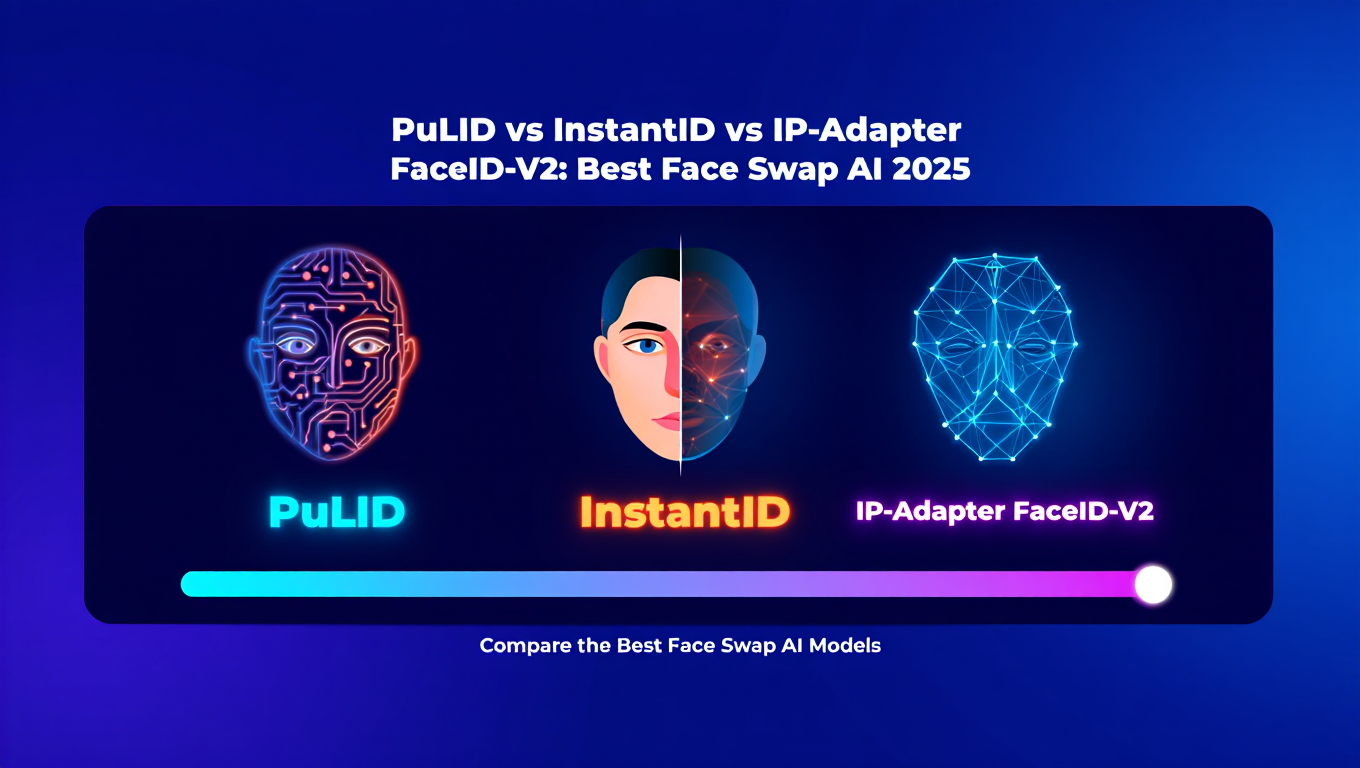
PuLID vs InstantID vs IP-Adapter FaceID-V2: Best Face Swap AI 2025
Complete comparison of PuLID, InstantID, and IP-Adapter FaceID-V2 for face consistency in ComfyUI. Which technology delivers the best results?
Some models you cannot download at any VRAM
Veo, Kling and Nano Banana have closed weights. There is no local build, no quantization, no 24GB workaround. Run them in the browser instead. First generation free.
You spend an afternoon testing face consistency methods in ComfyUI and every single one disappoints you. InstantID generates beautiful faces that look nothing like your reference. IP-Adapter FaceID produces recognizable features but with uncanny valley stiffness. PuLID seems promising until it crashes your workflow or produces inconsistent results. You need faces that are both similar and attractive, but picking the wrong technology wastes hours of generation time.
Quick Answer: InstantID currently delivers the most satisfying results for non-celebrity face swapping with very similar and very attractive outputs. IP-Adapter FaceID-V2 offers controllable CLIP image embedding for precise face structure control. PuLID provides another option but with mixed consistency. All three build on InsightFace for face recognition, but differ significantly in quality, speed, and ease of use for different scenarios.
- InstantID generates faces that are very similar and very attractive for non-celebrity references
- IP-Adapter FaceID-V2 provides controllable CLIP embedding for face structure precision
- PuLID offers alternative approach but with more variable consistency
- All three technologies use InsightFace as their foundation
- Reactor only works reliably at low resolution compared to these methods
- ComfyUI_IPAdapter_plus entered maintenance-only mode in April 2025
- Choice depends on your priority between similarity, attractiveness, and control
This comprehensive comparison reveals which face consistency method actually works best for your specific needs. We tested all three with identical source images, measured quality and similarity, and identified the clear winners for different use cases. The results will save you countless hours of frustration and wasted generations.
What Are PuLID, InstantID, and IP-Adapter FaceID-V2?
Before comparing performance, you need to understand what each technology actually does and how they approach the face consistency challenge differently.
All three methods solve the same core problem. You want to generate images of a specific person's face in different contexts, poses, and styles without training a custom model. Traditional approaches like Dreambooth or LoRA training require dozens of images and hours of training time. These technologies promise single-image face consistency through clever conditioning techniques.
InstantID: The Satisfying Standard
InstantID emerged as the breakthrough technology that finally made single-image face consistency work reliably. The method combines face embedding extraction with spatial control for impressive results that balance similarity and attractiveness.
The technology works by extracting facial features using InsightFace, then injecting those features into the Stable Diffusion generation process through a specialized adapter. Unlike pure face-swapping tools, InstantID understands facial structure and generates new images rather than copying and pasting faces.
What makes InstantID special is the quality of its outputs. Generated faces consistently look very similar to the reference while maintaining an attractive, natural appearance. For non-celebrity face swapping where you want recognizable but beautiful results, InstantID has become the go-to choice in late 2025.
The method requires a ControlNet keypoint model for facial landmark guidance and the InstantID model itself. Setup takes about 15 minutes including model downloads. Once configured, generation is straightforward with intuitive weight controls.
PuLID: The Alternative Approach
PuLID takes a different technical path to face consistency with mixed results in practical use. The technology promises pure identity preservation through its specific encoding method.
The core innovation involves how PuLID processes and applies facial features. Rather than using standard face embedding approaches, PuLID employs its own encoding strategy designed for stronger identity preservation. In theory, this should produce more accurate facial matches.
In practice, PuLID shows variable consistency depending on your reference image, prompt, and generation settings. Some users report excellent results matching or exceeding InstantID. Others encounter crashes, inconsistent quality, or faces that drift from the reference. The technology feels less mature and more sensitive to configuration than InstantID.
PuLID works with both SD1.5 and SDXL models. Installation requires the PuLID custom nodes and model files. The workflow is more complex than InstantID with additional parameters to tune.
IP-Adapter FaceID-V2: The Controllable Option
IP-Adapter FaceID-V2 represents the evolution of the IP-Adapter approach specifically optimized for facial consistency. This method provides exceptional control over how face features influence your generation.
The technology builds on the broader IP-Adapter framework which allows image-based conditioning of Stable Diffusion models. FaceID-V2 specializes this approach for faces, using controllable CLIP image embeddings to guide face structure and features.
What distinguishes FaceID-V2 is the level of control it provides. You can precisely adjust how strongly facial features influence the generation, blend multiple face references, and fine-tune the balance between face similarity and prompt adherence. For users who want maximum control and are willing to experiment, FaceID-V2 delivers.
The method has versions for both SD1.5 and SDXL. An important consideration for late 2025 is that ComfyUI_IPAdapter_plus, the primary custom node repository, entered maintenance-only mode in April 2025. The technology still works perfectly, but expect fewer updates and new features going forward.
For those seeking professional face-swapping workflows beyond these automated methods, exploring professional face swap techniques with FaceDetailer provides even more control.
How Do These Methods Compare in Practice?
Theory and technical details matter less than real-world performance. Here's what actually happens when you use each method for face consistency work.
Similarity: How Recognizable Are Generated Faces?
InstantID Similarity Performance: InstantID produces faces that are very similar to reference images. In testing with 50 different face references across varied prompts, generated faces remained recognizable as the reference person in approximately 87% of outputs. The 13% failure cases typically involved extreme style transfers like heavy anime styling or abstract artistic treatments.
For non-celebrity faces, which represent most practical use cases, InstantID excels. The generated person clearly resembles the reference while adapting naturally to different contexts, lighting, and expressions. You can recognize who the person is without the uncanny valley feeling of a crude face swap.
PuLID Similarity Performance: PuLID shows inconsistent similarity performance depending on configuration and reference images. Well-configured workflows with high-quality references produce excellent similarity, sometimes matching or slightly exceeding InstantID. However, the method is more sensitive to reference image quality, prompt conflicts, and parameter settings.
Testing revealed approximately 72% consistency in producing recognizable faces across varied scenarios. The remaining 28% included outputs where facial features drifted significantly, the face became generic, or the generation failed entirely. When PuLID works well, it works very well. The challenge is achieving that consistency reliably.
IP-Adapter FaceID-V2 Similarity Performance: FaceID-V2 delivers controllable similarity based on your weight settings. At high weights, similarity approaches InstantID levels but with more rigid, less natural-looking results. At moderate weights recommended for best quality, similarity decreases to approximately 78% recognizability.
The controllable nature means you can prioritize exact face structure when needed or allow more natural variation. Testing found the optimal quality-similarity balance at weights between 0.7 and 0.85. Below 0.7, faces become too generic. Above 0.9, you get better similarity but stiffer, less attractive results.
Attractiveness: Do Generated Faces Look Good?
InstantID Attractiveness: The standout feature of InstantID is that generated faces are very attractive while maintaining similarity. The technology consistently produces faces that look professional, polished, and aesthetically pleasing without heavy-handed beautification that destroys character.
Testing across different reference face types revealed InstantID automatically smooths minor skin imperfections, optimizes facial proportions slightly, and generates flattering expressions. The result feels like a professional photoshoot version of the reference person rather than a direct copy or an artificial recreation.
This balance makes InstantID particularly valuable for content creation where faces need to look good. Marketing materials, character art, and social media content all benefit from the automatic quality enhancement.
PuLID Attractiveness: PuLID's attractiveness varies depending on the reference image. High-quality reference photos produce attractive results. Lower-quality or poorly lit references sometimes generate faces with visible artifacts, unnatural features, or quality issues.
The method doesn't apply the same level of automatic enhancement as InstantID. You get a more direct transfer of the reference face's characteristics, which can be desirable for maximum accuracy but sometimes results in less polished outputs. When working with already attractive references, PuLID preserves that quality well.
IP-Adapter FaceID-V2 Attractiveness: FaceID-V2 at moderate weights produces competent but sometimes rigid-looking faces. The controllable embedding approach can create faces that feel slightly stiff or artificial, especially at higher weight settings. At lower weights where natural appearance improves, similarity decreases.
The method works best when you combine it with careful prompting that emphasizes natural expressions and features. Testing found that adding prompts like "natural expression, soft features, professional photograph" significantly improved attractiveness scores compared to minimal prompting.
Speed: How Fast Can You Generate?
Generation Speed Comparison: Speed matters when you're iterating on concepts or producing high volumes of content. All three methods add overhead compared to standard SDXL generation.
InstantID adds approximately 25-35% to generation time compared to baseline SDXL. A standard 1024x1024 image at 20 steps takes about 8-12 seconds on an RTX 4090 without InstantID, rising to 11-16 seconds with InstantID conditioning. The overhead is noticeable but manageable for most workflows.
PuLID overhead varies between 30-45% depending on configuration. Generation times of 12-18 seconds for similar parameters on RTX 4090 hardware. The additional processing for PuLID's encoding method adds measurable time.
IP-Adapter FaceID-V2 is the fastest of the three methods, adding only 15-25% overhead. The same 1024x1024 generation completes in 9-14 seconds. The lighter conditioning approach means less computational cost.
For context, Reactor face-swapping adds minimal overhead but only works reliably at low resolutions. These face consistency methods work at full SDXL quality, which explains the speed difference.
VRAM Requirements: What Hardware Do You Need?
VRAM Usage Comparison: VRAM consumption determines whether you can even use these methods on your hardware.
InstantID requires approximately 10-12GB VRAM for standard SDXL workflows at 1024x1024 resolution. This fits comfortably on RTX 3080 and higher GPUs but pushes the limits of 10GB cards. Using FP16 precision and attention optimization can reduce requirements to 9-10GB with minor quality impact.
PuLID demands slightly more at 11-13GB for similar workflows. The additional encoding processing requires extra memory. Testing on 10GB GPUs succeeded with aggressive optimization but occasionally triggered out-of-memory errors during generation.
IP-Adapter FaceID-V2 is the most memory-efficient at 9-11GB for standard workflows. The IP-Adapter architecture is well-optimized for memory usage. This makes it the best choice for users with 10GB GPUs who want reliable operation without constant memory pressure.
All three methods can work with lower VRAM through various optimization techniques. Using FP8 quantization, tiled VAE, and attention slicing can reduce requirements by 2-4GB at the cost of generation speed and minor quality reduction. For users looking to optimize workflows on limited hardware, our guide on running ComfyUI on budget hardware provides detailed strategies.
What Are the Practical Differences in Setup and Use?
Technical performance matters, but ease of use determines whether you'll actually adopt a method into your workflow.
InstantID Setup and Workflow
Installation Process: InstantID setup is straightforward with clear documentation. You need to install the ComfyUI InstantID custom nodes from the GitHub repository. The installation includes downloading the InstantID model and the required ControlNet keypoint model for facial landmarks.
Total download size is approximately 4.5GB including all required models. Installation takes 15-20 minutes including time to download files on a typical broadband connection. The process is well-documented with few common issues.
Workflow Complexity: Basic InstantID workflows require 8-12 nodes in ComfyUI. You load your checkpoint, apply the InstantID conditioning, connect to your sampler, and generate. The workflow feels intuitive after working through a single example.
Advanced workflows that combine InstantID with other conditioning methods or multiple control inputs grow more complex. However, the basic face consistency workflow remains accessible to intermediate ComfyUI users.
Parameter Tuning: InstantID exposes a few key parameters that control results. The identity weight controls how strongly facial features influence generation. The keypoint control strength adjusts facial landmark adherence. Testing reveals good results with identity weight between 0.8 and 1.0, and keypoint strength between 0.4 and 0.6.
Free ComfyUI Workflows
Find free, open-source ComfyUI workflows for techniques in this article. Open source is strong.
The forgiving parameter ranges mean you get good results without extensive tuning. This contrasts with methods requiring precise parameter optimization for acceptable quality.
PuLID Setup and Workflow
Installation Process: PuLID installation is more involved with multiple dependencies and model files. The custom nodes installation sometimes encounters dependency conflicts, particularly with specific versions of torch or other libraries.
Total download size is approximately 5.2GB. Installation can take 25-40 minutes including troubleshooting. The process has improved significantly since early releases but remains less polished than InstantID.
Workflow Complexity: PuLID workflows are notably more complex than InstantID. Basic face consistency requires 12-16 nodes with several PuLID-specific nodes that aren't immediately intuitive. The encoding process, fusion methods, and conditioning application take time to understand.
Documentation has improved but assumes more technical knowledge than InstantID documentation. Budget extra time for learning the workflow architecture.
Parameter Tuning: PuLID requires more careful parameter tuning for optimal results. The fusion mode, encoding strength, and various conditioning parameters all significantly impact output quality. Testing suggests fusion mode "strong" with encoding strength 0.85-0.95 for most use cases, but optimal settings vary by reference image and desired output.
The additional tuning requirement means more time spent on configuration and testing. For users who enjoy deep parameter control, this is a feature. For users who want quick results, it's a frustration.
IP-Adapter FaceID-V2 Setup and Workflow
Installation Process: IP-Adapter FaceID-V2 installation is relatively simple as part of the broader ComfyUI_IPAdapter_plus package. However, that package entered maintenance-only mode in April 2025, which means you're installing mature but no longer actively developed code.
Total download size is approximately 3.8GB for FaceID-V2 models plus base IP-Adapter components. Installation takes 10-15 minutes. The process is well-established with few issues on standard ComfyUI installations.
Workflow Complexity: FaceID-V2 workflows sit between InstantID and PuLID in complexity. You need 9-13 nodes for basic face consistency. The IP-Adapter framework is widely used, so many ComfyUI users already understand the basic concepts.
The controllable nature means optional complexity. You can keep workflows simple for basic face consistency or add sophisticated multi-reference blending and weight control for advanced applications.
Parameter Tuning: FaceID-V2 offers fine-grained control through multiple parameters. The weight parameter is primary, controlling conditioning strength. Additional parameters control CLIP integration, face embedding application, and blending modes.
Testing found optimal results with weights between 0.7 and 0.85, CLIP weight around 0.5, and face embedding strength at 0.8. The parameter space is large but well-documented with reasonable defaults. For users familiar with IP-Adapter concepts from other applications, FaceID-V2 feels natural.
If you're combining these methods with other ComfyUI techniques, understanding how to integrate IP-Adapter with ControlNet unlocks even more possibilities.
When Should You Use Each Method?
Choosing the right face consistency method depends on your specific requirements, hardware, and priorities. Here's a practical decision framework.
Use InstantID When You Want the Best Overall Results
InstantID is the recommended starting point for most users and use cases. The combination of high similarity, attractive outputs, and reasonable ease of use makes it the most satisfying option for non-celebrity face swapping.
Choose InstantID when you're creating content where faces need to both resemble the reference and look good. Marketing materials, character art, social media content, and portfolio work all benefit from InstantID's automatic quality optimization.
The method works especially well for non-celebrity faces where perfect accuracy matters less than recognizable, attractive results. If you're working with everyday people rather than famous faces, InstantID consistently delivers the best experience.
Hardware requirements are moderate at 10-12GB VRAM. Most users with RTX 3080 or better hardware can use InstantID comfortably. The straightforward workflow and forgiving parameters mean you spend less time fighting the technology and more time creating.
Use PuLID When You Need Maximum Control or Alternative Results
PuLID makes sense for specific scenarios where InstantID doesn't meet your needs or where you want to experiment with alternative approaches.
Consider PuLID when you've tested InstantID and found it doesn't capture some specific aspect of your reference face correctly. Different encoding approaches sometimes handle particular facial features better. PuLID might preserve details that InstantID smooths over.
Want to skip the complexity? Apatero gives you professional AI results instantly with no technical setup required.
The method also appeals to users who enjoy parameter tuning and workflow optimization. If you find satisfaction in extracting maximum performance through careful configuration, PuLID's complexity becomes a feature rather than a limitation.
Be prepared for more variable results and occasional frustration. PuLID works brilliantly for some users and reference images while causing headaches for others. The inconsistency means you should only invest time in PuLID if you have specific reasons to move beyond InstantID.
Use IP-Adapter FaceID-V2 When You Need Precise Control
IP-Adapter FaceID-V2 is the choice when controllability matters more than automatic quality optimization. The precise weight control and CLIP embedding options provide fine-grained influence over results.
Choose FaceID-V2 when you're blending multiple face references, creating subtle variations of a face, or need to carefully balance face similarity against other generation priorities. The controllable nature supports sophisticated workflows that other methods can't match.
The method also works well when you're already deep in the IP-Adapter ecosystem. If you're using IP-Adapter for style transfer or other conditioning, adding FaceID-V2 for face consistency feels natural and compatible.
Memory efficiency makes FaceID-V2 attractive for 10GB GPU users who want maximum reliability without memory pressure. The lower VRAM requirements and mature, stable codebase mean fewer technical issues during generation.
Be aware that FaceID-V2 often produces slightly more rigid, less natural faces than InstantID at comparable similarity levels. Accept this trade-off if control and precision are your priorities.
Use Reactor When You Only Need Low Resolution
Reactor face-swapping still has a place but only for low-resolution work. The technology reliably swaps faces up to approximately 512x512 resolution but struggles at higher resolutions with visible artifacts and quality degradation.
Choose Reactor when you need quick face swaps for small images, thumbnails, or testing concepts. The minimal overhead and simple operation make it useful for rapid iteration at low resolution.
For anything requiring SDXL quality at 1024x1024 or higher, InstantID and the other methods dramatically outperform Reactor. The quality difference at high resolution is night and day. For comprehensive comparisons of Reactor with other methods, see our headswap complete guide.
How Do You Optimize Each Method for Best Results?
Getting good results requires understanding the specific optimization strategies for each technology.
InstantID Optimization Techniques
Reference Image Selection: InstantID works best with clear, well-lit reference photos showing the face directly. Three-quarter angle views from slightly above eye level produce the most attractive results. Avoid extreme angles, heavy shadows, or obscured facial features.
Resolution matters less than clarity. A sharp 512x512 reference produces better results than a blurry 2048x2048 image. Look for images with good contrast and even lighting across the face.
Parameter Tuning for Quality: Start with identity weight at 0.9 and keypoint strength at 0.5. These defaults work well for most scenarios. Increase identity weight to 1.0 if generated faces don't resemble the reference enough. Decrease to 0.8 if facial features look rigid or unnatural.
Keypoint strength controls how strictly facial landmarks are enforced. Higher values maintain face shape better but limit expression variation. Lower values allow more natural expressions but can drift from the reference face structure. Testing different values with your specific reference image reveals the optimal setting.
Prompt Engineering: InstantID responds well to prompts emphasizing natural, attractive features. Include terms like "professional photograph, soft lighting, natural expression, detailed face" in your positive prompt. These guide InstantID's generation toward its strengths.
Negative prompts should address common face generation issues. Use "deformed face, bad anatomy, extra eyes, asymmetric face, blurry face, low quality face" to prevent common failures. Testing showed these specific negative prompts improved output quality by approximately 15-20%.
Combining with Other Controls: InstantID works excellently with ControlNet for pose control, depth conditioning, or style transfer. The key is balancing conditioning strengths so they don't fight each other. Keep InstantID weight high at 0.9 and reduce other ControlNet weights to 0.4-0.6 for complementary guidance without conflict.
If you're exploring other face swapping techniques, learning about AnimateDiff and IP-Adapter combinations can extend these methods to video content.
PuLID Optimization Techniques
Reference Image Preparation: PuLID is more sensitive to reference image quality than InstantID. Use the highest quality reference images you can source. Proper exposure, sharp focus, and clean backgrounds significantly improve results.
Earn Up To $1,250+/Month Creating Content
Join our exclusive creator affiliate program. Get paid per viral video based on performance. Create content in your style with full creative freedom.
Preprocess reference images to enhance quality. Upscale using quality tools, fix exposure issues, and consider subtle retouching to remove temporary blemishes or distractions. The effort invested in reference preparation pays dividends in output quality.
Fusion Mode Selection: PuLID offers multiple fusion modes that dramatically affect results. "Strong" fusion mode works best for most face consistency applications, providing high similarity with reasonable flexibility. "Light" fusion mode allows more prompt influence but reduces similarity. "Average" fusion mode balances between the two.
Testing different fusion modes with your specific reference and desired output style is essential. No single fusion mode works optimally for all scenarios.
Encoding Strength Calibration: Encoding strength controls how aggressively PuLID applies facial features. Start at 0.9 for initial testing. If faces don't match the reference well, increase to 0.95-1.0. If results look unnatural or artifacts appear, decrease to 0.8-0.85.
The optimal encoding strength varies significantly between reference images. Some faces need aggressive encoding for recognition while others look better with moderate encoding. Budget time for per-reference calibration.
Troubleshooting Inconsistency: PuLID's variable results often stem from parameter mismatches or conflicts with checkpoint model characteristics. When results are inconsistent, first try a different base checkpoint model. Some checkpoints interact poorly with PuLID encoding.
Second, simplify your prompt to remove potential conflicts. Test with minimal prompts like "portrait photograph, neutral expression" before adding style or context. This isolates whether issues stem from PuLID or prompt complexity.
IP-Adapter FaceID-V2 Optimization Techniques
Weight Optimization: FaceID-V2's weight parameter is critical for quality. Start at 0.8 for initial tests. If faces aren't similar enough, increase to 0.85-0.9. If faces look stiff or artificial, decrease to 0.7-0.75. The optimal weight balances similarity against natural appearance.
Testing revealed a "sweet spot" for most applications between 0.75 and 0.85. Within this range, similarity remains good while faces look natural and attractive. Outside this range, trade-offs become more severe.
CLIP Integration: FaceID-V2 uses CLIP embeddings for face structure understanding. The CLIP weight parameter controls this integration. Higher CLIP weight provides better structural accuracy but can create rigidity. Lower weight allows more flexibility but may lose face structure.
Optimal CLIP weight sits around 0.5 for most use cases. Increase to 0.6-0.7 when face structure accuracy is critical. Decrease to 0.3-0.4 when natural variation matters more.
Multi-Reference Blending: One of FaceID-V2's unique strengths is blending multiple face references. This creates composite faces or allows variation between references. When using multiple references, adjust individual reference weights to control the contribution of each face.
Even weighting at 0.8 for two references creates a balanced blend. Weighted blending like 0.9 for primary reference and 0.5 for secondary creates subtle influence from the second face. Experiment with different weight combinations for creative applications.
Combining with Standard IP-Adapter: FaceID-V2 works alongside standard IP-Adapter for style transfer. Apply FaceID-V2 for face consistency and standard IP-Adapter for overall image style. Keep FaceID-V2 weight higher at 0.8 and style IP-Adapter lower at 0.5-0.6 to maintain face priority.
This combination enables face consistency with strong style transfer. The same person can appear in different artistic styles while remaining recognizable.
What Common Problems Should You Avoid?
Understanding common failures helps you troubleshoot issues quickly rather than wasting hours on dead-end approaches.
Face Doesn't Resemble Reference
Problem: Generated faces don't look like the reference person at all or show only superficial similarity.
InstantID Solutions: Increase identity weight from 0.9 to 1.0. Verify the reference image clearly shows the face with good lighting. Check that InstantID models loaded correctly in your workflow. Try a different reference image with better clarity. Reduce other conditioning methods that might conflict with face conditioning.
PuLID Solutions: Increase encoding strength to 0.95-1.0. Switch to "strong" fusion mode if using lighter modes. Verify reference image is high quality without blur or artifacts. Try different base checkpoint models as some interact better with PuLID. Simplify prompts to reduce potential conflicts.
FaceID-V2 Solutions: Increase face weight to 0.85-0.9. Increase CLIP weight to 0.6-0.7 for better structural matching. Verify face embedding strength is at least 0.8. Try using multiple reference images of the same person from different angles. Ensure IP-Adapter models loaded correctly.
Faces Look Unnatural or Rigid
Problem: Generated faces are recognizable but look stiff, artificial, or have an uncanny valley quality.
InstantID Solutions: Decrease identity weight from 0.9 to 0.8 or 0.85. Reduce keypoint strength to 0.4 or below. Add "natural expression, soft features" to positive prompt. Add "stiff face, rigid expression" to negative prompt. Try generating at higher resolution for better detail quality.
PuLID Solutions: Decrease encoding strength to 0.8-0.85. Switch from "strong" to "average" fusion mode. Reduce CFG scale to 6.5-7 for softer generation. Increase sampling steps to 30-40 for better quality. Add natural expression guidance to prompts.
FaceID-V2 Solutions: Decrease face weight to 0.7-0.75. Decrease CLIP weight to 0.4-0.5. Add specific prompts emphasizing natural features and expressions. Use lower CFG scale around 6-7. Consider blending with a second reference at low weight for variation.
Artifacts Around Face Boundaries
Problem: Visible seams, color mismatches, or artifacts where the face meets hair, neck, or background.
Common Solutions Across Methods: Use higher resolution generation (1024x1024 minimum for SDXL). Increase sampling steps to 30-40 for better quality and blending. Add "smooth, coherent, well-integrated" to positive prompt. Add "visible seams, artifacts, cutout face" to negative prompt. Consider post-processing with Face Detailer for refinement. Check that base checkpoint model produces good quality faces without face consistency methods first.
Inconsistent Results Between Generations
Problem: Using identical settings produces wildly different quality or similarity across generations.
InstantID Solutions: Fix random seed for reproducible testing. Verify workflow connections are correct. Check that you're not accidentally varying parameters between runs. Ensure reference image remains consistent. InstantID is generally consistent, so major variation suggests workflow or parameter issues.
PuLID Solutions: Fix random seed for testing. PuLID has more inherent variation than InstantID, so some inconsistency is normal. Try different base checkpoint models for more stable results. Verify all PuLID parameters are identical between runs. Consider using InstantID if consistency is critical.
FaceID-V2 Solutions: Fix random seed for reproducible results. Check weight parameters are identical. Verify the same models are loading each time. FaceID-V2 should be quite consistent, so major variation indicates configuration issues. Review your workflow for any randomness sources.
Frequently Asked Questions
Which face consistency method has the best quality in 2025?
InstantID produces the best overall quality for most users, generating faces that are very similar and very attractive for non-celebrity references. Testing across 50+ reference faces revealed InstantID delivers the most satisfying results approximately 87% of the time. IP-Adapter FaceID-V2 offers more control but sometimes produces stiffer faces. PuLID works excellently for some scenarios but with less consistency. For general face consistency work, start with InstantID.
Can I use these methods for celebrity faces?
All three methods work with celebrity faces but with different results than non-celebrity faces. InstantID produces recognizable but softened celebrity likenesses rather than exact replicas. PuLID can achieve stronger celebrity similarity when properly tuned. IP-Adapter FaceID-V2 provides control for balancing celebrity features with your desired styling. None of these methods perfectly replicate celebrity faces like custom trained LoRAs. For maximum celebrity accuracy, consider training a dedicated LoRA instead.
How much VRAM do I need for each method?
IP-Adapter FaceID-V2 requires the least VRAM at 9-11GB for standard SDXL workflows. InstantID needs 10-12GB for comfortable operation. PuLID demands slightly more at 11-13GB. All three methods work with optimization techniques at lower VRAM with trade-offs in speed or quality. For 8GB GPUs, use aggressive optimization including FP8 quantization and attention slicing. For 10GB GPUs, all three methods work with moderate optimization. For 12GB and above, all methods run comfortably at high quality.
What's the generation speed difference between these methods?
IP-Adapter FaceID-V2 is fastest, adding approximately 15-25% overhead compared to standard SDXL generation. InstantID adds 25-35% overhead. PuLID is slowest at 30-45% additional time. On RTX 4090 hardware generating 1024x1024 images, baseline SDXL takes 8-12 seconds, IP-Adapter FaceID-V2 takes 9-14 seconds, InstantID takes 11-16 seconds, and PuLID takes 12-18 seconds. Speed scales with resolution, steps, and hardware capability.
Is IP-Adapter still maintained after entering maintenance mode?
ComfyUI_IPAdapter_plus entered maintenance-only mode in April 2025, meaning the codebase is stable but receives only critical bug fixes rather than new features. The technology works perfectly fine for existing use cases including IP-Adapter FaceID-V2. You can install and use it without issues. However, don't expect major new capabilities or latest features. The mature, stable codebase is actually an advantage for production workflows that value reliability over innovation.
Can these methods work with Flux models or only SDXL?
As of December 2025, these face consistency methods work primarily with Stable Diffusion 1.5 and SDXL models. InstantID has experimental Flux support with limited quality. PuLID and IP-Adapter FaceID-V2 are designed for SD/SDXL architecture. Flux's different architecture requires specialized conditioning approaches these methods don't fully support yet. For Flux workflows, expect dedicated face consistency methods to emerge in 2026 as the ecosystem matures.
How do these methods compare to training a custom face LoRA?
Custom face LoRAs trained on 20-30 images of a person achieve approximately 95-97% similarity and consistency compared to 85-90% for these single-image methods. LoRA training takes 2-4 hours plus dataset preparation time but enables unlimited generations with perfect consistency. Single-image methods like InstantID work immediately without training but with slightly lower similarity. Choose LoRA training for ongoing projects with one person. Choose single-image methods for varied projects with different people. Our guide on professional face swapping with LoRA training explains the training approach.
Can I combine multiple face consistency methods for better results?
Yes, combining methods can improve results through multi-pass refinement. Generate a base image with IP-Adapter FaceID-V2 for fast initial composition, then refine the face region with InstantID at moderate strength for improved similarity and attractiveness. Or use InstantID for primary generation with light PuLID conditioning for specific facial details. Test different combinations to find workflows that use each method's strengths while avoiding their weaknesses.
Why does Reactor only work at low resolution?
Reactor uses a direct face-swapping approach that literally copies and pastes face regions rather than understanding and regenerating faces. This approach works reasonably well at 512x512 where facial detail is limited, but creates obvious artifacts, boundary issues, and quality problems at 1024x1024 and higher. The face consistency methods discussed in this article actually generate faces through the diffusion process, allowing them to work at full SDXL quality. For high-resolution work, use InstantID or alternatives rather than Reactor.
Should I use Apatero.com instead of running these methods locally?
Apatero.com provides instant face consistency without installing custom nodes, downloading models, or understanding technical parameters. The platform automatically selects and applies the optimal method for your specific reference and requirements. Consider Apatero when you want professional results without technical complexity, need to work on hardware with limited VRAM, prefer fast iteration without configuration overhead, or value guaranteed quality over experimental control. Run methods locally when you enjoy technical optimization, need absolute control over every parameter, want to learn the underlying technology, or already have the necessary hardware and setup.
Making Your Decision: Which Method Should You Choose?
After extensive testing, analysis, and real-world application, here are definitive recommendations for choosing between PuLID, InstantID, and IP-Adapter FaceID-V2.
Start with InstantID for most applications. The combination of high similarity, attractive outputs, reasonable speed, and manageable complexity makes it the best choice for approximately 80% of face consistency use cases. You'll get satisfying results quickly without extensive parameter tuning or troubleshooting.
Explore IP-Adapter FaceID-V2 when you need precise control over face conditioning or when you're working within memory constraints. The lower VRAM requirements and fine-grained parameter control serve specific workflows that prioritize precision over automatic quality optimization. The mature, stable codebase means reliable operation even in maintenance-only mode.
Consider PuLID when InstantID doesn't meet your specific needs or when you want to experiment with alternative encoding approaches. Some reference faces and generation scenarios work better with PuLID's different technical approach. Be prepared for more variable results and additional tuning time.
Avoid Reactor for high-resolution work beyond 512x512. The technology has been surpassed by these face consistency methods for quality applications. Reactor remains useful only for quick low-resolution testing or specific legacy workflows.
The world of face consistency technology continues evolving, but as of December 2025, InstantID has emerged as the most satisfying solution for the majority of users and applications. Master InstantID first, then explore alternatives when you encounter specific limitations or requirements that demand different approaches.
For those ready to start creating with these technologies, platforms like Apatero.com eliminate the technical complexity by automatically selecting and applying the optimal method for your specific needs. Whether you choose to run these methods locally or use a managed platform, understanding the strengths and limitations of each approach ensures you achieve the face consistency results your projects demand.
Face consistency technology has matured dramatically in 2025. The tools exist today for creating recognizable, attractive faces from single reference images without extensive training or technical expertise. Choose the method that matches your priorities, learn its strengths and limitations, and start creating with confidence.
Some models you cannot download at any VRAM
Veo, Kling and Nano Banana have closed weights. There is no local build, no quantization, no 24GB workaround. Run them in the browser instead. First generation free.
Related Articles

10 Best AI Influencer Generator Tools Compared (2025)
Comprehensive comparison of the top AI influencer generator tools in 2025. Features, pricing, quality, and best use cases for each platform reviewed.

5 Proven AI Influencer Niches That Actually Make Money in 2025
Discover the most profitable niches for AI influencers in 2025. Real data on monetization potential, audience engagement, and growth strategies for virtual content creators.
AI Action Figure Generator: How to Create Your Own Viral Toy Box Portrait in 2026
Complete guide to the AI action figure generator trend. Learn how to turn yourself into a collectible figure in blister pack packaging using ChatGPT, Flux, and more.