Z-Image Turbo Plus SteadyDancer - Results Speak for Themselves
See how combining Z-Image Turbo with SteadyDancer produces exceptionally stable dance and motion videos with impressive results
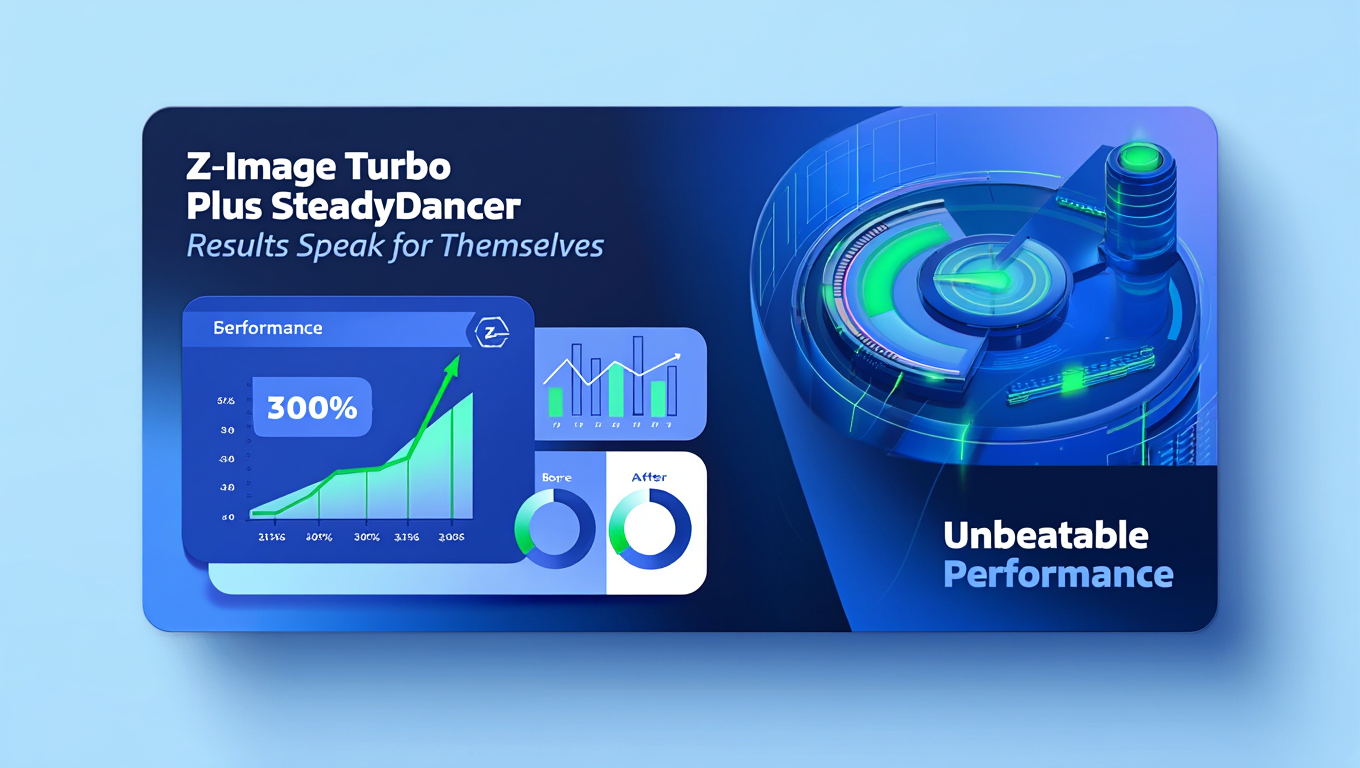
Some combinations in AI video generation just work better than expected. Z-Image Turbo paired with SteadyDancer falls into this category, producing dance and motion videos with stability that surprises even experienced creators. The results genuinely speak for themselves, delivering motion content that maintains coherence through complex choreography.
Quick Answer: Z-Image Turbo combined with SteadyDancer produces exceptionally stable dance and motion videos by using SteadyDancer's motion guidance with Z-Image Turbo's efficient generation, creating coherent choreography that maintains character consistency throughout.
- SteadyDancer provides motion guidance specifically optimized for dance
- Z-Image Turbo's speed enables rapid iteration on motion workflows
- Character consistency improves dramatically with this combination
- Complex choreography maintains coherence better than standard approaches
- The workflow produces professional-quality dance content efficiently
Dance content has historically been among the hardest AI video generation challenges. Bodies need to move coherently, limbs need to track properly through complex poses, and characters need to maintain identity through rapid motion. SteadyDancer addresses these challenges specifically, and when combined with Z-Image Turbo's capabilities, the results exceed what either achieves independently.
What Is SteadyDancer?
Purpose-Built for Dance Motion
SteadyDancer was developed specifically to address the challenges of generating dance and rhythmic motion content. Unlike general-purpose motion guidance, SteadyDancer understands the specific patterns and requirements of dance movements.
The system provides motion guidance optimized for the types of movements that appear in dance choreography. Quick direction changes, body isolations, and complex multi-limb coordination all benefit from SteadyDancer's specialized training.
Dance movements present unique challenges that general motion guidance handles poorly. SteadyDancer's focused approach produces better results for this specific content type than broader solutions.
How SteadyDancer Guides Generation
SteadyDancer provides frame-by-frame motion guidance that tells the generation model where body parts should be positioned. This guidance creates the structural consistency that dance videos require.
The guidance comes from analyzed dance reference footage or manually created motion sequences. SteadyDancer translates this motion information into a format Z-Image Turbo can follow during generation.
Think of SteadyDancer as a choreographer for AI generation. It doesn't create the visual style or content details but ensures the motion follows the intended choreography precisely.
Why Dance Is Particularly Hard
Dance challenges AI video generation in multiple ways that compound each other:
Rapid motion pushes temporal consistency limits. Bodies move quickly between positions, stressing the model's ability to maintain coherent form.
Complex poses require all body parts to position correctly simultaneously. Arms, legs, torso, and head must coordinate in anatomically plausible configurations.
Repeated patterns expose inconsistency. Dance often involves repeated movements, and any variation between repetitions becomes obvious.
Music synchronization demands precise timing. Dance movements need to align with audio beats, leaving no room for timing drift.
SteadyDancer addresses all these challenges through specialized motion guidance optimized for exactly these demands.
Why Does Z-Image Turbo Work So Well with SteadyDancer?
Speed Enables Iteration
Creating quality dance video requires experimentation. Different choreography interpretations, character designs, and style choices all need testing. Z-Image Turbo's generation speed makes this iteration practical.
Where other models might take hours to generate a test dance sequence, Z-Image Turbo produces results in minutes. This speed advantage transforms dance video production from an overnight batch process into an interactive creative session.
The ability to quickly try variations leads to better final results. Creators can explore options they would skip if each variation required hours of generation time.
Quality Under Motion Stress
Z-Image Turbo maintains quality even under the stress of rapid motion generation. Some models that produce excellent static content struggle when bodies start moving quickly.
The temporal consistency that Z-Image Turbo provides complements SteadyDancer's motion guidance. SteadyDancer ensures correct positioning while Z-Image Turbo ensures coherent rendering of those positions.
Character details survive motion better with Z-Image Turbo than many alternatives. Faces maintain identity. Clothing stays consistent. These details matter for dance content where characters need recognition throughout performances.
Efficient Resource Usage
Both Z-Image Turbo and SteadyDancer prioritize efficiency. The combination doesn't overwhelm hardware that handles either component individually.
This efficiency matters because dance video typically involves many frames. A 30-second dance at 30fps requires 900 frames. Efficiency multiplied across hundreds of frames creates significant time and resource differences.
Users with mid-range hardware can produce quality dance content. The combination doesn't demand top-tier GPUs to achieve good results.
What Results Can You Achieve?
Character Consistency Through Motion
The most impressive aspect of Z-Image Turbo plus SteadyDancer is character stability through complex motion. Characters maintain recognizable identity even through challenging choreography.
Facial features stay consistent as heads turn and tilt. Body proportions remain stable through poses that would distort with less capable systems. Clothing and accessories track properly with body movement.
This consistency creates the professional quality that separates impressive AI dance video from obvious AI artifacts.
Choreography Fidelity
Dance movements follow intended choreography accurately. When SteadyDancer provides specific motion guidance, Z-Image Turbo executes that guidance faithfully.
Complex moves that require precise timing execute correctly. Quick direction changes land on the right beats. Isolations affect only the intended body parts while others remain stable.
The combination successfully handles choreography that would fail with general-purpose video generation approaches.
Style Flexibility
Despite the motion constraints from SteadyDancer, Z-Image Turbo maintains flexibility in visual style. The same choreography can render in different visual treatments.
Photorealistic dancers, anime characters, stylized illustrations, and other visual approaches all work with SteadyDancer guidance. The motion remains consistent while style varies.
This flexibility enables creative exploration. Test choreography with simple character designs, then render final versions with detailed, production-quality visuals.
Diverse Dance Styles
Different dance genres work effectively with this combination:
Hip hop with its sharp isolations and quick directional changes generates well.
Contemporary with flowing movements and full-body coordination maintains coherence.
Ballet with precise positions and controlled movements renders clearly.
Street dance with complex footwork and body waves produces convincing results.
The versatility across dance styles demonstrates the robustness of the approach.
How Do You Set Up This Workflow?
Required Components
Implementing Z-Image Turbo with SteadyDancer requires several components working together:
Z-Image Turbo model provides the generation capability.
SteadyDancer nodes integrate motion guidance into ComfyUI workflows.
Reference motion provides the choreography SteadyDancer will guide generation to follow.
Compatible hardware handles the combined processing requirements.
Install each component and verify individual functionality before attempting the combined workflow.
Creating Motion Reference
SteadyDancer needs motion input to guide generation. Several approaches provide this input:
Extracted from video: Process existing dance footage to extract motion information. Dance covers, reference performances, or original choreography all work.
Motion capture data: Professional or consumer motion capture provides precise movement information directly usable by SteadyDancer.
Manual creation: Create motion guidance frame-by-frame for maximum control. Time-intensive but provides complete creative control.
Each approach has tradeoffs between effort, precision, and creative control.
Workflow Configuration
Connect the workflow components in this sequence:
- Load motion reference into SteadyDancer processing
- Generate frame-by-frame motion guidance
- Apply guidance to Z-Image Turbo generation pipeline
- Generate each frame with motion conditioning
- Compile frames into final video
Each stage requires appropriate node selection and parameter configuration.
Parameter Optimization
Several parameters significantly affect output quality:
SteadyDancer guidance strength controls how strictly generation follows motion. Higher values produce more accurate motion at potential cost to visual quality.
Z-Image Turbo step count affects generation quality. More steps improve detail but extend generation time.
Resolution impacts both quality and resource requirements. Balance based on final use requirements.
Start with moderate values and adjust based on test results.
What Limitations Should You Expect?
Not Magic
Despite impressive results, the combination has limitations. Extremely complex choreography can still challenge the system. Multiple interacting dancers introduce additional complexity.
Set realistic expectations. The results are excellent for AI-generated content but don't perfectly match professionally shot real footage.
Use the technology as a tool that accelerates creative work rather than expecting it to eliminate all effort.
Motion Reference Dependency
Output quality depends heavily on motion reference quality. Poorly extracted or noisy motion guidance produces inferior results regardless of other settings.
Invest time in quality motion reference preparation. The effort pays off across all generations using that reference.
Multiple dance sequences require multiple motion references. Plan reference preparation as part of project timelines.
Character Limitations
Certain character types present more challenges than others. Very loose clothing introduces motion complexity. Complex hairstyles may not track perfectly. Accessories can behave unexpectedly.
Test character designs with motion before committing to production. Simple adjustments to character design often resolve problems.
Audio Synchronization
SteadyDancer handles motion but doesn't automatically synchronize to audio. Ensuring dance movements align with music requires attention during motion reference preparation.
Plan choreography to match intended music before creating motion reference. Attempting to adjust timing after generation is much more difficult.
How Do You Get the Best Results?
Quality Motion Reference
Start with the best possible motion reference. Clean, stable input produces clean, stable output.
If extracting from video, use high-quality source footage. Good lighting, clean backgrounds, and stable cameras all improve extraction quality.
Review extracted motion for errors before using for generation. Fix problems in the motion data rather than hoping generation will overcome them.
Appropriate Complexity
Match choreography complexity to system capabilities. Start with simpler movements and increase complexity as you understand the system's strengths and limitations.
Break complex sequences into shorter segments if needed. Generate segments separately, then combine in post-production.
Simple choreography executed well looks better than complex choreography with artifacts.
Iterative Refinement
Use Z-Image Turbo's speed advantage to iterate toward better results. Generate quick tests, evaluate, adjust, repeat.
Don't expect perfect results on first attempts. The iteration process leads to understanding what works for your specific content and style goals.
Document successful configurations for reuse. When you find settings that work well, save them as templates.
Post-Processing Polish
Generation provides the foundation. Post-processing adds polish.
Frame interpolation can smooth any remaining motion inconsistencies. Color grading unifies visual style. Audio integration completes the professional package.
For users who want dance video capability without managing complex workflows, platforms like Apatero.com are developing motion-controlled generation that handles technical complexity internally.
Frequently Asked Questions
Does SteadyDancer work only for dance?
SteadyDancer is optimized for dance but works for other rhythmic or performance motion. Any content with similar motion characteristics can benefit.
Can I use my own dancing as reference?
Yes, record yourself performing choreography, extract the motion, and use it as SteadyDancer reference. Your movements become guidance for AI generation.
How long does generation take?
Generation time depends on clip length, resolution, and hardware. A 15-second dance clip at 720p might take 5-10 minutes on capable hardware.
What hardware do I need?
12GB+ VRAM handles most dance generation workflows. Higher VRAM enables longer clips and higher resolutions.
Can multiple dancers work?
Multiple dancers are possible but increase complexity. Each dancer needs motion reference. Interactions between dancers require careful guidance.
How do I add music?
Add music in post-production after video generation. Ensure your motion reference was created with intended music timing in mind.
Does this work with anime characters?
Yes, SteadyDancer motion guidance works across visual styles including anime. Z-Image Turbo renders the motion in whatever style you specify.
Can I sell content created this way?
Check license terms for all components used. Most allow commercial use but verify before selling content.
Conclusion
Z-Image Turbo combined with SteadyDancer delivers dance and motion video quality that genuinely impresses. The specialized motion guidance from SteadyDancer paired with Z-Image Turbo's efficient, high-quality generation creates results that speak for themselves.
The combination addresses dance video's specific challenges through purpose-built solutions rather than general-purpose workarounds. Character consistency, choreography fidelity, and motion stability all exceed what general video generation approaches achieve.
Setting up the workflow requires some technical investment, but the results justify the effort. Once configured, the system enables rapid iteration and production of professional-quality dance content.
For creators interested in dance video without the technical setup, platforms like Apatero.com are developing accessible interfaces that incorporate similar motion guidance capabilities. Whether through custom workflows or managed platforms, quality AI dance video is becoming accessible to creators at all technical levels.
Render the video you just read about
Kling, Veo, Seedance and more, in your browser, no queue to build. Check your welcome allowance and the displayed cost before generating.
Related Articles
5 Proven AI Influencer Niches That Actually Make Money in 2025
Discover the most profitable niches for AI influencers in 2025. Real data on monetization potential, audience engagement, and growth strategies for virtual content creators.
AI Background Replacement: Professional Guide 2025
Master AI background replacement for professional results. Learn rembg, BiRefNet, and ComfyUI workflows for smooth background removal and replacement.
AI Character Consistency: How to Maintain Virtual Persona Identity Across Content
Learn techniques for maintaining AI character consistency across hundreds of images. Master the art of creating recognizable virtual personas with consistent visual identity.