Z-Image + SeedVR2 4K Generation - Ultimate Quality Workflow Guide 2025
Combine Z-Image Turbo with SeedVR2 upscaling for stunning 4K image generation. Complete guide to the optimal two-stage workflow for maximum resolution and detail.
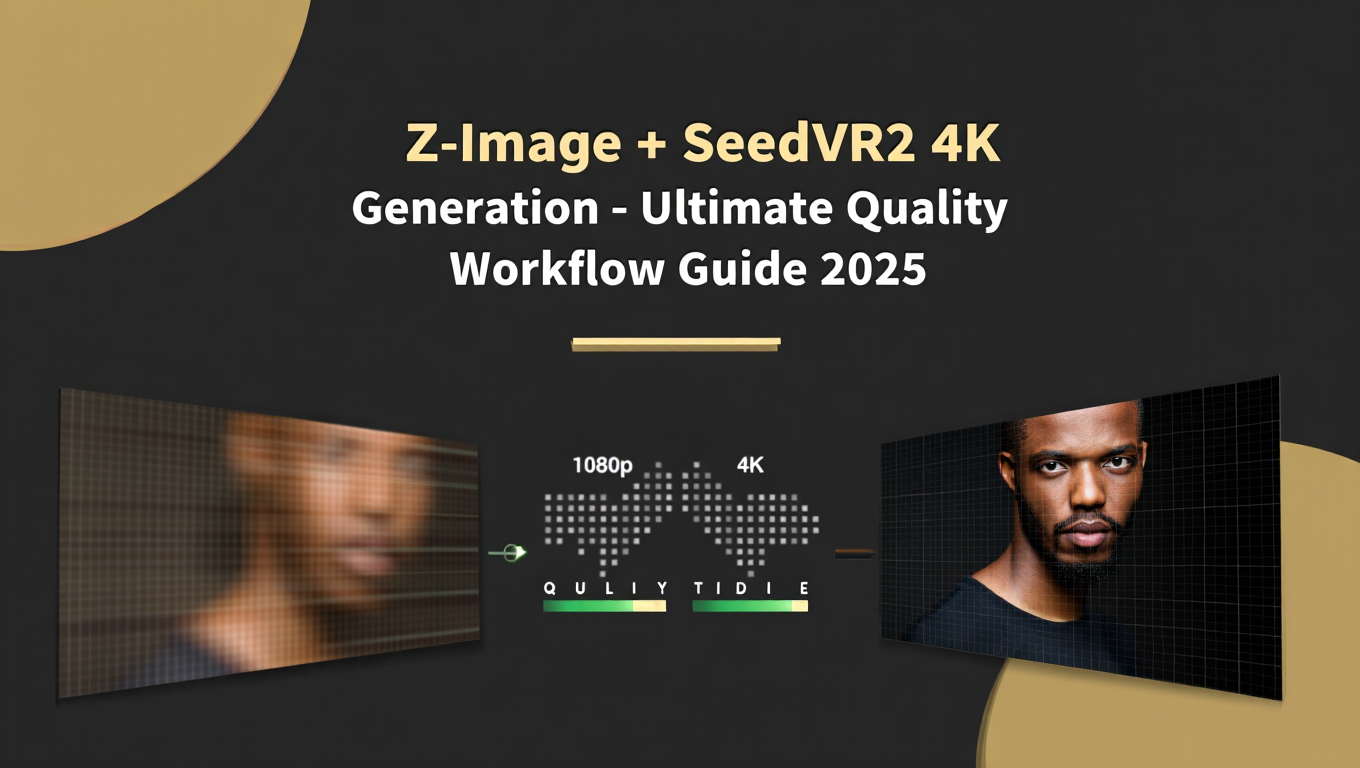
Generating AI images at 1024x1024 produces excellent results, but many applications demand 4K resolution or higher. The combination of Z-Image Turbo for base generation with SeedVR2 for intelligent upscaling delivers 4K outputs that maintain detail and coherence, rivaling images generated natively at impossible VRAM requirements.
Quick Answer: Z-Image Turbo generates at 1024x1024 with exceptional photorealistic quality, then SeedVR2 upscales to 4K using AI that understands image content rather than simple interpolation. The result is 4096x4096 images with sharp details, realistic textures, and no upscaling artifacts.
- Two-stage approach achieves 4K without massive VRAM requirements
- SeedVR2 preserves and enhances Z-Image's photorealistic detail
- 7B FP16 model produces highest quality, 3B FP8 offers speed
- GGUF quantization enables 4K on 8GB VRAM GPUs
- Workflow produces print-ready images from AI generation
Why Combine Z-Image With SeedVR2?
Native 4K generation would require exponentially more compute and VRAM than current consumer hardware provides. The smarter approach generates high-quality base images at manageable resolutions, then uses specialized upscaling that understands image content.
Z-Image Turbo produces exceptional 1024x1024 outputs with photorealistic detail, proper lighting, and coherent textures. SeedVR2, developed by ByteDance, uses a Diffusion Transformer architecture specifically trained for upscaling, understanding how to enhance detail rather than simply interpolating pixels.
The combination produces 4K images indistinguishable from hypothetical native 4K generation, at a fraction of the computational cost.
- Setting up the Z-Image to SeedVR2 pipeline
- Choosing between SeedVR2 model variants
- Optimal parameters for different output sizes
- VRAM optimization for consumer hardware
- Quality comparison across configurations
How Do You Set Up the 4K Generation Pipeline?
The workflow involves sequential processing through Z-Image Turbo then SeedVR2, with specific configuration for each stage.
Stage 1 - Z-Image Turbo Generation
Configure Z-Image with standard settings for your base generation.
| Parameter | Value |
|---|---|
| Resolution | 1024x1024 |
| Steps | 8 |
| CFG | 4-5 |
| Model | z_image_turbo_bf16.safetensors |
Generate your base image focusing on composition and subject quality. The 1024x1024 resolution provides sufficient detail for SeedVR2 to work effectively.
Stage 2 - SeedVR2 Upscaling
Process the Z-Image output through SeedVR2 with these parameters.
| Parameter | Value |
|---|---|
| Scale Factor | 4x (1024 to 4096) |
| Model | 7B FP16 for quality, 3B FP8 for speed |
| Output Format | PNG for maximum quality |
Installing SeedVR2 for ComfyUI
Install the ComfyUI-SeedVR2 custom nodes from the official repository. The installation includes both upscaler nodes and model management utilities.
Place SeedVR2 model files in the designated ComfyUI models directory. Model files are substantial so ensure adequate storage.
What SeedVR2 Model Should You Choose?
SeedVR2 offers multiple model configurations balancing quality, speed, and VRAM requirements.
Model Comparison:
| Model | Quality | Speed | VRAM Required |
|---|---|---|---|
| 7B FP16 | Maximum | Slower | 24GB+ |
| 7B FP8 | Excellent | Moderate | 16GB |
| 3B FP8 | Very Good | Fast | 10-12GB |
| 7B GGUF Q8 | Excellent | Moderate | 8GB |
| 7B GGUF Q4 | Good | Fast | 6GB |
When to Use 7B FP16:
Choose the full 7B FP16 model when maximum quality matters, you have 24GB+ VRAM available, and processing time isn't critical. This configuration produces the sharpest results with best detail preservation.
When to Use 3B FP8:
The 3B variant offers excellent speed-quality balance for iterative work. Use when testing compositions before final 7B processing, working with batch operations, or VRAM limits prevent 7B operation.
When to Use GGUF Quantization:
GGUF versions democratize 4K generation for consumer hardware. The 7B GGUF Q8 model on 8GB VRAM produces results remarkably close to full precision, making professional 4K accessible to most users.
What Quality Differences Exist Between Configurations?
Understanding quality trade-offs helps you choose appropriate configurations for different use cases.
Detail Preservation by Model:
The 7B FP16 model produces noticeably sharper results when pixel-peeping at 100% zoom. Hair strands, fabric textures, and skin pores show clearer definition compared to quantized versions.
At normal viewing distances or social media resolutions, differences between 7B FP16 and 3B FP8 become subtle. The quality gap matters most for large prints or detailed examination.
Artifact Comparison:
| Model | Sharpness | Texture Quality | Artifact Risk |
|---|---|---|---|
| 7B FP16 | Excellent | Excellent | Minimal |
| 7B FP8 | Excellent | Very Good | Low |
| 3B FP8 | Very Good | Good | Low |
| 7B GGUF | Very Good | Good | Low |
Practical Recommendations:
For portfolio work, client deliverables, and print output, use 7B FP16 if hardware permits. For social media, web use, and iteration, 3B FP8 or GGUF variants provide excellent quality with practical resource usage.
How Do You Optimize VRAM Usage?
Running both Z-Image and SeedVR2 requires careful memory management on consumer hardware.
Sequential Model Loading:
Don't keep both models loaded simultaneously unless you have 40GB+ VRAM. Unload Z-Image after generation before loading SeedVR2 for upscaling.
Batch Processing Strategy:
Generate multiple Z-Image outputs first, saving to disk. Then switch to SeedVR2 and batch process all upscaling. This minimizes model switching overhead.
GGUF for Limited VRAM:
With GGUF quantization, the full pipeline runs on 8GB GPUs. Generate with Z-Image GGUF variant, upscale with SeedVR2 GGUF. Quality remains high despite quantization.
Resolution Stepping:
For extreme upscaling (8K+), use multiple 2x passes rather than single 4x passes. This produces better results while managing VRAM through smaller intermediate outputs.
For users without high-VRAM GPUs, Apatero.com provides cloud-based access to optimized upscaling pipelines without local hardware requirements.
What Upscaling Settings Work Best?
SeedVR2 parameters affect output quality and processing characteristics.
Scale Factor Selection:
| Target Resolution | Source | Scale Factor |
|---|---|---|
| 2048x2048 | 1024x1024 | 2x |
| 4096x4096 | 1024x1024 | 4x |
| 4096x4096 | 2048x2048 | 2x |
| 8192x8192 | 2048x2048 | 4x |
Quality Parameters:
SeedVR2's diffusion-based approach means higher step counts can improve quality. Default settings work well, but experimentation with inference steps may benefit specific content types.
Output Formats:
Save 4K outputs as PNG for maximum quality preservation. JPEG at high quality (95+) provides smaller files with minimal visible loss. Avoid heavy compression that negates upscaling benefits.
How Does This Compare to Other Upscaling Methods?
SeedVR2 represents state-of-the-art AI upscaling, but alternatives exist for different needs.
SeedVR2 vs. ESRGAN:
| Aspect | SeedVR2 | ESRGAN |
|---|---|---|
| Architecture | Diffusion Transformer | GAN |
| Detail Generation | Creates new detail | Enhances existing |
| Artifact Risk | Lower | Higher on some content |
| Processing Speed | Slower | Faster |
| VRAM Required | Higher | Lower |
SeedVR2 vs. Simple Upscalers:
Traditional upscaling (bicubic, Lanczos) interpolates pixels without understanding content. SeedVR2's AI approach generates appropriate detail based on image understanding, producing dramatically superior results for AI-generated content.
When SeedVR2 Excels:
AI-generated images benefit most from SeedVR2 because the upscaler understands typical generation artifacts and how to resolve them. Skin, fabric, and natural textures see particular improvement.
Frequently Asked Questions
Can I upscale directly to 8K?
Yes, using 8x scale or two 4x passes. Quality remains excellent though processing time increases significantly. Ensure your workflow handles the large output files.
Does SeedVR2 add detail that wasn't in the original?
SeedVR2 generates plausible detail based on image understanding rather than simply interpolating. This hallucinated detail is typically appropriate and enhances perceived quality.
How does SeedVR2 handle text in images?
Text upscaling works reasonably well but may show some artifacts. For critical text, consider generating at higher base resolution or post-processing text areas specifically.
Can I use SeedVR2 on non-AI-generated images?
Absolutely. SeedVR2 works well on photographs, scans, and other image types. AI-generated images show particular benefit due to upscaler training, but all images improve.
What's the speed difference between 7B and 3B models?
Approximately 2-3x faster for 3B FP8 compared to 7B FP16. Actual times depend on hardware, but expect significant speed improvement with moderate quality trade-off.
Does Z-Image resolution affect upscaling quality?
Higher base resolution generally produces better upscaled results. If possible, generate at 1024x1024 rather than 512x512 before upscaling for optimal 4K output.
Can I chain multiple upscaling passes?
Yes, and this can produce superior results to single large-factor upscaling. Two 2x passes often outperform single 4x pass, though processing time doubles.
How large are 4K output files?
PNG files at 4096x4096 typically range from 15-50MB depending on content complexity. Ensure adequate storage for large batches.
Conclusion
Z-Image Turbo combined with SeedVR2 upscaling delivers professional 4K output from consumer hardware. The two-stage approach sidesteps impossible VRAM requirements while producing results that rival hypothetical native high-resolution generation.
Key Implementation Points:
Generate with Z-Image at 1024x1024 for optimal base quality. Process through SeedVR2 with appropriate model selection for your hardware. Use GGUF quantization to enable 4K on limited VRAM systems.
Best Applications:
Print production, portfolio work, large displays, and any application requiring resolution beyond native generation capabilities. The combination excels where detail matters.
Getting Started:
Install SeedVR2 custom nodes, configure model loading for your VRAM, and test with standard Z-Image outputs. Once comfortable with the pipeline, optimize for your specific quality and speed requirements.
Platforms like Apatero.com offer cloud-based high-resolution generation for users preferring simplified access without local hardware configuration.
The democratization of 4K AI image generation through efficient workflows like Z-Image + SeedVR2 transforms what's possible for creators at every hardware level. Professional-quality high-resolution output is no longer limited to expensive cloud services or enterprise hardware.
Some models you cannot download at any VRAM
Veo, Kling and Nano Banana have closed weights. There is no local build, no quantization, no 24GB workaround. Run them in the browser instead. Check current model access and generation costs in the app.
Related Articles
5 Proven AI Influencer Niches That Actually Make Money in 2025
Discover the most profitable niches for AI influencers in 2025. Real data on monetization potential, audience engagement, and growth strategies for virtual content creators.

AI Background Replacement: Professional Guide 2025
Master AI background replacement for professional results. Learn rembg, BiRefNet, and ComfyUI workflows for smooth background removal and replacement.

AI Character Consistency: How to Maintain Virtual Persona Identity Across Content
Learn techniques for maintaining AI character consistency across hundreds of images. Master the art of creating recognizable virtual personas with consistent visual identity.