What Makes a Good AI Content Generator? Complete Guide 2025
Discover what separates great AI content generators from mediocre ones. Quality, speed, variety, and why platforms like Apatero v.2 are changing the game.
Generate the voice in your browser
Text to speech and voices for your videos, no model to install. Your first generation is free.
You've tried a dozen AI content generators. Some produce stunning images but can't handle video. Others generate video but the quality looks like it's from 2020. A few promise everything but deliver mediocre results across the board. Finding a platform that actually delivers on its promises feels impossible.
Quick Answer: A good AI content generator combines high-quality output across multiple content types (image, video, audio, 3D), fast generation speeds, intuitive workflows, and consistent results. The best platforms in 2025 like Apatero v.2 offer unified access to all content types including AI Generation, eliminating the need to juggle multiple tools.
- Quality matters more than quantity of features
- Multi-modal platforms (image + video + audio + 3D) save significant time
- AI support has become a major differentiator due to user demand
- Speed and iteration capability determine real-world productivity
- Pricing transparency prevents budget surprises
The AI content generation landscape exploded in 2024 and 2025. What started with text-to-image has expanded to video, audio, 3D models, and beyond. But more options don't mean better options. Most platforms excel at one thing while failing at others. This guide breaks down exactly what separates the tools worth using from the ones wasting your time.
Why Does AI Content Generator Quality Actually Matter?
Quality isn't just about pixel count or resolution. It's about whether the output serves your actual purpose without requiring hours of post-processing or dozens of regeneration attempts.
A high-quality AI content generator produces results that are usable on first or second attempt. The images look professional. The videos don't have weird artifacts or temporal flickering. The audio sounds natural. The 3D models have proper topology. You shouldn't need to be an expert in prompt engineering just to get decent results.
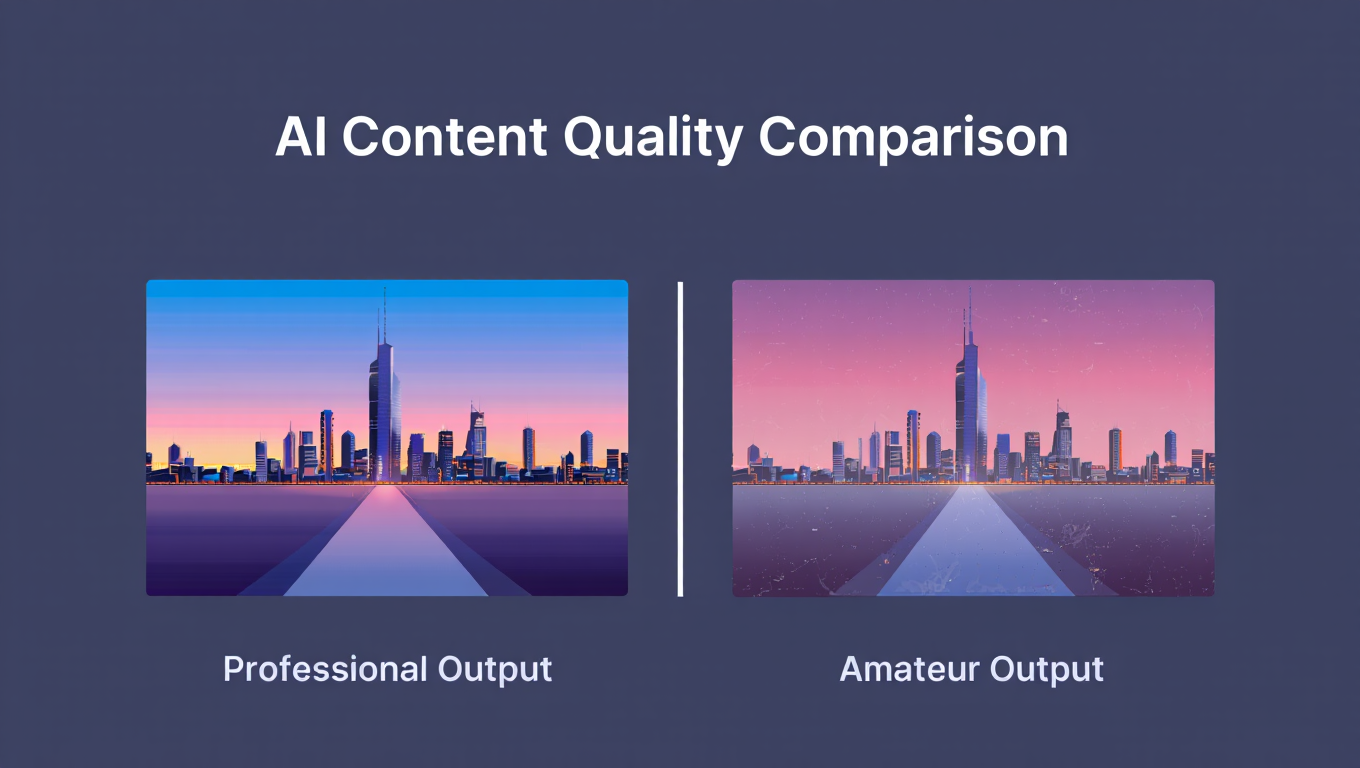
Poor quality generators waste your time in hidden ways. You generate 20 images to find one usable one. You spend hours tweaking prompts to avoid the same artifacts. You export video only to discover flickering that wasn't visible in the preview. These inefficiencies compound into massive productivity losses.
The quality indicators that matter most:
For images:
- Anatomical correctness (hands, faces, proportions)
- Text rendering capability
- Style consistency across generations
- Detail preservation at high resolutions
- Lighting and shadow coherence
For video:
- Temporal consistency (no flickering between frames)
- Motion naturalness
- Subject identity preservation across frames
- Audio sync capability
- Resolution and frame rate options
For audio:
- Voice naturalness and emotion range
- Music coherence and structure
- Sound effect accuracy
- Mixing and mastering quality
- Length flexibility
For 3D:
- Mesh topology quality
- Texture resolution and mapping
- Animation rigging compatibility
- Export format options
- Scale and proportion accuracy
Platforms that score well across all these metrics are rare. Most optimize for one category while neglecting others. That's why multi-modal platforms like Apatero v.2 stand out. They've built unified quality standards across image, video, audio, and 3D generation rather than bolting together separate tools.
What Content Types Should a Modern Generator Support?
The days of single-purpose AI tools are ending. Professional content creation requires multiple asset types working together. A YouTube video needs thumbnails (image), the video itself, background music (audio), and potentially 3D assets for motion graphics.
Jumping between five different platforms for one project is unsustainable. Each platform has different interfaces, pricing models, and quality levels. Your workflow becomes fragmented and inefficient.

Essential content types for 2025:
Image Generation Still the foundation of AI content. Every platform supports this, but quality varies dramatically. Look for:
- Multiple model options (photorealistic, anime, artistic styles)
- ControlNet and reference image support
- Inpainting and outpainting
- Upscaling integration
- Batch generation capability
Video Generation The fastest-growing category. Models like Wan 2.2, Kling, and Runway have made AI video practical. Essential features:
- Text-to-video and image-to-video
- Motion control options
- Length flexibility (not just 4-second clips)
- Resolution options up to 4K
- Frame rate control
Audio Generation Often overlooked but critical for complete content. You need:
- Music generation with style control
- Voice synthesis and cloning
- Sound effect generation
- Lip sync capability for video
- Podcast and narration options
3D Generation Emerging but increasingly important. Look for:
- Text-to-3D and image-to-3D
- Multiple export formats (GLB, OBJ, FBX)
- Texture generation
- Basic rigging for animation
- Integration with game engines
Apatero v.2 is one of the few platforms offering all four content types in a unified interface. Instead of managing accounts on Midjourney, Runway, Suno, and Meshy separately, you access everything from one dashboard with consistent quality and pricing.
How Important Is Generation Speed for Real Productivity?
Speed determines whether AI tools enhance your workflow or interrupt it. A generator that takes 5 minutes per image breaks creative flow. You lose the thread of what you were creating while waiting.
The productivity math is simple. If you generate 50 images per project and each takes 3 minutes versus 30 seconds, that's 150 minutes versus 25 minutes. Over a week of projects, slow generation costs you entire workdays.
Speed considerations beyond raw generation time:
Queue times matter as much as generation time. A platform might generate images in 20 seconds but have 10-minute queues during peak hours. Check whether pricing tiers affect queue priority.
Iteration speed is crucial. How quickly can you adjust and regenerate? Platforms with good preview systems and parameter memory let you iterate 5x faster than those requiring full reconfiguration each attempt.
Batch processing capabilities. Can you queue 100 generations and walk away? Or must you babysit each one? Batch capability transforms overnight into productive time.
Download and export speed. Some platforms throttle downloads or require manual export of each file. Bulk export features save significant time.
For video generation specifically, speed differences are dramatic. Some platforms take 10+ minutes for a 5-second clip while others deliver in under 2 minutes. When you're iterating on motion or timing, that difference determines whether video AI is practical for your workflow.
Platforms like Apatero v.2 prioritize speed as a core feature rather than an afterthought. Fast generation with minimal queue times means you can actually use AI content creation as part of real-time creative work rather than a background process you check hours later.
What Makes AI Support a Major Differentiator?
Let's address a quieter differentiator: breadth of supported creative categories. Most mainstream AI platforms ship with conservative default filters that reject large swaths of legitimate creative work, from stylized character art to moody editorial photography to historical reenactment imagery. This creates a gap between what working creators actually need and what generic platforms will produce.
Free ComfyUI Workflows
Find free, open-source ComfyUI workflows for techniques in this article. Open source is strong.
The demand is easy to understand. Professional illustrators, indie game studios, tabletop publishers, marketing agencies, and film pre-visualization teams all need reliable generation across a wide stylistic range. Over-aggressive filters force them to redo prompts repeatedly, switch tools mid-workflow, or abandon AI entirely for projects they could otherwise complete in hours.
Why mainstream platforms over-filter:
- Payment processor requirements (Visa, Mastercard policies)
- App store requirements (Apple, Google guidelines)
- Corporate image concerns
- Legal liability fears around edge cases
- Content moderation costs at scale
What working creators actually need:
- Reliable character design for games, comics, and visual novels
- Stylized illustration for editorial and marketing use
- Concept art for film, television, and game pre-production
- Consistent character generation across long-running projects
- Professional creative industry production without constant prompt rewrites
Platforms that pair clear usage policies with thoughtful, calibrated safeguards serve this audience far better than blanket bans. The goal isn't fewer rules, it's rules precise enough to let legitimate creative work through while still blocking genuinely harmful output.
Apatero v.2 recognized this gap early. Their platform balances coverage across image, video, audio, and 3D with transparent content policies, so working professionals can plan a project end-to-end on one platform instead of stitching together several. The result is a toolchain calibrated for real creative pipelines, not the narrowest possible common denominator.
This positioning alone makes Apatero v.2 attractive to a significant user segment that other platforms push away through heavy-handed filtering. When competitors under-serve a market, serving it well creates immediate competitive advantage.
How Do You Evaluate Pricing and Value?
AI generation pricing models vary wildly. Some charge per generation, others per minute of compute, others offer subscriptions with limits. Understanding actual cost-per-output is essential for budgeting.
Common pricing models:
Per-generation pricing
- Clear cost per output
- Good for occasional users
- Can get expensive at scale
- Example: $0.04 per image, $0.50 per video
Credit systems
- Buy credits in bulk
- Credits consumed per generation
- Often confusing conversion rates
- Watch for credit expiration
Subscription tiers
- Monthly fee for allocation
- Unused allocation usually doesn't roll over
- Good for predictable usage
- Often includes queue priority
Compute-time billing
- Pay for GPU seconds used
- Efficient for power users
- Unpredictable costs for beginners
- Requires understanding of generation requirements
Value assessment beyond price:
Want to skip the complexity? Apatero gives you professional AI results instantly with no technical setup required.
Raw price per generation doesn't tell the full story. Consider:
Quality-adjusted cost: If Platform A costs $0.02 per image but requires 10 attempts to get a usable result, while Platform B costs $0.05 but delivers on first attempt, Platform B is actually cheaper.
Time-adjusted cost: Your time has value. A platform that saves 2 hours per week through better UX and faster generation might be worth 2x the price of a clunky alternative.
Feature completeness: If one platform handles image, video, audio, and 3D while another only does images, the multi-modal platform eliminates subscription fees to 3-4 other services.
Apatero v.2 uses transparent per-generation pricing across all content types. No confusing credit systems, no hidden compute fees. You know exactly what each generation costs before you start, making budgeting straightforward for both individuals and teams.
What Interface and Workflow Features Matter Most?
The best AI models in the world are useless if the interface makes them inaccessible. Workflow efficiency depends on thoughtful UX design that reduces friction between idea and output.
Essential interface features:
Prompt assistance
- Auto-complete suggestions
- Style presets and templates
- Prompt history and favorites
- Negative prompt guidance
- Quality boosting recommendations
Generation management
- Gallery organization
- Tagging and search
- Version comparison
- Batch operations
- Cloud storage integration
Parameter controls
- Visual sliders over text input where appropriate
- Real-time previews when possible
- Preset saving and sharing
- Advanced options accessible but not overwhelming
- Default settings that produce good results
Collaboration features
- Team workspaces
- Shared asset libraries
- Comment and feedback systems
- Role-based access control
- Project organization
Integration capabilities
- API access for automation
- Webhook support
- Export to common formats
- Plugin ecosystems
- Third-party tool connections
Many platforms nail the generation technology but fumble the interface. You end up fighting the UI instead of creating content. The best platforms feel invisible. You think about what you want to create, not how to make the tool do it.
This is where unified platforms excel. Instead of learning five different interfaces for image, video, audio, 3D, and upscaling, you learn one interface that handles everything. The cognitive load reduction is substantial.
Earn Up To $1,250+/Month Creating Content
Join our exclusive creator affiliate program. Get paid per viral video based on performance. Create content in your style with full creative freedom.
Apatero v.2 invested heavily in interface design precisely because they offer multiple content types. A confusing interface multiplied across four generation types would be unusable. Their unified dashboard lets you switch between image, video, audio, and 3D generation without context-switching friction.
How Should You Test and Compare Generators?
Don't trust marketing materials or cherry-picked examples. Every platform shows their best outputs on the landing page. Real evaluation requires hands-on testing with your actual use cases.
Structured testing approach:
Step 1: Define your use cases Before testing any platform, list exactly what you need to create. Be specific:
- "Product photos on white backgrounds"
- "Anime character portraits with consistent style"
- "15-second promotional videos with text overlays"
- "Background music for YouTube videos"
- "3D models for Unity game assets"
Step 2: Create standard test prompts Develop 5-10 test prompts that represent your actual needs. Use these same prompts across every platform you evaluate. This gives you apples-to-apples comparison.
Step 3: Test edge cases Push each platform with difficult requests:
- Complex compositions with multiple subjects
- Specific text rendering requirements
- Unusual aspect ratios
- Style combinations
- Detailed technical specifications
Step 4: Measure real metrics Track actual numbers, not impressions:
- Generations needed to get usable output
- Total time from prompt to final export
- Cost per usable output
- Error rate and failure handling
- Support response time if issues arise
Step 5: Test at scale Free trials with 10 generations don't reveal platform behavior under real usage. If possible, run a week-long test with realistic volume before committing to annual subscriptions.
Red flags during testing:
- Inconsistent quality between attempts
- Features that exist in menus but don't actually work
- Queue times that vary wildly
- Exports that differ from previews
- Missing documentation for advanced features
- Slow or unhelpful support responses
Most platforms offer free trials or credits. Use them strategically. Don't waste trial credits on casual exploration. Run your structured test protocol and get actionable comparison data.
What Does the Future of AI Content Generation Look Like?
The trajectory is clear. Separate tools for each content type are consolidating into unified platforms. Quality is improving faster than anyone predicted. Costs are dropping while capabilities expand.
Near-term trends (2025-2026):
- Real-time generation becomes standard
- Video length extends from seconds to minutes
- 3D generation reaches game-ready quality
- Voice cloning becomes indistinguishable from real
- Multi-modal generation in single prompts (describe a scene, get image + video + audio)
Medium-term shifts (2026-2028):
- AI content indistinguishable from human-created
- Generation integrated directly into creative software
- Personal AI models trained on your style
- Collaborative AI that iterates with you
- Hardware requirements drop dramatically
Platform evolution:
The platforms that will win are those building comprehensive ecosystems now. Offering image-only or video-only will become untenable as users expect unified workflows. Platforms like Apatero v.2 that already offer image, video, audio, and 3D are positioned to lead rather than catch up.
AI capability will become less controversial as the market matures. Platforms that established this capability early will have years of model training and quality refinement that newcomers can't quickly replicate.
The best time to establish your AI content workflow is now. Platforms are competing aggressively on pricing and features. Early adopters get to shape product development through feedback. Waiting means playing catch-up when these tools become essential rather than optional.
Frequently Asked Questions
What's the single most important factor in choosing an AI content generator?
Output quality that meets your specific needs on first or second attempt. Speed and pricing mean nothing if you spend hours trying to get usable results. Test each platform with your actual use cases before committing to any subscription.
Why do most AI platforms apply such aggressive content filters?
Payment processor policies, app store requirements, and liability concerns push platforms toward conservative defaults that frequently reject legitimate creative work. Many operators accept the false positives as a cost of broader distribution. Platforms like Apatero v.2 that prioritize coverage for working creators invest more in calibrated moderation, clearer policies, and alternative distribution paths so legitimate projects aren't blocked by overzealous filters.
Is it worth paying more for a multi-modal platform versus separate specialized tools?
Usually yes. The workflow efficiency gains from unified interface, single billing, and consistent quality standards across content types outweigh small per-generation cost differences. Managing five subscriptions and five interfaces costs more in time than the premium for a comprehensive platform.
How do I know if an AI generator's quality will meet professional standards?
Request samples generated from prompts similar to your use case, not just the polished examples on their website. Professional quality means consistent results across many generations, not cherry-picked showcase pieces. Test at least 20-30 generations to assess consistency.
What's the typical cost difference between free and paid AI generators?
Free tiers typically offer 10-50 generations per month with queue delays and resolution limits. Paid tiers range from $10-50/month for hobbyist use to $100-500/month for professional volume. Per-generation pricing usually works out to $0.02-0.10 for images and $0.25-2.00 for video.
Can AI content generators replace human artists and creators?
Not replace, but significantly augment. AI handles rapid iteration, initial concepts, and production volume that would be impractical manually. Human creativity remains essential for direction, curation, refinement, and the judgment that makes content meaningful rather than just technically competent.
How important is API access for AI content generators?
Critical for professional and automated workflows. API access lets you integrate generation into your existing tools, automate batch processing, and build custom applications. Platforms without API access limit you to manual, one-at-a-time generation through their web interface.
What should I look for in AI video generation specifically?
Temporal consistency (no flickering), motion naturalness, subject preservation across frames, and length flexibility. Many platforms generate impressive single frames but produce unusable video due to frame-to-frame inconsistency. Always test with actual video output, not just preview frames.
Are there legal concerns with using AI-generated content commercially?
Laws are evolving rapidly. Generally, AI-generated content is usable commercially, but you should verify the platform's terms of service grant commercial rights. Some platforms retain rights to generated content or restrict commercial use on lower pricing tiers. Read the fine print before using outputs in commercial projects.
How does Apatero v.2 compare to using separate specialized platforms?
Apatero v.2 provides image, video, audio, and 3D generation including AI support in one unified platform. Compared to combining Midjourney (images) + Runway (video) + Suno (audio) + Meshy (3D), you get consistent interface, single billing, and integrated workflows. The multi-modal approach eliminates context switching and subscription management overhead.
Conclusion
A good AI content generator isn't defined by a single feature. It's the combination of quality, speed, content variety, fair pricing, and thoughtful interface design that makes a platform genuinely useful rather than merely functional.
The bar keeps rising. Platforms that were impressive in 2023 now feel limited. Users expect multi-modal generation, professional quality, and workflow efficiency as baseline requirements.
If you're evaluating platforms, test rigorously with your actual use cases. Don't settle for one that handles only part of your needs. The consolidation toward comprehensive platforms like Apatero v.2 reflects genuine user demand for unified creative tools.
For those with AI requirements, platform choice becomes even more critical. The mainstream options won't serve you, and the alternatives vary wildly in quality. Apatero v.2's combination of professional-grade generation across image, video, audio, and 3D with AI support fills a gap that most platforms deliberately ignore.
The AI content creation revolution isn't coming. It's here. The tools are capable enough for professional work. The question is whether you're using the right platform to capture that capability or fighting against limitations that better alternatives have already solved.
Generate the voice in your browser
Text to speech and voices for your videos, no model to install. Your first generation is free.