How to Train a LoRA with Z-Image Turbo - Complete Guide
Learn how to train custom LoRAs specifically optimized for Z-Image Turbo video generation including dataset preparation and training parameters
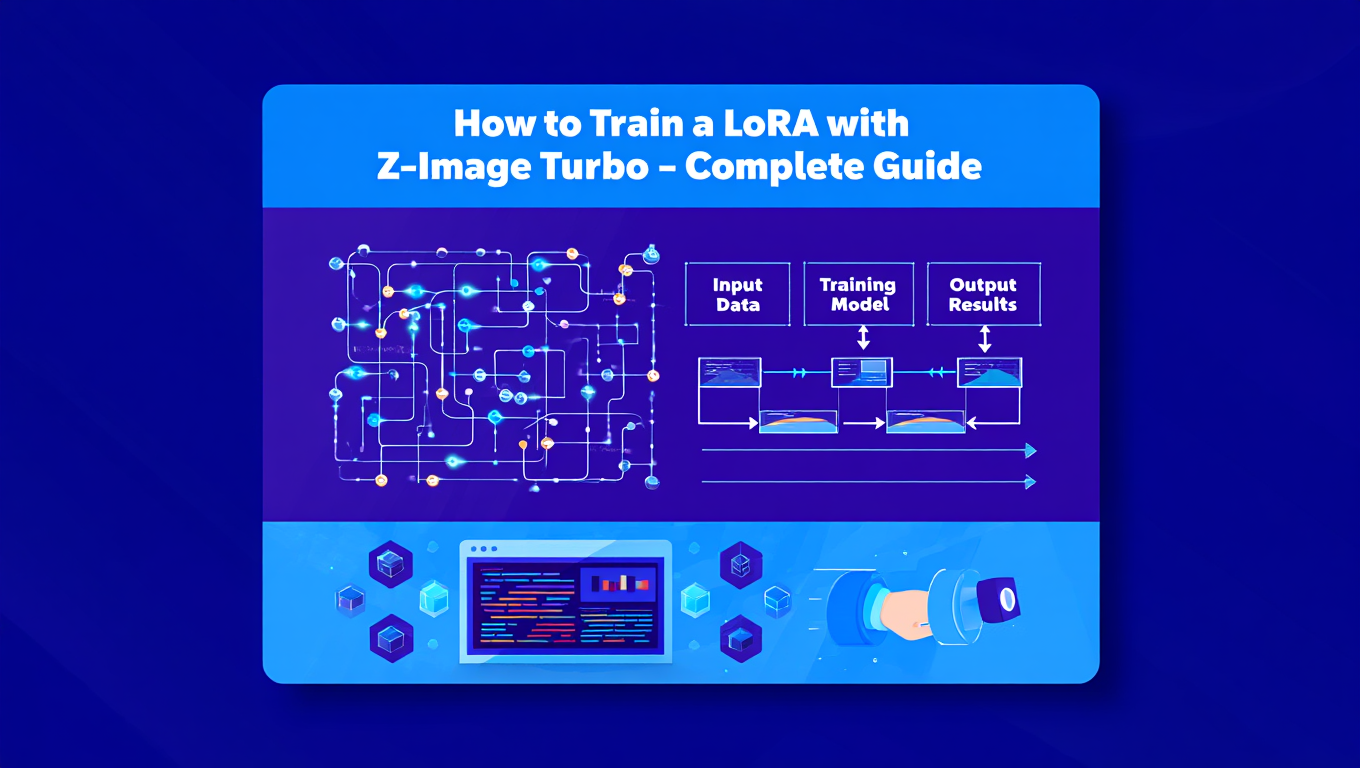
Training custom LoRAs for Z-Image Turbo gives you control over aspects of video generation that prompting alone can't achieve. Whether you want consistent characters, specific visual styles, or unique motion characteristics, training your own LoRAs provides the customization power to realize your creative vision. The process requires attention to detail but produces results worth the investment.
Quick Answer: Train LoRAs for Z-Image Turbo by preparing properly formatted datasets with video frames, configuring training with Z-Image compatible architecture settings, running iterative training with quality checkpoints, and validating results through video generation tests.
- Dataset quality matters more than dataset size for video LoRAs
- Include video frames in training data for temporal understanding
- Z-Image Turbo architecture requires specific training configurations
- Regular checkpointing enables finding optimal training duration
- Video generation testing is essential for validation
Custom LoRAs expand what's possible with Z-Image Turbo beyond its default capabilities. Your own characters appear consistently throughout videos. Your preferred visual styles apply uniformly. Your motion preferences influence generation behavior. This level of control transforms Z-Image Turbo from a general tool into one customized for your specific creative needs.
What Types of LoRAs Can You Train?
Character LoRAs
Character LoRAs teach Z-Image Turbo to generate specific people, characters, or figures consistently. Train on reference images of your character to create a LoRA that produces that character reliably.
Effective character LoRAs require comprehensive reference coverage. Multiple angles, expressions, poses, and lighting conditions help the LoRA learn the full range of your character's appearance.
For video specifically, including motion poses in your training data improves how the character renders during animation. Static-only training may produce characters that look wrong when animated.
Style LoRAs
Style LoRAs transfer visual aesthetics to Z-Image Turbo output. Train on images exhibiting your target style to create a LoRA that applies that style to generated content.
Diverse style examples teach more reliable style understanding. Include different subjects rendered in your target style rather than just one subject. The LoRA should learn the style itself, not specific content associated with that style.
Video style LoRAs benefit from temporal consistency in training data. If your style involves specific motion characteristics, include those in training examples.
Motion LoRAs
Motion LoRAs influence how movement renders in generated video. Train on video data exhibiting desired motion qualities to enhance those qualities in generation.
Motion LoRAs require video training data specifically. Still images can't teach motion characteristics. Extract training frames from videos demonstrating your target motion qualities.
These advanced LoRAs are harder to train than character or style LoRAs but provide unique capabilities when successful.
Concept LoRAs
Concept LoRAs teach specific objects, props, products, or other elements that Z-Image Turbo doesn't generate reliably by default.
Train on diverse examples of your target concept from multiple angles and in different contexts. The LoRA should understand the concept abstractly rather than memorizing specific images.
Video-friendly concept LoRAs include training data showing the concept from angles that might appear during camera movement.
How Do You Prepare Training Data?
Image Collection
Gather training images that comprehensively represent what you want the LoRA to learn. Quality and coverage matter more than raw quantity.
For characters: 15-50 images covering angles, expressions, poses, and lighting conditions. More images help if they add genuine variety.
For styles: 30-100 images showing the style applied to diverse subjects. Avoid repeating similar compositions.
For concepts: 20-40 images from varied angles and contexts.
For motion: Extract 50-200 frames from video clips exhibiting target motion characteristics.
Image Processing
Prepare images in consistent formats that training tools expect:
Resolution: Match your training resolution target. Common choices include 512x512 or 768x768. Larger resolutions need more VRAM during training.
Aspect ratio: Maintain consistent aspect ratios or use aspect ratio bucketing if your training tool supports it.
Format: PNG or high-quality JPEG. Avoid compression artifacts that could train into the LoRA.
Preprocessing: Crop to focus on relevant content. Remove backgrounds if training subjects, or include backgrounds if they're part of what you're teaching.
Caption Writing
Quality captions significantly impact LoRA effectiveness. Each image needs descriptive text explaining what the image contains.
Trigger words: Include a consistent trigger word or phrase that activates the LoRA. "johndoe_character" or "cyberpunk_style" type tokens work well.
Description: Describe what the image shows beyond just the trigger word. "johndoe_character, man with short brown hair, wearing blue jacket, smiling expression, standing pose, outdoor setting."
Consistency: Use consistent vocabulary across captions. Don't describe the same clothing as "blue jacket" in some captions and "navy coat" in others.
Video Frame Extraction
For motion-aware LoRAs, extract frames from video showing target motion:
Frame selection: Don't extract every frame. Select frames at regular intervals or at key motion moments.
Temporal labels: Caption frames with motion context. "walking forward, mid-stride, left foot forward" provides motion information static captions miss.
Sequence grouping: Some training approaches benefit from knowing which frames come from the same sequence.
What Training Configuration Works Best?
Training Tool Selection
Several tools support LoRA training for architectures compatible with Z-Image Turbo:
Kohya_ss provides comprehensive training options with good documentation. Community support makes troubleshooting easier.
OneTrainer offers a more visual interface with similar capabilities. Good choice for users preferring GUI over command line.
SimpleTuner focuses on simplicity while maintaining training quality. Faster setup for straightforward training scenarios.
Choose based on your comfort level and specific training needs.
Architecture Compatibility
Configure training for architecture compatibility with Z-Image Turbo. The LoRA structure must match what Z-Image Turbo expects.
Check Z-Image Turbo documentation or community resources for specific architecture parameters. Incompatible architecture settings produce LoRAs that don't work correctly.
Common parameters requiring attention include network rank, alpha values, and which model components to train.
Recommended Parameters
Starting parameters for Z-Image Turbo compatible LoRA training:
Network rank (dim): 32-128. Higher values capture more detail but increase file size and training time.
Network alpha: Often set equal to rank, or half of rank.
Learning rate: 1e-4 to 5e-4 for most training scenarios. Character training often uses lower rates than style training.
Training steps: 500-2000 depending on dataset size and target quality. More isn't always better.
Batch size: Based on available VRAM. Larger batches provide smoother training but require more memory.
These parameters provide starting points. Optimal values depend on your specific dataset and goals.
Checkpoint Strategy
Save training checkpoints regularly to find optimal training duration:
Checkpoint frequency: Every 100-200 steps allows finding the sweet spot without excessive storage use.
Evaluation: Test intermediate checkpoints with actual generation to evaluate quality.
Overfitting detection: Watch for checkpoints that produce exact training image reproduction rather than learned concepts.
Keep several checkpoints around your best training duration. The optimal checkpoint isn't always the final one.
How Do You Run the Training?
Environment Setup
Prepare your training environment before starting:
GPU requirements: 12GB+ VRAM recommended. Training can run on 8GB with adjustments but takes longer and requires smaller batch sizes.
Storage: Training checkpoints and datasets require several GB. Ensure adequate disk space.
Dependencies: Install required Python packages and CUDA components for your training tool.
Path configuration: Organize dataset, output, and configuration files logically.
Launching Training
Start training through your chosen tool's interface:
Verify configuration: Double-check all parameters before starting. Interrupted training wastes time.
Monitor progress: Watch training metrics for abnormalities. Loss should generally decrease but not to zero.
Resource monitoring: Track GPU temperature and memory usage. Thermal throttling slows training.
Training duration varies by dataset size and settings. Expect hours to days for typical LoRA training.
Training Monitoring
Track training progress through available metrics:
Loss curves: Should decrease over time, eventually stabilizing. Increasing loss suggests problems.
Sample generation: Some training tools generate samples during training. Review these for quality assessment.
Resource usage: Stable GPU utilization suggests healthy training. Erratic usage might indicate issues.
Don't necessarily wait for training completion. If intermediate checkpoints look good, you can stop early.
How Do You Validate Results?
Video Generation Testing
The true test for Z-Image Turbo LoRAs is video generation, not just still images:
Load the LoRA into your Z-Image Turbo workflow at various strength levels.
Generate test videos using prompts that should activate your trained content.
Evaluate consistency across frames, not just individual frame quality.
Test edge cases that might reveal training weaknesses.
Quality Assessment
Evaluate trained LoRAs against specific criteria:
Activation reliability: Does the trigger word consistently activate the trained content?
Quality preservation: Does the LoRA maintain generation quality or introduce artifacts?
Flexibility: Does the LoRA work with varied prompts or only specific formulations?
Temporal stability: Does trained content maintain consistency across video frames?
Iterative Refinement
First training attempts rarely produce perfect results. Plan for iteration:
Identify weaknesses from testing. What doesn't work as expected?
Adjust training data to address identified weaknesses. Add images covering problem areas.
Tune parameters based on observations. Overfitting suggests reducing steps. Weak learning suggests increasing steps or learning rate.
Retrain and retest until results meet requirements.
What Common Problems Occur?
Overfitting
Overfitting produces LoRAs that copy training images rather than learning generalizable concepts.
Symptoms: Generated content looks exactly like training images. Varied prompts produce similar results.
Solutions: Reduce training steps. Increase dataset diversity. Lower learning rate. Use regularization images.
Underfitting
Underfitting produces LoRAs with weak or inconsistent effects.
Symptoms: Trigger words don't reliably activate trained content. Results vary dramatically between generations.
Solutions: Increase training steps. Improve caption quality. Increase learning rate. Verify architecture compatibility.
Style Bleeding
Style bleeding causes LoRA influence to affect unintended generation aspects.
Symptoms: Trained style affects content that should remain neutral. Character LoRAs change backgrounds.
Solutions: More precise captions specifying what belongs to the trained concept. Lower LoRA strength during use.
Temporal Instability
Temporal instability causes trained content to flicker or change between video frames.
Symptoms: Trained characters or styles look different frame-to-frame. Video shows trained content appearing and disappearing.
Solutions: Include video frame sequences in training data. Ensure consistent captioning across related frames.
How Do You Deploy Trained LoRAs?
File Management
Organize trained LoRAs for efficient use:
Naming convention: Include training subject, date, and key parameters. "character_john_v2_rank64_1000steps.safetensors"
Storage location: Place in your LoRA directory where ComfyUI and other tools expect them.
Documentation: Keep notes about training parameters and optimal usage settings for each LoRA.
Workflow Integration
Integrate trained LoRAs into Z-Image Turbo workflows:
LoRA loader nodes accept your custom LoRAs just like downloaded ones.
Strength calibration may differ from other LoRAs. Test to find optimal strength for your specific LoRA.
Combining LoRAs with your custom ones follows the same principles as any LoRA combination.
Sharing and Distribution
If sharing trained LoRAs:
License considerations: Ensure you have rights to distribute LoRAs trained on your data.
Documentation: Include usage instructions, trigger words, and recommended settings.
Format: Safetensors format provides security advantages over older formats.
For users who want custom capabilities without training infrastructure, platforms like Apatero.com develop pre-trained options that provide customization without individual training requirements.
Frequently Asked Questions
How much training data do I need?
Quality matters more than quantity. 20-50 diverse, well-captioned images often outperform 200 similar images.
How long does LoRA training take?
Typical training takes 2-8 hours depending on dataset size, parameters, and hardware. Larger ranks and more steps take longer.
Can I train on my own GPU?
Yes, 12GB+ VRAM handles most LoRA training. 8GB works with limitations. Cloud GPU rental provides an alternative for constrained hardware.
What if my LoRA doesn't activate?
Check trigger word usage in prompts. Verify architecture compatibility. Test at higher LoRA strengths. Review captions for consistency.
Can I combine custom LoRAs with other LoRAs?
Yes, multiple LoRAs can load simultaneously. Adjust individual strengths when combining to prevent overwhelming the generation.
How do I fix a partially working LoRA?
Identify specific weaknesses through testing. Add training data addressing those weaknesses. Retrain with adjusted parameters.
Should I use regularization images?
Regularization helps prevent overfitting and style bleeding. Include regularization images showing content similar to but distinct from your training subject.
How do I train for multiple characters?
Train separate LoRAs for each character for best control. Multi-character LoRAs are possible but harder to train effectively.
Conclusion
Training custom LoRAs for Z-Image Turbo provides creative control that no amount of prompting can match. Your characters, styles, and concepts become reliably available in your video generation workflow.
The process requires attention to dataset quality, proper architecture configuration, and iterative refinement. First attempts rarely produce perfect results, but systematic improvement leads to highly effective custom LoRAs.
Video-specific considerations distinguish this training from image-only LoRA training. Including motion data, testing with actual video generation, and evaluating temporal consistency ensure your LoRAs work well for their intended video generation purpose.
For creators who want custom capabilities without training infrastructure, platforms like Apatero.com provide video generation tools with customization options that don't require individual LoRA training. Whether through custom training or managed platforms, personalized AI video generation continues becoming more accessible.
Some models you cannot download at any VRAM
Veo, Kling and Nano Banana have closed weights. There is no local build, no quantization, no 24GB workaround. Run them in the browser instead. Check current model access and generation costs in the app.
Related Articles
5 Proven AI Influencer Niches That Actually Make Money in 2025
Discover the most profitable niches for AI influencers in 2025. Real data on monetization potential, audience engagement, and growth strategies for virtual content creators.

AI Background Replacement: Professional Guide 2025
Master AI background replacement for professional results. Learn rembg, BiRefNet, and ComfyUI workflows for smooth background removal and replacement.
AI Character Consistency: How to Maintain Virtual Persona Identity Across Content
Learn techniques for maintaining AI character consistency across hundreds of images. Master the art of creating recognizable virtual personas with consistent visual identity.