DMVAE - Distribution Matching VAE for Better Image Generation 2025
Understanding DMVAE and how distribution matching improves VAE-based image generation. Complete guide to this new approach for optimal latent space design.
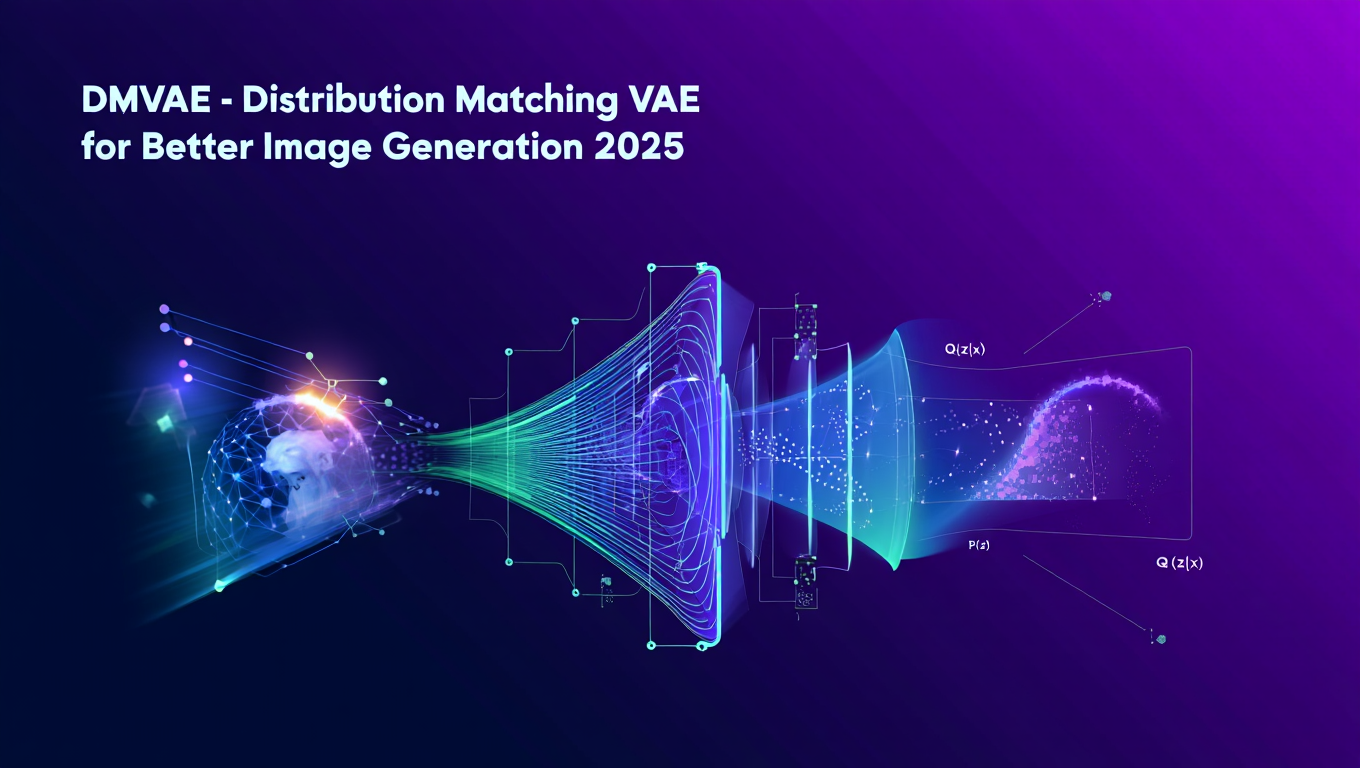
Variational Autoencoders have always struggled with a fundamental question: what distribution should the latent space follow? Traditional VAEs assume Gaussian priors, but this arbitrary choice limits generation quality. DMVAE (Distribution-Matching VAE) solves this by explicitly aligning encoder distributions with optimal references, producing better images with more efficient modeling.
Quick Answer: DMVAE explicitly aligns the encoder's latent distribution with an arbitrary reference distribution via a distribution matching constraint. This generalizes beyond Gaussian priors, enabling alignment with SSL features, diffusion noise, or other distributions that produce better generation results.
- DMVAE replaces fixed Gaussian priors with optimal reference distributions
- SSL-derived distributions provide best balance of fidelity and efficiency
- Distribution-level alignment matters more than fixed priors
- Improves both reconstruction quality and generation efficiency
- Open source implementation available on GitHub
What Problem Does DMVAE Address?
Most visual generative models compress images into a latent space before applying diffusion or autoregressive modeling. Existing approaches like VAEs and foundation model aligned encoders implicitly constrain the latent space without explicitly shaping its distribution, making it unclear which types of distributions are optimal for modeling.
The Traditional VAE Limitation:
Standard VAEs enforce a Gaussian prior on the latent space. This choice is mathematically convenient but not necessarily optimal for generation. The mismatch between what's easy to model and what produces good images creates a fundamental tension.
Why Distribution Matters:
| Distribution Type | Modeling Ease | Generation Quality |
|---|---|---|
| Standard Gaussian | Easy | Moderate |
| SSL-Aligned | Moderate | High |
| Diffusion-Aligned | Variable | High |
| Optimal Reference | Requires finding | Maximum |
DMVAE provides a framework for systematically investigating which latent distributions are more conducive to modeling, rather than accepting arbitrary constraints.
- How DMVAE improves upon standard VAE approaches
- The distribution matching mechanism
- Why SSL distributions work well for generation
- Practical implications for image generation
- How to access and use DMVAE
How Does Distribution Matching Work?
DMVAE introduces a distribution matching constraint that explicitly aligns the encoder's latent distribution with a chosen reference distribution.
The Matching Mechanism:
Rather than forcing latents toward a fixed Gaussian, DMVAE measures the divergence between the encoder's output distribution and a target reference distribution. Training minimizes this divergence while maintaining reconstruction quality.
Reference Distribution Options:
DMVAE can align with various reference distributions including:
- SSL Features: Distributions derived from self-supervised learning models like DINO or CLIP
- Diffusion Noise: Distributions matching diffusion process noise schedules
- Custom Distributions: Any distribution that might benefit generation
Why This Generalizes:
Traditional VAEs are a special case where the reference distribution is fixed as Gaussian. DMVAE generalizes this, allowing the reference to be any distribution that benefits the downstream generative task.
What Did Researchers Discover?
The DMVAE research produced several important findings about optimal latent distributions.
Key Finding 1: SSL Distributions Excel
Self-supervised learning derived distributions provide an excellent balance between reconstruction fidelity and modeling efficiency. Features from models trained on tasks like contrastive learning naturally organize in ways that benefit generation.
Key Finding 2: Distribution Structure Matters
Choosing a suitable latent distribution structure through distribution-level alignment, rather than relying on fixed priors, is key to bridging the gap between easy-to-model latents and high-fidelity image synthesis.
Key Finding 3: creative Beats Implicit
DMVAE's creative distribution alignment outperforms implicit constraints used in conventional VAEs. Making the distribution target creative enables better optimization and clearer understanding of what makes latent spaces effective.
Performance Improvements:
| Metric | Standard VAE | DMVAE |
|---|---|---|
| Reconstruction Fidelity | Baseline | Improved |
| Generation Quality | Baseline | Significantly Improved |
| Modeling Efficiency | Baseline | Improved |
How Does DMVAE Improve Image Generation?
The practical benefits of DMVAE translate directly to better image generation quality.
Reconstruction Benefits:
Better latent distribution alignment means the encoder captures more relevant image information. Reconstruction from latents preserves details that Gaussian-constrained VAEs lose.
Generation Benefits:
Generative models operating in DMVAE latent spaces produce higher quality samples. The latent space organization matches what generators naturally produce, reducing the burden on the generation model.
Efficiency Benefits:
Well-organized latent spaces are easier to model. Generative processes converge faster and require fewer parameters to achieve equivalent quality.
Comparison With Standard Approaches:
| Aspect | Standard VAE | Foundation Aligned | DMVAE |
|---|---|---|---|
| Prior Constraint | Fixed Gaussian | Implicit | creative Optimal |
| Distribution Choice | None | None | Systematic |
| Reconstruction | Good | Variable | Excellent |
| Generation Support | Moderate | Variable | Excellent |
What Are the Practical Applications?
DMVAE's improvements apply across various image generation scenarios.
Diffusion Model Enhancement:
Diffusion models operating in DMVAE latent spaces benefit from better-organized representations. The distribution matching can align with diffusion noise schedules for optimal compatibility.
Autoregressive Generation:
Autoregressive models like transformers benefit from latent spaces that have natural sequential structure. DMVAE can align with distributions that support this modeling approach.
Hybrid Architectures:
Modern architectures combining multiple generative approaches benefit from flexible latent spaces that DMVAE provides. The ability to match different distributions enables architecture-specific optimization.
For users wanting generation improvements without implementing DMVAE directly, Apatero.com incorporates advanced VAE techniques in their generation pipelines.
How Do You Use DMVAE?
Implementation details for integrating DMVAE into workflows.
Code Availability:
The DMVAE implementation is available at github.com/sen-ye/dmvae. The repository includes training code, pretrained models, and example usage.
Integration Approach:
Replace standard VAE encoders with DMVAE equivalents. Choose appropriate reference distributions for your generation approach. Train or fine-tune with distribution matching loss.
Reference Distribution Selection:
For diffusion models, consider diffusion-aligned distributions. For autoregressive models, consider SSL-aligned distributions. Experimentation determines optimal choices for specific architectures.
Training Considerations:
Distribution matching adds computational overhead during training. The benefits in generation quality typically justify this cost. Pretrained DMVAE models reduce need for custom training.
What Limitations Exist?
Understanding DMVAE limitations helps set appropriate expectations.
Computational Cost:
Distribution matching requires additional computation during training. For very large-scale training, this overhead may be significant.
Reference Selection:
Choosing optimal reference distributions requires experimentation. Not all distributions work equally well for all generation tasks.
Integration Complexity:
Replacing existing VAEs with DMVAE requires architectural changes. Drop-in replacement isn't always straightforward.
Current Research Status:
DMVAE represents active research. Best practices continue to evolve as the community gains experience with the approach.
Frequently Asked Questions
Is DMVAE better than standard VAE for all applications?
For image generation, DMVAE consistently outperforms standard VAEs. For pure compression or other tasks, the benefits may vary.
Can I use DMVAE with existing diffusion models?
Yes, though integration requires replacing the VAE component and potentially fine-tuning. The latent space dimensions and semantics change.
What reference distribution should I choose?
SSL-derived distributions (from DINO, CLIP, etc.) provide strong general-purpose results. Experiment with alternatives for specific use cases.
How much does DMVAE improve generation quality?
Improvements vary by baseline and task. Expect meaningful but not dramatic improvements over well-tuned standard VAE approaches.
Is pretrained DMVAE available?
Check the GitHub repository for pretrained models. Availability depends on research release schedules.
Does DMVAE work with video generation?
The principles apply to video, though temporal considerations add complexity. Research on video-specific DMVAE is ongoing.
How does DMVAE compare to VQ-VAE?
Different approaches to latent space design. DMVAE uses continuous distributions with matching; VQ-VAE uses discrete codebooks. Both improve upon basic VAE.
Can DMVAE improve existing generation models?
Potentially, by replacing VAE components. This requires retraining or fine-tuning downstream models to work with new latent spaces.
Conclusion
DMVAE represents a principled approach to VAE design that addresses the long-standing question of optimal latent distributions. By explicitly matching distributions rather than assuming Gaussian priors, DMVAE achieves better reconstruction and generation quality.
Key Insights:
Distribution choice matters more than previously recognized. creative matching outperforms implicit constraints. SSL-derived distributions provide excellent general-purpose performance.
Practical Impact:
For image generation practitioners, DMVAE offers a path to improved quality through better latent space design. The open-source implementation enables experimentation and integration.
Future Direction:
As the community gains experience with DMVAE, expect best practices to emerge for different generation architectures and applications. The framework provides tools for systematic investigation of optimal latent distributions.
For users wanting improved generation without implementation complexity, platforms like Apatero.com incorporate advanced techniques including optimized VAE approaches in their generation services.
The evolution from fixed Gaussian priors to optimal distribution matching represents a meaningful advance in generative model design. DMVAE provides both the theoretical framework and practical tools to benefit from this progress.
Make AI images and video in your browser
Characters, video, photo packs. No GPU, no setup. Check your welcome allowance and the displayed cost before generating.
Related Articles
5 Proven AI Influencer Niches That Actually Make Money in 2025
Discover the most profitable niches for AI influencers in 2025. Real data on monetization potential, audience engagement, and growth strategies for virtual content creators.

AI Background Replacement: Professional Guide 2025
Master AI background replacement for professional results. Learn rembg, BiRefNet, and ComfyUI workflows for smooth background removal and replacement.

AI Character Consistency: How to Maintain Virtual Persona Identity Across Content
Learn techniques for maintaining AI character consistency across hundreds of images. Master the art of creating recognizable virtual personas with consistent visual identity.