AI Making Movies in 2026: The Current State and What's Actually Possible
Realistic assessment of AI filmmaking in 2026. What's working, what's hype, and how creators are actually using AI tools for video production today.
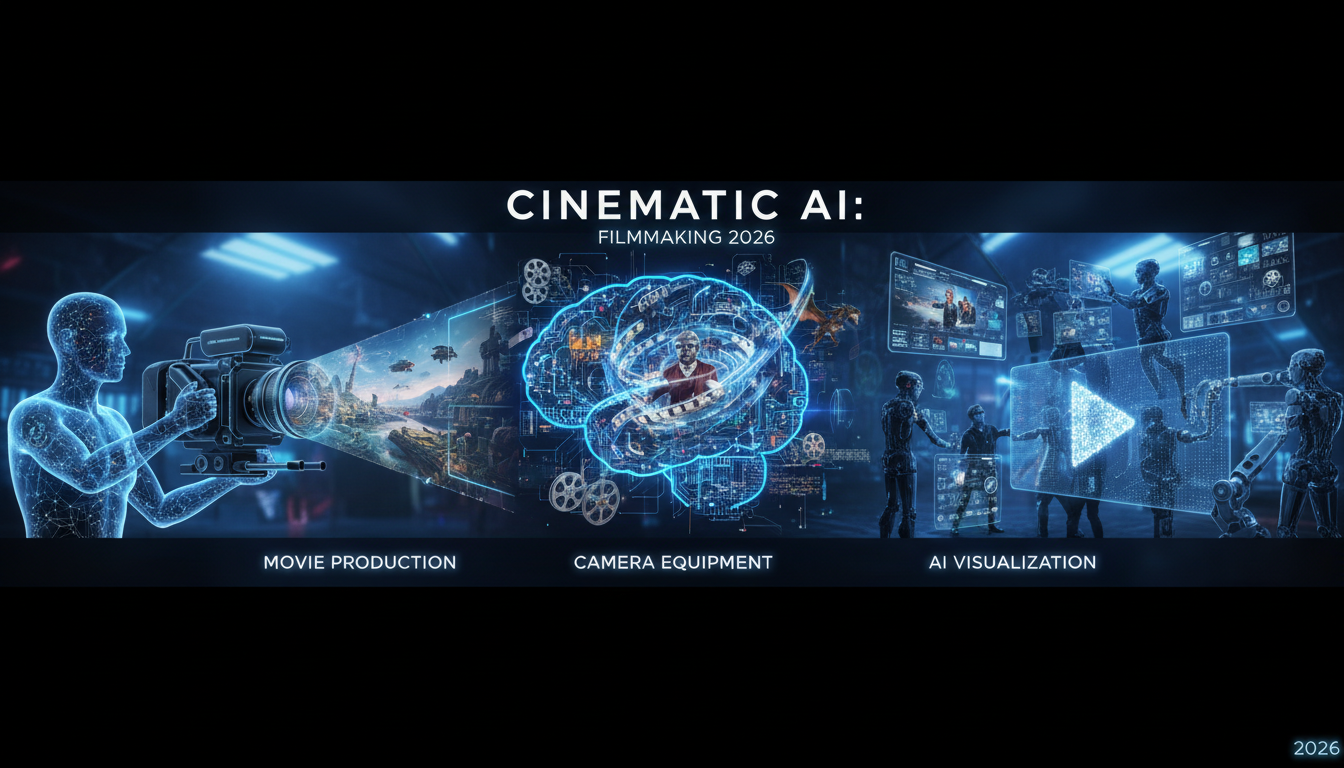
We were promised AI-generated movies by now. "Anyone can make a Hollywood film from their bedroom." That was the hype. The reality in January 2026 is more nuanced. AI is genuinely transforming filmmaking, but not in the ways most people expected. Let me break down what's actually happening, what works, and what's still fantasy.
Quick Answer: AI in 2026 can generate impressive short clips (up to 60 seconds), assist with pre-visualization, handle specific VFX tasks, and simplify production workflows. Full AI-generated feature films remain impractical due to consistency issues, narrative limitations, and quality unpredictability. The real transformation is AI as a tool within traditional filmmaking, not a replacement for it.
- Short-form AI video (under 60 seconds) has reached professional quality
- Feature-length AI films face unresolved consistency challenges
- Pre-visualization and concept work are the strongest current applications
- The film industry is integrating AI tools, not being replaced by them
- Open-source models (LTX-2, Wan) have caught up with closed APIs
The Hype vs. Reality Gap
Let's start with what people expected versus what we have.
What Was Promised
- Full movies generated from text prompts
- Anyone can be a filmmaker
- Hollywood disrupted overnight
- Unlimited creative freedom
- Zero production costs
What We Actually Have
- Professional-quality clips up to 60 seconds
- Powerful tools that require skill to use well
- Film industry cautiously adopting AI for specific tasks
- Significant creative freedom within constraints
- Reduced costs for certain production elements
The gap isn't that AI failed. It's that the timeline was off and the application is different than predicted. AI is becoming an incredibly powerful filmmaking tool, not a filmmaker replacement.
Current Capabilities: What Works in 2026
Let's be specific about what AI video generation can actually do today.
Short-Form Content (Under 60 Seconds)
This is where AI excels. Tools like LTX-2, Runway Gen-3, Kling, and Pika produce clips that genuinely look cinematic.
What works:
- Single-scene shots
- Nature and environment footage
- Product shots and visualizations
- Music video clips
- Social media content
- B-roll and establishing shots
Quality level: Indistinguishable from real footage for many use cases. The "AI look" is increasingly rare with proper prompting and model selection.
Pre-Visualization (Previz)
This might be AI's most practical current application in professional filmmaking.
How it's being used:
- Directors visualize scenes before shooting
- Storyboards come to life as rough video
- Camera movements and angles can be tested
- Location scouting augmented with AI visualization
- Pitch materials created quickly
Major studios are using AI previz to save millions on traditional animatic production. A scene that took weeks to previsualize can now be roughed out in hours.
Specific VFX Applications
AI handles certain VFX tasks exceptionally well.
Working applications:
- Background replacement and extension
- Crowd multiplication
- Weather effects (rain, snow, fog)
- Time-of-day changes
- De-aging and face work (with human oversight)
- Rotoscoping assistance
These aren't replacing VFX artists, but augmenting them. A task that took a junior artist three days might now take one day with AI assistance.
Concept Development
The creative ideation phase has been transformed.
How creators use AI:
- Generate visual concepts for pitches
- Explore art direction possibilities
- Test color palettes and lighting approaches
- Develop character looks before costume design
- Create mood boards that move
This accelerates the creative process significantly. Ideas can be visualized quickly, enabling faster iteration.
What Doesn't Work Yet
Being honest about limitations is essential for practical use.
Feature-Length Consistency
The fundamental challenge: maintaining consistent characters, settings, and style across 90+ minutes.
Current issues:
- Characters drift in appearance between scenes
- Environments change unexpectedly
- Style consistency requires constant correction
- Continuity errors multiply over length
Even with multi-keyframe techniques and character LoRAs, the effort required to maintain consistency across a feature exceeds traditional production for most projects.
Narrative Complexity
AI doesn't understand story. It generates visually plausible content without narrative awareness.
What this means:
- No understanding of cause and effect
- Emotional beats happen by chance
- Character behavior isn't motivated
- Subtext is impossible to generate intentionally
You can prompt for "sad scene" but the AI doesn't know WHY the character is sad or how that connects to the story.
Dialogue Scenes
Conversations between characters remain challenging.
Issues:
- Lip sync is imperfect
- Eyeline matching is inconsistent
- Reaction shots don't match dialogue
- Blocking feels unnatural
Dialogue scenes require extensive human correction and often traditional shooting or animation.
Precise Action Choreography
Complex action sequences with specific choreography resist AI generation.
Challenges:
- Fight choreography can't be precisely specified
- Stunt timing is unpredictable
- Multi-character action is inconsistent
- Spatial relationships break down
AI can generate impressive action-style footage, but specific choreography requires traditional methods.
The Tools Available in 2026
The landscape has matured significantly. Here's what's actually available.
Open-Source Models
LTX-2 (Lightricks)
- Native 4K resolution
- 60-second generation
- Synchronized audio
- Runs locally on consumer hardware
- Full guide available
Wan 2.2
- Excellent motion quality
- Strong LoRA ecosystem
- Multiple aspect ratios
- Good for anime and stylized content
Open Sora (Community)
- Attempting to replicate Sora capabilities
- Improving rapidly
- Fully open-source
Commercial APIs
Runway Gen-3
- Production-grade quality
- Professional features
- Pay-per-generation
- Industry standard for commercial work
Kling
- Strong character consistency
- Good motion quality
- Competitive pricing
Pika
- Fast generation
- Style variety
- Accessible interface
Sora (OpenAI)
- Impressive demos
- Limited availability
- Industry watching closely
Specialized Tools
Luma Dream Machine
- Good for dreamy, abstract content
- Easy to use
Haiper
- Fast generation
- Stylized aesthetic
Lightricks VideoAI
- Mobile-first approach
- Consumer-friendly
How Filmmakers Are Actually Using AI
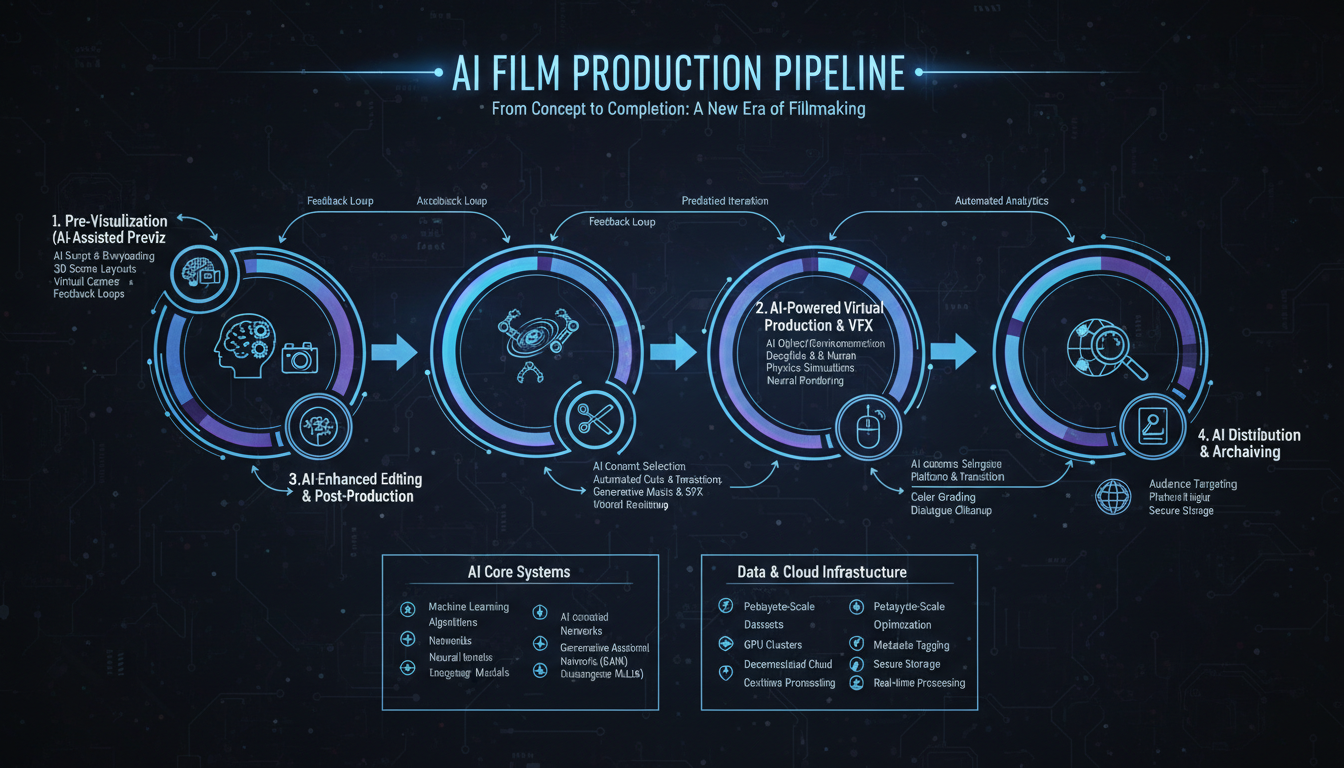 Modern filmmaking integrates AI tools at multiple stages of the production pipeline
Theory aside, here's how real productions incorporate AI today.
Independent Filmmakers
Use case: Filling gaps in low-budget productions
Small productions use AI for:
- Establishing shots they can't afford to shoot
- Background replacement instead of on-location filming
- VFX that would otherwise be impossible on budget
- Music video production
- Short film projects
Example workflow:
- Script and storyboard traditionally
- Shoot primary actor footage
- Generate backgrounds and environments with AI
- Composite actor footage into AI environments
- Use AI for specific VFX shots
- Traditional editing and sound
Commercial Production
Use case: Rapid iteration and cost reduction
Ad agencies use AI for:
- Concept testing before expensive production
- Quick variations for A/B testing
- Background generation for product shots
- Pitch materials and previsualization
Cost impact: Some agencies report 60-80% reduction in previsualization costs.
Studio Productions
Use case: Augmenting traditional workflows
Studios integrate AI for:
- Previz and concept development
- Specific VFX assistance
- Training data generation
- Background and environment extension
- De-aging and face work
Studios are cautious but actively exploring. Union negotiations and rights issues slow adoption but don't stop it.
YouTube and Social Media
Use case: Content creation at scale
Online creators use AI for:
- Thumbnail generation
- Short-form video content
- Channel branding visuals
- Faceless content channels
- Educational visualization
This is where AI video is most freely adopted, with fewer industry constraints.
The Economics in 2026
Understanding the financial reality helps set expectations.
Traditional Production Costs
Feature film (low budget): $1-5 million Feature film (studio): $50-200+ million Commercial (30 seconds): $50,000-500,000 Music video: $50,000-1,000,000
AI Costs for Equivalent Content
60-second cinematic clip: $10-100 (cloud) or hardware costs (local) Music video equivalent (with AI): $5,000-50,000 (hybrid approach) Short film (5 minutes): $1,000-10,000 (mostly AI) to $20,000-50,000 (hybrid) Feature film (mostly AI): Currently impractical for quality results
Where AI Saves Money
- Pre-production visualization: 70-90% cost reduction
- B-roll and establishing shots: 80-95% cost reduction
- Concept development: 60-80% cost reduction
- Specific VFX tasks: 40-60% cost reduction
Where AI Doesn't Save Money (Yet)
- Dialogue scenes: Minimal savings
- Complex narrative: No savings
- Character consistency: Often increases costs due to correction work
- Quality control: Requires significant human oversight
The Quality Question
"Is AI video good enough for professional use?"
The answer is: for specific applications, yes.
Professional-Quality Applications
- Social media content: Yes
- Music videos: Yes (with skill)
- Commercials: Selectively
- Film B-roll: Yes
- Title sequences: Yes
- Documentaries (visualization): Yes
Still Requires Traditional Methods
- Feature narrative: No
- Long-form storytelling: No
- Precise choreography: No
- Complex dialogue: No
- Consistent characters over length: Challenging
The Threshold Keeps Moving
What was "AI looking" a year ago now passes for professional. Expect continued improvement, but don't expect miracles in the next 12 months.
Industry Reaction and Adoption
How is the film industry actually responding?
Union Perspectives
SAG-AFTRA and other unions negotiated AI provisions in 2023-2024 contracts. Key points:
- Consent required for digital likeness use
- Compensation for AI-based work
- Limits on AI replacement of performer labor
- Ongoing negotiations as technology evolves
These rules shape how studios can use AI, creating guardrails that slow but don't stop adoption.
Studio Strategy
Major studios are:
- Building internal AI capabilities
- Acquiring AI companies
- Testing in specific production areas
- Moving cautiously due to PR considerations
- Using AI extensively in pre-production
Independent Response
Indies are:
- Adopting faster than studios
- Using AI to compete above their budget level
- Experimenting freely with new techniques
- Facing fewer regulatory constraints
- Publishing more AI-generated content
Creating AI Video Content Today
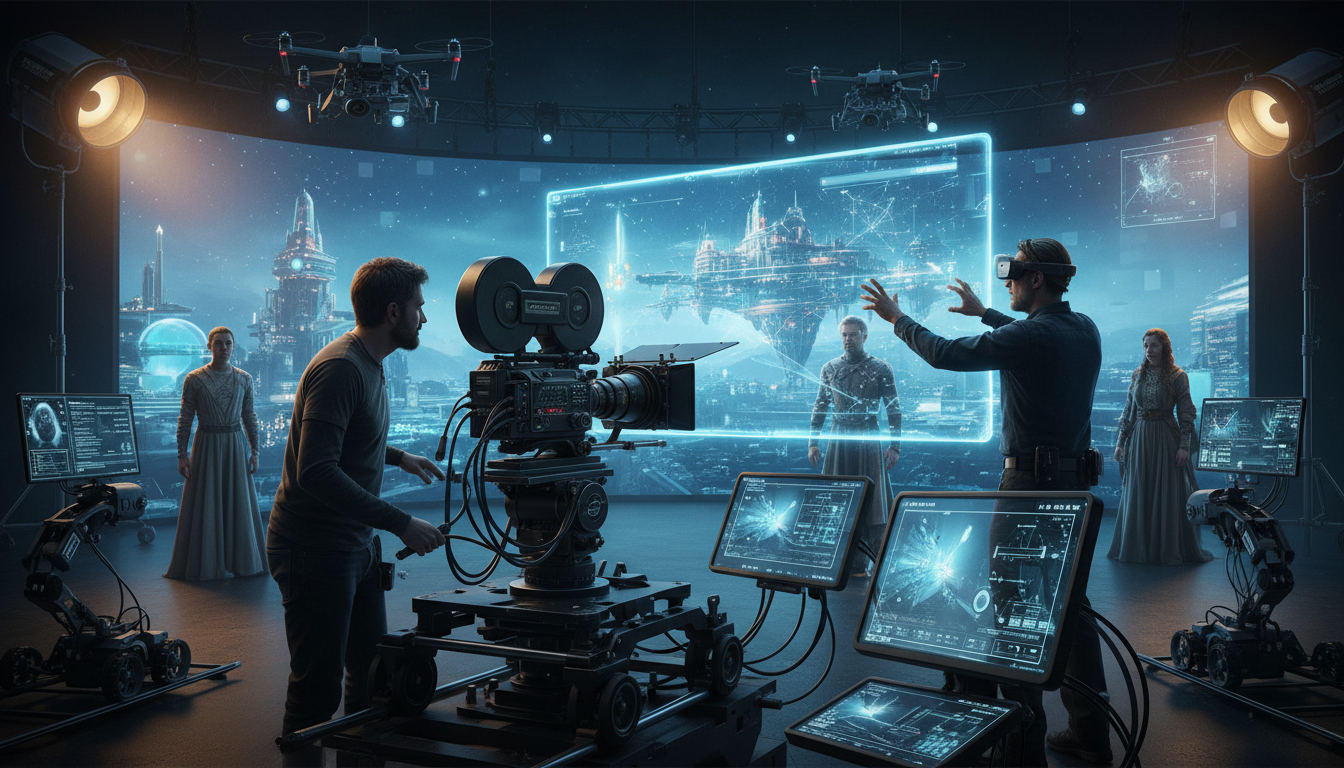 The most successful approach combines traditional filming techniques with AI-generated elements
If you want to make AI video content in 2026, here's a practical approach.
For Short-Form (Under 60 Seconds)
Recommended setup:
- LTX-2 or Runway Gen-3
- Clear concept and storyboard
- Single-scene approach
- Post-production polish
Workflow:
- Write specific prompts with cinematography language
- Generate multiple variations
- Select best results
- Color grade and edit
- Add sound design
Results can be genuinely impressive with this approach.
For Longer Content
Hybrid approach required:
- Traditional shooting for key scenes
- AI for specific supporting elements
- Heavy post-production integration
- Consistency management workflow
Reality check: Long-form AI content requires as much or more work than traditional production for comparable quality. The value is in creative possibilities, not labor savings.
For Commercial Work
Professional considerations:
- Rights and licensing
- Client expectations
- Quality control processes
- Revision workflows
- Delivery formats
Commercial work is viable with AI for appropriate projects, but requires professional production standards.
The Future: 2027 and Beyond
Predictions are risky, but directional trends seem clear.
Likely Developments
- Consistency improvements through better conditioning
- Longer generation limits
- Real-time generation for interactive content
- Better audio-visual synchronization
- Improved control mechanisms
Speculative Developments
- True narrative understanding (unlikely soon)
- Fully AI-generated features (possible but probably lower quality)
- Real-time cinematic generation (gaming crossover)
What Won't Change
- Need for human creative direction
- Story and emotion require human understanding
- Quality control remains essential
- Filmmaking craft remains valuable
Frequently Asked Questions
Can I make a full movie with AI in 2026?
Technically yes, practically no. Consistency and narrative limitations make quality feature films impractical with current technology.
What's the best AI video tool for filmmaking?
For open-source: LTX-2 for quality and features. For commercial: Runway Gen-3 for reliability and professional features.
Will AI replace filmmakers?
No. AI is a tool that changes what filmmakers can do, not a replacement for creative vision and storytelling ability.
How long until AI can make full movies?
Conservative estimate: 5-10 years for quality comparable to human production. Timeline could accelerate with breakthroughs.
Is the film industry resisting AI?
Cautiously adopting, not resisting. Unions set terms, studios explore within those terms, indie filmmakers experiment freely.
Can I sell AI-generated video content?
Yes, with appropriate licenses. Most tools allow commercial use, but check specific terms and consider disclosure.
What skills do I need for AI filmmaking?
Traditional filmmaking knowledge (cinematography, editing, storytelling) plus AI-specific skills (prompting, workflow management, model understanding).
Is AI video getting better?
Yes, significantly. Year-over-year improvement is dramatic. What was impossible 18 months ago is routine now.
Should I learn traditional filmmaking or just AI tools?
Both. AI is a tool within filmmaking, not a replacement for understanding story, visual language, and craft.
What budget do I need to start?
For cloud services: $20-100/month covers significant experimentation. For local: $2,000-4,000 for capable hardware.
Wrapping Up
AI filmmaking in 2026 is real but different than the hype suggested. The practical reality:
What's working:
- Short-form content at professional quality
- Pre-visualization and concept work
- Specific VFX applications
- Workflow augmentation
What's not working yet:
- Feature-length consistency
- Narrative complexity
- Precise control
- Replacement of human creativity
The opportunity is genuine. AI tools enable creators to realize visions that were previously impossible without massive budgets. But the craft of filmmaking, understanding story, emotion, and visual language, remains essential.
Start experimenting with LTX-2 for open-source filmmaking capabilities, or use Apatero.com to test AI video generation without local setup.
The revolution is happening. It just looks different than the hype predicted.
Render the video you just read about
Kling, Veo, Seedance and more, in your browser, no queue to build. Check your welcome allowance and the displayed cost before generating.
Related Articles
AI Documentary Creation: Generate B-Roll from Script Automatically
Transform documentary production with AI-powered B-roll generation. From script to finished film with Runway Gen-4, Google Veo 3, and automated...
AI Music Videos: How Artists Are changing Production and Saving Thousands
Discover how musicians like Kanye West, A$AP Rocky, and independent artists are using AI video generation to create stunning music videos at 90% lower costs.
AI Video for E-Learning: Generate Instructional Content at Scale
Transform educational content creation with AI video generation. Synthesia, HeyGen, and advanced platforms for scalable, personalized e-learning videos in 2025.