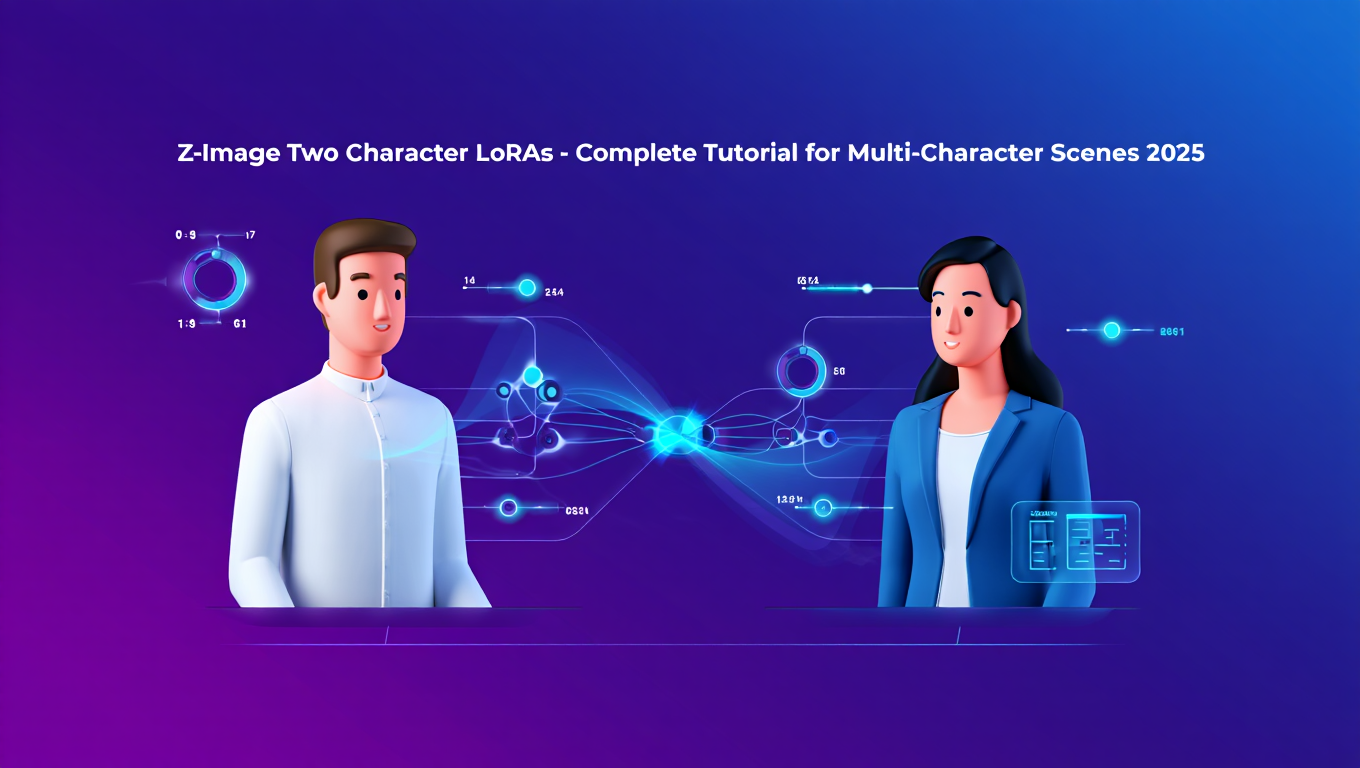
Z-Image Two Character LoRAs - Complete Tutorial for Multi-Character Scenes 2025
Master combining two character LoRAs in single Z-Image generations. Complete tutorial for multi-character scenes with consistent identities and proper positioning.
Some models you cannot download at any VRAM
Veo, Kling and Nano Banana have closed weights. There is no local build, no quantization, no 24GB workaround. Run them in the browser instead. First generation free.
Generating a single character with LoRA is straightforward. Adding a second character while maintaining both identities is where things get challenging. Character features blend, positions swap, and the results become unpredictable. This tutorial shows you exactly how to generate clean two-character scenes using Z-Image with dual LoRAs.
Quick Answer: Successfully combining two character LoRAs in Z-Image requires using Z-Image-De-Turbo for LoRA compatibility, careful prompt structure separating character descriptions, moderate LoRA strengths (0.6-0.8), and possibly ControlNet or regional prompting for position control.
- Use Z-Image-De-Turbo variant for best LoRA compatibility
- Structure prompts to clearly separate character descriptions
- Keep individual LoRA strengths moderate (0.6-0.8)
- Use positional terms like "on the left" and "on the right"
- Consider ControlNet pose guidance for precise positioning
Why Is Multi-Character Generation Difficult?
Understanding the challenges helps you avoid common mistakes.
The Blending Problem:
When you load two character LoRAs simultaneously, their influences combine across the entire image. Without proper separation, features from Character A appear on Character B and vice versa. This creates hybrid characters that don't match either LoRA.
The Position Problem:
Text prompts give limited control over exact character placement. "Two people standing together" doesn't specify who stands where. The model makes arbitrary decisions that may not match your intent.
The Identity Problem:
Even with separate positioning, maintaining distinct identities requires the model to apply different LoRA influences to different image regions - something standard generation doesn't handle automatically.
- Proper LoRA loading configuration
- Prompt structuring for character separation
- Using ControlNet for position control
- Regional prompting techniques
- Troubleshooting common issues
How Do You Set Up Dual Character LoRAs?
Proper configuration is essential for multi-character success.
Use Z-Image-De-Turbo:
The standard Z-Image-Turbo distilled model has limited LoRA support. Z-Image-De-Turbo, the de-distilled variant, provides better LoRA integration essential for multi-character work.
LoRA Loading Configuration:
| Parameter | Character A LoRA | Character B LoRA |
|---|---|---|
| Strength | 0.6-0.8 | 0.6-0.8 |
| Load Order | First | Second |
| Model | Z-Image-De-Turbo | Same |
Why Moderate Strengths:
High LoRA strengths (0.9+) cause excessive influence that bleeds between characters. Moderate strengths allow the base model to maintain scene coherence while LoRAs provide character identity.
Stacking Order:
Load both LoRAs through sequential LoRA loader nodes. Order can affect results - experiment with which character loads first for your specific LoRAs.
How Do You Structure Prompts for Two Characters?
Prompt structure is critical for maintaining character separation.
Basic Two-Character Prompt Structure:
"[Character A description], on the left, [Character B description], on the right, [scene description], [quality terms]"
Example:
"a woman with red hair wearing a blue dress, on the left, a man with black hair wearing a gray suit, on the right, standing in an office, professional photography, high quality"
Separation Techniques:
Use clear positional terms (left, right, foreground, background). Describe each character completely before moving to the next. Avoid ambiguous pronouns that could apply to either character.
What to Avoid:
Don't use vague terms like "two people" without specification. Don't describe both characters in one run-on description. Don't assume the model will figure out positioning.
How Does ControlNet Help Multi-Character Scenes?
ControlNet provides the position control that text prompts lack.
Pose ControlNet Setup:
Create or obtain a pose reference showing two figures in your desired positions. Process through pose estimation (OpenPose, DWPose). Use resulting pose map as ControlNet condition.
Free ComfyUI Workflows
Find free, open-source ComfyUI workflows for techniques in this article. Open source is strong.
Workflow Integration:
Load pose ControlNet model compatible with Z-Image. Connect pose map to ControlNet conditioning. Adjust ControlNet strength (0.7-0.9 typically works well).
Benefits:
ControlNet definitively establishes where each figure appears. Combined with prompt positioning, you get reliable character placement. Pose maps can be reused across multiple generations.
Creating Pose References:
Use existing photos with two people in desired positions. Create simple stick figures in drawing software. Use 3D posing software for precise control.
What Is Regional Prompting?
Regional prompting applies different prompts to different image areas.
How It Works:
Divide the image into regions (left half, right half). Assign Character A prompt to left region. Assign Character B prompt to right region. Each LoRA primarily affects its designated region.
ComfyUI Implementation:
Use regional prompting nodes or attention coupling techniques. Define regions as masks or coordinate specifications. Connect character-specific prompts to corresponding regions.
Effectiveness:
Regional prompting provides the strongest separation between characters. It's more complex to set up but produces the most reliable results for distinct character identities.
Want to skip the complexity? Apatero gives you professional AI results instantly with no technical setup required.
Limitations:
Characters overlapping regions may still blend. Setup complexity increases workflow difficulty. Not all regional techniques work equally well with Z-Image.
For users wanting multi-character generation without complex setup, Apatero.com provides simplified access to character consistency features.
What Common Issues Occur and How Do You Fix Them?
Multi-character generation has predictable failure modes.
Issue: Characters Blend Together
Features from both characters appear on both figures.
Solutions:
- Reduce LoRA strengths to 0.5-0.6
- Add more specific distinguishing features in prompts
- Use regional prompting for stronger separation
- Try different LoRA loading order
Issue: Wrong Character in Wrong Position
Character A appears where Character B should be.
Solutions:
- Strengthen positional language in prompts
- Use ControlNet pose guidance
- Add regional prompting constraints
- Generate multiple seeds and select correct results
Issue: One Character Dominates
One LoRA overpowers the other.
Solutions:
Earn Up To $1,250+/Month Creating Content
Join our exclusive creator affiliate program. Get paid per viral video based on performance. Create content in your style with full creative freedom.
- Reduce dominant LoRA strength
- Increase weaker LoRA strength
- Check LoRA training strength/quality differences
- Consider LoRAs may have incompatible training
Issue: Scene Coherence Lost
Characters look correct but don't belong in same scene.
Solutions:
- Strengthen scene/environment descriptions
- Reduce both LoRA strengths slightly
- Add lighting and atmosphere consistency terms
- Use reference images for scene coherence
What Are Advanced Techniques?
Beyond basics, several advanced approaches improve results.
Iterative Generation:
Generate characters separately, then composite or use img2img to combine. Provides maximum control but requires post-processing.
Attention Masking:
Advanced workflows can mask attention to force LoRA influence to specific regions. Complex to implement but highly effective.
Multi-Pass Approach:
Generate base scene first, then add characters through controlled inpainting. Each character added separately with full LoRA influence.
Seed Exploration:
Different seeds produce different character arrangements. Generate many variations and select the best rather than trying to force specific outcomes.
Frequently Asked Questions
Can I use more than two character LoRAs?
Technically possible but increasingly difficult. Each additional character increases blending probability. Three+ characters typically require advanced regional techniques.
Do both LoRAs need to be trained on Z-Image?
Best results come from LoRAs trained on Z-Image or highly compatible bases. LoRAs from other models may work but with reduced effectiveness.
What resolution works best for two characters?
Higher resolutions provide more space for distinct characters. 1024x1024 minimum, wider aspect ratios (like 1536x1024) work well for side-by-side placement.
How do I prevent clothing from swapping between characters?
Include detailed clothing descriptions for each character. Use color differentiation. Strengthen positional associations between character and clothing.
Can I use this technique for group shots?
Two characters is manageable; larger groups become exponentially harder. Consider multiple passes or specialized group generation approaches.
Why do some LoRA combinations work better than others?
LoRA training affects compatibility. LoRAs trained similarly (same base, similar parameters) typically combine better than dissimilar LoRAs.
Should I use the same seed for both characters?
Using the same seed for the combined generation is standard. You're generating one image with two characters, not two separate images.
How important is prompt order?
Prompt order affects attention distribution. Generally, describe the more important or left-positioned character first, but experiment for your specific case.
Conclusion
Generating two-character scenes with dual LoRAs requires understanding the challenges and applying appropriate techniques. Proper model selection (Z-Image-De-Turbo), careful prompt structure, moderate LoRA strengths, and optionally ControlNet or regional prompting combine to produce clean multi-character results.
Key Success Factors:
Use Z-Image-De-Turbo for LoRA compatibility. Structure prompts with clear character separation and positioning. Keep LoRA strengths moderate to prevent blending. Consider ControlNet for definitive position control.
When Complexity Exceeds Value:
If multi-character generation becomes too complex, consider generating characters separately and compositing. Sometimes the simpler approach produces better results faster.
Getting Started:
Begin with two well-trained, compatible LoRAs. Start with simple side-by-side compositions. Add complexity (ControlNet, regional prompting) as needed.
For users wanting consistent multi-character generation without workflow complexity, Apatero.com provides access to character consistency features through intuitive interfaces.
Multi-character AI generation remains challenging, but these techniques make it practical. With proper setup and technique, dual character LoRA scenes become achievable rather than aspirational.
Some models you cannot download at any VRAM
Veo, Kling and Nano Banana have closed weights. There is no local build, no quantization, no 24GB workaround. Run them in the browser instead. First generation free.
Related Articles

10 Best AI Influencer Generator Tools Compared (2025)
Comprehensive comparison of the top AI influencer generator tools in 2025. Features, pricing, quality, and best use cases for each platform reviewed.
5 Proven AI Influencer Niches That Actually Make Money in 2025
Discover the most profitable niches for AI influencers in 2025. Real data on monetization potential, audience engagement, and growth strategies for virtual content creators.
AI Action Figure Generator: How to Create Your Own Viral Toy Box Portrait in 2026
Complete guide to the AI action figure generator trend. Learn how to turn yourself into a collectible figure in blister pack packaging using ChatGPT, Flux, and more.