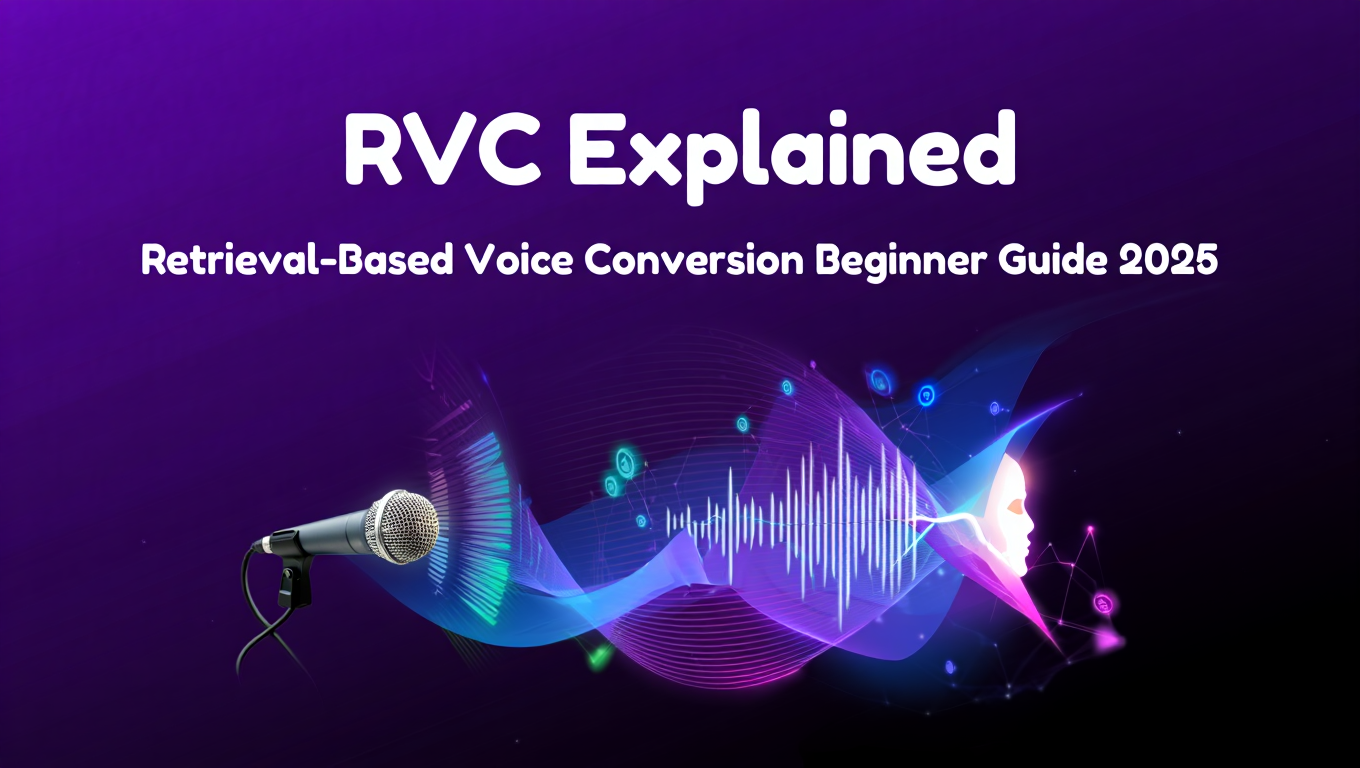
RVC Explained - Retrieval-Based Voice Conversion Beginner Guide 2025
Understanding RVC (Retrieval-Based Voice Conversion) for AI voice cloning. Complete beginner guide explaining how RVC works, use cases, and getting started.
Make AI images and video in your browser
Characters, video, photo packs. No GPU, no setup. Your first generation is free.
You've seen those AI song covers where your favorite characters sing popular songs, or voice changers that make anyone sound like someone else in real-time. The technology behind many of these is RVC - Retrieval-Based Voice Conversion. This guide explains what RVC is, how it works, and why it matters.
Quick Answer: RVC (Retrieval-Based Voice Conversion) is an open-source AI algorithm that converts one person's voice to sound like another while preserving the original speech content, emotion, and timing. It requires minimal training data (5-10 minutes of audio) and can run in real-time with low latency.
- RVC performs speech-to-speech voice conversion, not text-to-speech
- Requires only 5-10 minutes of target speaker audio for training
- Preserves original emotion, timing, and speech characteristics
- Achieves 90-170ms latency for real-time applications
- Open source with active community development
What Is RVC?
Retrieval-Based Voice Conversion is an AI algorithm that transforms voice recordings. You speak or sing, and RVC converts your voice to sound like someone else while keeping everything you said or sang intact.
Key Distinction - Speech-to-Speech:
Unlike text-to-speech systems (like ElevenLabs) that generate voice from written text, RVC takes actual voice input and converts it. This preserves the modulation, timbre, and vocal attributes of your original performance.
When you use TTS, you lose the subtle emotion and timing of real speech. RVC maintains these because it works with actual voice, not text.
- How RVC differs from other voice AI
- The technical process behind voice conversion
- Training your own voice models
- Common applications and use cases
- Limitations and ethical considerations
How Does RVC Work?
RVC uses a three-component architecture to transform voice.
Component 1 - Content Feature Extractor
First, RVC extracts what you're saying from your voice. This uses either phonetic posteriorgram (PPG) encoders or self-supervised models like HuBERT to identify speech content independent of voice characteristics.
Component 2 - Vector Retrieval Module
This module searches a database of target voice audio fragments for segments that best match your input. Rather than generating voice from scratch, it retrieves similar sounds from real examples.
Component 3 - Vocoder/Neural Decoder
Finally, a neural decoder synthesizes the output waveform from the retrieved representations, creating smooth, natural-sounding converted audio.
The Retrieval Approach:
Traditional voice conversion used statistical models trained on parallel data (recordings of two speakers saying identical things). RVC doesn't require parallel data. It retrieves similar audio segments from the target speaker and blends them, producing highly realistic output.
What Makes RVC Different From TTS?
Understanding the distinction helps you choose the right tool.
Comparison:
| Aspect | RVC | Text-to-Speech |
|---|---|---|
| Input | Voice recording | Written text |
| Emotion | Preserved from input | Generated/limited |
| Timing | Matches original | System-determined |
| Authenticity | High (real performance) | Variable |
| Use Case | Covers, dubbing, voice acting | Audiobooks, assistants |
When RVC Excels:
Music covers where emotion and timing matter. Dubbing where lip sync requires matching original timing. Voice acting where performance nuance is critical. Real-time voice changing.
When TTS Is Better:
Generating speech from written content. Creating entirely new dialogue. Audiobook narration from text. Automated voice responses.
How Do You Train an RVC Model?
Training an RVC model requires surprisingly little data.
Data Requirements:
Minimum 5-10 minutes of clear target speaker audio. Higher quality and more varied audio produces better results. Clean recordings without background noise or music work best.
Training Process:
Gather audio samples of your target voice. Clean audio to remove noise and non-speech elements. Process through RVC training pipeline. Training typically takes 30-60 minutes on modern GPUs.
What Makes Good Training Data:
Clear speech or singing without background music. Varied pitch and expression showing vocal range. Consistent audio quality across samples. Multiple recording sessions if possible for variety.
Training Results:
After training, you have a voice model that can convert any input to sound like your target speaker. The model file is typically small (tens of MB) and can be shared.
What Are Common RVC Applications?
RVC enables various creative and practical applications.
AI Song Covers:
The most visible RVC application. Artists create covers of songs using character voices or celebrity voices. These AI-generated covers have gained popularity on YouTube and social media.
Voice Acting and Dubbing:
Free ComfyUI Workflows
Find free, open-source ComfyUI workflows for techniques in this article. Open source is strong.
Actors can perform in one voice then convert to character voices. Dubbing can match original actors' timing while using different voices. Reduces need for multiple voice actors in some scenarios.
Real-Time Voice Changing:
Streamers and content creators change their voice live. Privacy protection by disguising voice identity. Entertainment applications and games.
Accessibility:
Users with speech impairments can communicate using voices that reflect their identity. Voice restoration for those who've lost their voice.
Personalized Assistants:
Virtual assistants speaking in custom voices. Personalized notification voices. Character voices for applications.
What Are RVC's Technical Capabilities?
Understanding capabilities helps set realistic expectations.
Latency:
The RVC project achieved end-to-end latency of 170ms with standard audio. With ASIO input/output devices, latency drops to 90ms. This enables real-time applications.
Quality:
The retrieval-based approach mitigates oversmoothing common in neural sequence-to-sequence models. Output sounds more natural and expressive than many alternatives.
Resource Requirements:
Training requires a GPU (consumer cards work fine). Inference can run on CPU for non-real-time use. Real-time inference benefits from GPU acceleration.
Supported Content:
Want to skip the complexity? Apatero gives you professional AI results instantly with no technical setup required.
Works with speech and singing. Handles multiple languages (model quality may vary). Preserves emotional expression from input.
What Are RVC's Limitations?
No technology is perfect. Understanding limitations prevents frustration.
Tone Leakage:
Sometimes synthesized speech retains characteristics from the source speaker's voice. Complete voice transformation isn't always achievable.
Database Coverage:
Limited diversity in target voice training data may cause poor retrieval in some situations. More varied training data produces better coverage.
Quality Variation:
Results vary based on input quality, model training, and compatibility between source and target voices. Some voice combinations work better than others.
Specific Sounds:
Certain sounds, accents, or singing styles may convert poorly if not well-represented in training data.
For users wanting voice features integrated with image generation, Apatero.com focuses on visual AI while RVC handles audio.
What Ethical Considerations Exist?
Powerful voice conversion technology raises important questions.
Consent:
Using someone's voice without permission raises ethical and potentially legal issues. Always consider whether you have the right to use a particular voice.
Earn Up To $1,250+/Month Creating Content
Join our exclusive creator affiliate program. Get paid per viral video based on performance. Create content in your style with full creative freedom.
Misinformation:
Voice conversion could create convincing fake audio. Responsible use means not creating deceptive content.
Attribution:
When sharing AI voice content, transparency about AI involvement maintains trust.
Platform Policies:
Many platforms have specific policies about AI-generated voices. Review terms of service before publishing.
Best Practices:
Use voices you have permission to use. Be transparent about AI involvement. Don't create deceptive or harmful content. Respect platform policies.
How Do You Get Started With RVC?
Beginning with RVC involves installing software and preparing data.
Software Options:
The main project is RVC-Project/Retrieval-based-Voice-Conversion-WebUI on GitHub. This provides a web interface for training and inference. Community forks and improvements exist with various features.
Basic Setup:
Install Python and required dependencies. Clone the RVC repository. Install model files for feature extraction. Launch the web interface.
First Training:
Gather 10+ minutes of target voice audio. Process through the web interface. Train for recommended number of epochs. Test with sample input audio.
Inference:
Load your trained model. Provide input audio (your voice or source recording). Generate converted output. Adjust settings based on results.
Frequently Asked Questions
How long does RVC training take?
Typical training takes 30-60 minutes on consumer GPUs. Quality continues improving with longer training up to a point.
Can RVC convert any voice to any other voice?
In principle yes, but quality varies. Similar voice types often convert better than very different ones.
Is RVC legal?
The technology itself is legal. How you use it determines legality. Using protected voices or creating harmful content may violate laws.
Does RVC work in real-time?
Yes, with 90-170ms latency depending on configuration. This works for live streaming and voice chat.
How much training data do I need?
Minimum 5-10 minutes, but more data generally improves quality. 30+ minutes of varied audio produces excellent results.
Can RVC do singing and speaking?
Yes, both work. Singing often produces impressive results since musical timing is preserved.
Is RVC the same as deepfake audio?
RVC is one technology that could create synthetic audio. "Deepfake" is a broader term. RVC specifically does voice conversion.
Does RVC work on CPU?
Yes, but slower. GPU acceleration is recommended, especially for real-time use.
Conclusion
RVC represents a significant advancement in voice conversion technology. By using retrieval-based approaches rather than pure generation, it achieves natural-sounding results with minimal training data and real-time capability.
Key Strengths:
Speech-to-speech conversion preserving emotion and timing. Minimal training data requirements. Real-time capability for live applications. Open source with active development.
Getting Started:
Install the RVC software. Gather target voice samples. Train your first model. Experiment with conversion.
Use Responsibly:
Powerful voice technology requires responsible use. Respect consent, avoid deception, and follow platform policies.
The democratization of voice conversion opens creative possibilities previously limited to professional studios. Whether for music covers, voice acting, or accessibility, RVC provides accessible entry to voice AI.
For users interested in combining voice work with AI visuals, various tools complement each other - RVC for audio, while platforms like Apatero.com handle image generation.
Make AI images and video in your browser
Characters, video, photo packs. No GPU, no setup. Your first generation is free.
Related Articles
10 Best AI Influencer Generator Tools Compared (2025)
Comprehensive comparison of the top AI influencer generator tools in 2025. Features, pricing, quality, and best use cases for each platform reviewed.
5 Proven AI Influencer Niches That Actually Make Money in 2025
Discover the most profitable niches for AI influencers in 2025. Real data on monetization potential, audience engagement, and growth strategies for virtual content creators.
AI Action Figure Generator: How to Create Your Own Viral Toy Box Portrait in 2026
Complete guide to the AI action figure generator trend. Learn how to turn yourself into a collectible figure in blister pack packaging using ChatGPT, Flux, and more.